

A voter-approved redistricting plan has already shifted the structural balance of the House before a single 2026 ballot is cast.
What to Know
- Virginia voters approved the redistricting referendum 51.5 to 48.6 percent, shifting 4 Republican-held House seats toward Democrats.
- The new map favors Democrats in 10 of 11 Virginia congressional districts, a projected gain of up to 4 seats.
- The redrawn 2nd District moved 5 points left, putting Rep. Jen Kiggans in a seat Harris would have carried.
- The redrawn 6th District went from safely Republican to competitive, with Rep. Ben Cline's home drawn into a neighboring district.
- The 2nd District has a shortage of 11,518 affordable rental homes and needs $74,677 in annual income to afford a two-bedroom unit.
Virginia's April 2026 redistricting referendum was not a forecast. It was a structural event. When voters approved the new congressional map 51.5 to 48.6 percent, they locked in a Democratic-leaning starting position across the state's congressional delegation that applies before any campaign has run a single television ad. Inside Elections made 5 Virginia ratings shifts, including 4 GOP-held districts moving toward Democrats, covering VA-01, VA-02, VA-05, VA-06, and VA-07. The Brookings Institution projects the new lines will produce three or four additional Democratic seats and likely represent the final major mid-decade redistricting battle before the fall elections.
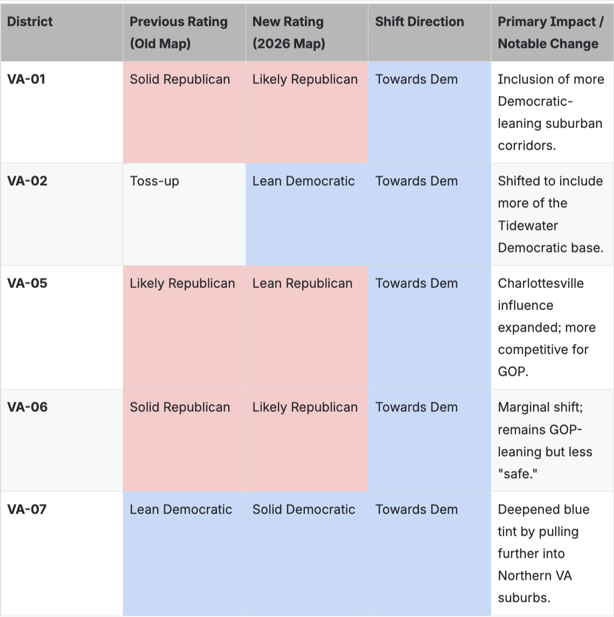
For campaign planning, this is a locked variable, not a casual hypothetical. Until the courts resolve the challenge, candidates and outside groups still have to prepare around the possibility that these lines define the fall battlefield. The economic and policy consequences for affected districts, from housing costs to small business representation, will follow whoever wins the seats the map has already tilted.
Two Republican Incumbents Face Structurally Different Districts
The clearest candidate-level impact falls on two Republican incumbents whose districts changed the most. Rep. Jen Kiggans of the 2nd District now defends a seat that, according to Cook Political Report, moved five points left under the new map and would have voted for Harris by five points in 2024. That is not a marginal shift. It is a presidential baseline that places her seat in Democratic-leaning territory on the day the map took effect.
-jpg-May-16-2026-09-45-24-7161-AM.jpeg?width=281&height=281&name=image%20(3)-jpg-May-16-2026-09-45-24-7161-AM.jpeg)
Jen Kiggans, U.S. Representative for Virginia’s 2nd District
-jpg-May-16-2026-09-45-32-7858-AM.jpeg?width=173&height=260&name=image%20(4)-jpg-May-16-2026-09-45-32-7858-AM.jpeg)
Ben Cline, U.S. Representative for Virginia’s 6th District
Rep. Ben Cline of the 6th District faces a different but equally serious structural problem. The new map drew his home address into the neighboring 9th District, currently held by Rep. Morgan Griffith. Cline has stated he plans to run in the current 6th, but that district's partisan character changed dramatically under the new lines, shifting from safely Republican to newly competitive. He is effectively campaigning for a seat whose ground shifted beneath him.
-jpg-May-16-2026-09-45-47-9972-AM.jpeg?width=432&height=288&name=image%20(1)-jpg-May-16-2026-09-45-47-9972-AM.jpeg)
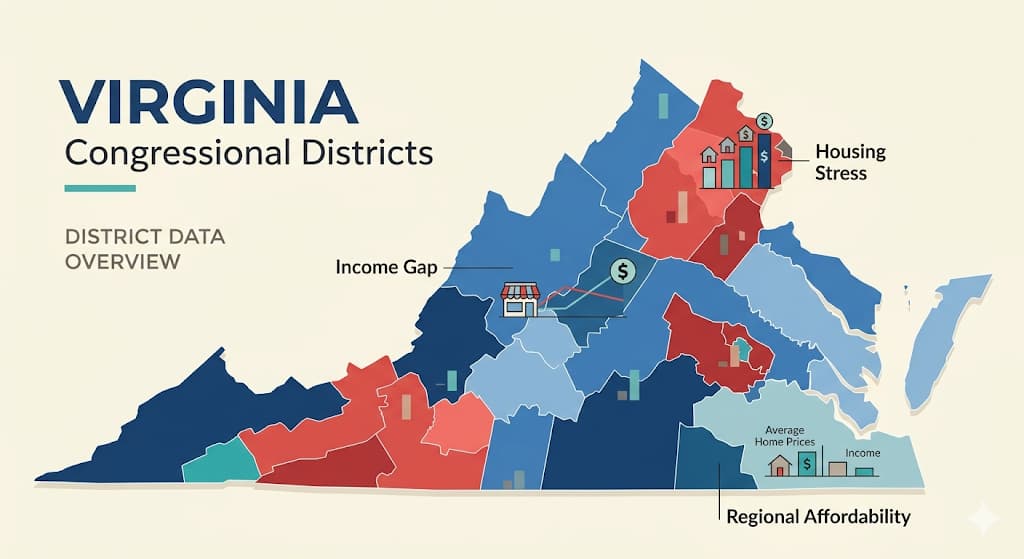
Image generated by DALL-E, Virginia map shifts key House districts.
-jpg-May-16-2026-09-45-57-4435-AM.jpeg?width=185&height=226&name=image%20(5)-jpg-May-16-2026-09-45-57-4435-AM.jpeg)
Dwayne Yancey, Founding Editor, Cardinal News
Founding editor Dwayne Yancey of Cardinal News framed what the new lines actually require of any winner:
"By creating districts with such dissimilar interests, mapmakers have drawn maps with more internal stresses than before. The real challenge will come if some of these districts have interests within them that are diametrically opposed."
Winning these seats will require navigating constituencies with sharply competing economic priorities, not just partisan headwinds.
Housing and Small Business Stakes Are Real
The economic consequences of who wins these districts are not abstract. Data from the National Low Income Housing Coalition show that the redrawn 2nd District carries a shortage of 11,518 affordable rental homes. A household needs $74,677 annually to afford a two-bedroom unit at fair market rent without exceeding 30% of income on housing. Whoever wins Kiggans' seat will inherit a constituency under acute housing pressure, with direct consequences for how they vote on housing vouchers, federal infrastructure funding, and the Low Income Housing Tax Credit.
-jpg-May-16-2026-09-46-11-5576-AM.jpeg?width=515&height=343&name=image%20(2)-jpg-May-16-2026-09-46-11-5576-AM.jpeg)
Image generated by DALL-E, housing and business stakes in Virginia districts.
The SBA Office of Advocacy counts 14,349 small businesses employing 128,151 workers in the current 2nd District, and 14,498 small businesses employing 139,733 workers in the current 6th District. Both seats are now rated competitive. For those businesses, the change in representation carries direct consequences for federal contracting access, SBA loan programs, and pass-through income treatment in the tax code.
-jpg-May-16-2026-09-46-21-2120-AM.jpeg?width=167&height=251&name=image%20(6)-jpg-May-16-2026-09-46-21-2120-AM.jpeg)
Elaine Kamarck, Senior Fellow, Brookings Institution
Brookings Senior Fellow Elaine Kamarck placed Virginia's outcome inside the national redistricting war:
"Virginia Democrats' narrow redistricting victory may end up winning the party more than the obvious prize of three or four additional seats in Congress."
Virginia's small business owners and renters did not start this redistricting fight, but they will live inside whatever congressional representation it produces.
Wrap Up
A lower court has blocked certification of the referendum results, and the Virginia Supreme Court is considering the constitutionality of the entire amendment. The map could still be invalidated. But until that ruling comes, every campaign operating in Virginia must treat these lines as the operational starting point. Candidate recruitment, donor conversations, and resource allocation are happening right now under these new district boundaries.
The structural Democratic advantage baked into this map is not a polling number that fluctuates week to week. It is a geographic and partisan baseline that applies before Election Day. For the households, renters, and small business owners inside these districts, the question of who represents them in Washington on housing policy, federal spending, and fiscal priorities is already being shaped by lines drawn this spring.