While digital virality can generate name identification and fundraising, the 2024 Republican primary demonstrated that internet momentum rarely translates into electoral viability without a robust offline ground operation.
What to Know:
- Conversion Failure: Despite dominating Google Trends and podcast circuits, Vivek Ramaswamy secured only 7.7% of the vote in the Iowa caucuses, placing a distant fourth.
- The Ad-Spend Pivot: In the final weeks before voting, the campaign sharply reduced TV ad spending and bet on addressable, digital-first targeting.
- The Polling Gap: A major disparity emerged between internet-based polls showing Ramaswamy around 7.8% and telephone polls of likely voters placing him closer to 2.6%.
- Reinforcement vs. Persuasion: Research on social and digital campaigning suggests online exposure often strengthens existing attitudes more than it converts undecided or opposing voters.
- The 2026 Correction: Ramaswamy has described digital echo chambers as misleading and has shifted toward more “tactile” in-person campaigning for his 2026 Ohio gubernatorial bid.
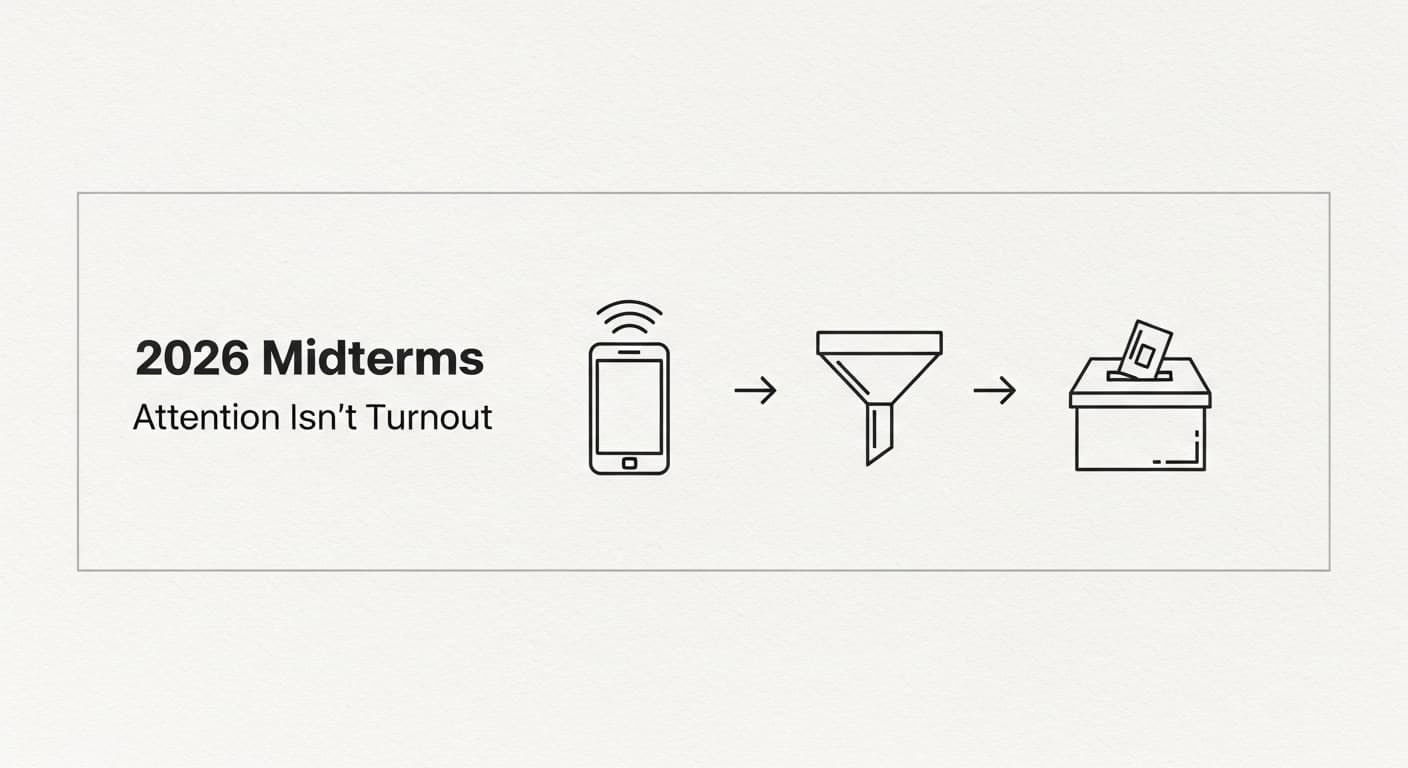
The 2024 Republican primary offered a real-world stress test for a modern political hypothesis: can a candidate bypass traditional field infrastructure and ride a wave of digital virality directly to ballot success? Vivek Ramaswamy’s campaign provided a clean case study. By flooding the podcast circuit and maintaining an everywhere-all-at-once social presence, he achieved an outsize share of attention relative to his standing in the race. But when the voting began, attention did not reliably convert into ballots.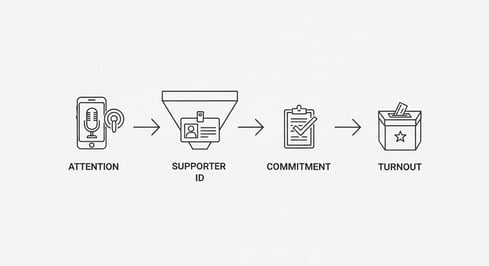
Attention-to-turnout funnel. Created by Campaign Now with Gemini.
Ramaswamy’s Iowa result — 7.7% and a fourth-place finish — underscored the operational difference between building an audience and building a coalition. A digital-first campaign can create momentum narratives, spike searches, and generate clip-driven buzz. It cannot, by itself, replace the mechanics that identify supporters, validate a candidate with trusted local cues, and then convert those supporters into turnout under real-world voting conditions; indeed, the Ramaswamy later concluded that
“The echo chambers of the internet are not sufficient — in fact, not only not sufficient, maybe outright misleading in terms of what’s actually on real voters’ minds” — NBC News Exclusive by Henry J. Gome.
The Online-First Bet
Ramaswamy’s 2024 strategy was characterized by high-velocity content creation and an “everywhere-all-at-once” media presence. He appeared on over 150 podcasts between February and August 2023, sometimes stacking interviews at an unusually high clip.
That strategy generated algorithmic engagement. Politico also noted the post-debate spike where Ramaswamy topped Google Trends—an attention signal that reinforced the perception of momentum even when vote intent was less clear.
The online-first approach also supported small-dollar fundraising. The Hill reported that the campaign touted a large donor base and a meaningful share of first-time political donors. But the campaign operated on an assumption that digital enthusiasm would naturally convert into caucus participation. The campaign highlighted its activity level, including an aggressive schedule of public events in Iowa. The problem wasn’t effort. It was conversion design: attention and activity aren’t a substitute for the “handshake-to-ballot” infrastructure that closes the loop.
The Strategy Shift: Turning Off the TV Spigot
In the final stretch before Iowa, the campaign made a decision that symbolized its broader theory of the case: it pulled back sharply on traditional television advertising, , a strategic pivot highlighted by NPR. The argument was straightforward — TV is expensive, inefficient, and consultant-driven; digital targeting is more precise and modern; earned media and online reach can substitute for broad paid broadcast exposure.
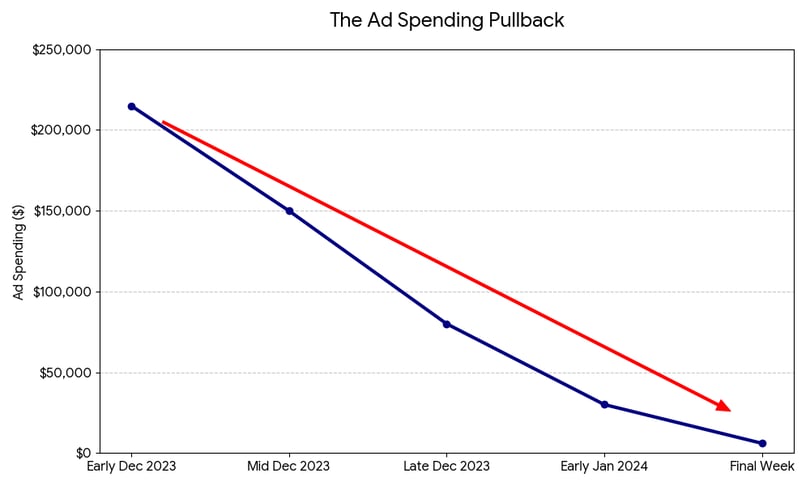
In the crucial final month, Ramaswamy's campaign withdrew from traditional television advertising, betting entirely on digital targeting. Based on NBC News reporting and AdImpact data. Created by Campaign Now with Gemini
“Presidential TV ad spending is idiotic, low-ROI [return on investment] & a trick that political consultants use to bamboozle candidates who suffer from low IQ” — Edward Helmore, The Guardian
There is a coherent logic to reallocating budget into addressable channels, especially when a candidate believes persuasion is happening through longform interviews and social distribution rather than 30-second spots. But timing matters. In early-state primaries and caucuses, the electorate is older, higher-propensity, and more traditional in media consumption. Reducing TV presence in the final weeks effectively concedes mindshare among exactly the voters who most reliably participate — unless the campaign has an equally strong substitute in direct voter contact and field.
The strategic question isn’t “TV or digital?” The real question is: what’s your closing mechanism? If you move away from broadcast, you must overbuild the offline contact program that replaces it — door, phones, live persuasion, validator networks, and turnout logistics. Otherwise, the shift becomes less a modern optimization and more a late-stage retreat.
The Measurement Trap: Online Enthusiasm Isn’t the Electorate
One of the most dangerous traps for modern campaigns is confusing the online audience with the actual electorate. The Ramaswamy case shows how this happens: online panels and internet-native signals can significantly overstate support compared to methods that better capture likely voters.
Politico observed that the gap between internet-based polling numbers around 7.8% and telephone polling closer to 2.6% is more than a statistical curiosity. It’s an operational warning sign. A campaign optimized for online attention tends to attract supporters who are more digital, often younger, and frequently less likely to participate in low-frequency elections or high-friction voting environments like caucuses. Meanwhile, the voters who dominate early contests — older, habitual participants — are often underrepresented in the “internet momentum” picture.
-jpg-1.jpeg?width=298&height=298&name=2%20(1)-jpg-1.jpeg)
Ramaswamy's support varied dramatically by polling method. Based on Politico analysis via Statistical Modeling, Causal Inference, and Social Science.Created by Campaign Now with Gemini
“In internet surveys over the past month — the vast majority of which are conducted among panels of people who sign up ahead of time to complete polls, often for financial incentives — Ramaswamy earns an average of 7.8 percent... In polls conducted mostly or partially over the telephone... he’s way back in seventh place, at just 2.6 percent” — Andrew Gelman, Statistical Modeling, Causal Inference, and Social Science
If a campaign treats the online environment as its primary feedback loop, it will misread its own position. It will overinvest in content that plays well to highly engaged online audiences while underinvesting in persuasion, supporter identification, and turnout operations needed for an electorate that is not chronically online.
What Research Says About Digital Persuasion Limits
Research on digital campaigning, including field experiments published in Research and Politics, repeatedly points to a hard truth: most online political content is better at reinforcement than conversion. Social platforms can deepen loyalty among supporters, increase engagement, and harden identity-based attachment.But those same dynamics often fail to persuade undecided voters at scale — and can even intensify polarization, making opponents more negative rather than more persuadable; indeed, earlier studies found that
“People who favor a candidate develop even more favorite attitudes, whereas opponents develop even more negative attitudes” — Sonja Utz, Journal of Computer-Mediated Communication.
That reinforces a key strategic point for campaign operators: reach is not persuasion, and persuasion is not turnout. The most common failure mode in digital-first politics is mistaking the volume of impressions for the depth of movement. Broad digital distribution can create familiarity without trust. It can create notoriety without persuasion. It can create fundraising without expanding a coalition.
Digital can persuade under certain conditions — typically when it mimics high-trust interaction rather than broadcast noise. Interactivity, direct exchange, local relevance, and credible messengers matter. But most clip-driven campaigning is designed to win attention, not to patiently move voters through the persuasion ladder. When a campaign’s digital program is built for virality first, the conversion stage often remains underbuilt.
The Offline Layer: Conversion Infrastructure
The difference between an internet-forward campaign that wins and one that stalls is whether digital energy feeds a real-world conversion machine.
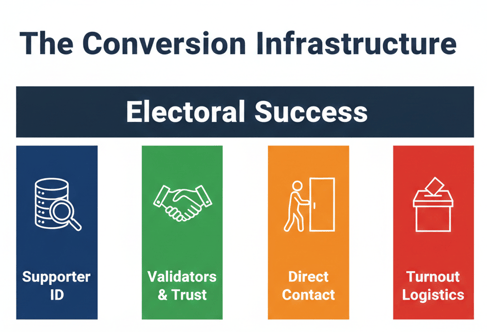
Winning campaigns require four core components working together—attention alone cannot substitute for systematic voter conversion. Based on campaign conversion framework principles from Public Opinion Quarterly research. Created by Campaign Now with Gemini
That machine has four core parts:
- Supporter identification and data capture.The campaign must convert attention into usable voter-file assets: who supports you, where they live, how reachable they are, and what issue frame moves them. That requires consistent acquisition, not just broad reach. Ramaswamy’s team later underscored the point in their own words:
“[…] bringing out the voters we’ve identified — best way to reach them is using addressable advertising, mail, text, live calls and doors.” — Tricia McLaughlin via The Guardian
- Validators and trusted cues. Voters frequently use endorsements, local leaders, community networks, and peer signals to reduce uncertainty. Online fame does not automatically produce trust in the local context where votes are cast.
- Direct voter contact and persuasion. Doors, phones, small-group events, and live interaction are not nostalgic rituals; they are conversion engines, a reality supported by research in Public Opinion Quarterly.
“[…] investing more in shoe leather… appears to actually move voters.” — Seth E. Masket, Public Opinion Quarterly.
- Turnout logistics. GOTV requires a plan: chase, reminders, rides, commitment cards, precinct captains, and a final-week contact surge that matches the electorate’s habits and voting rules.
Whether that pivot succeeds or not, the logic behind it is a direct acknowledgement of the lesson: online presence is a tool, not a substitute for the field-and-conversion layer. Ramaswamy put it plainly:
“There’s no substitute for actual real world interaction. The echo chambers of the internet are not sufficient — in fact, not only not sufficient, maybe outright misleading in terms of what’s actually on real voters’ minds.” — Vivek Ramaswamy, NBC News
Playbook for 2026 Campaigns
The takeaway from the Ramaswamy experiment isn’t that digital is useless. The takeaway is that digital must be integrated into a conversion strategy that is designed for real voters, not online audiences.
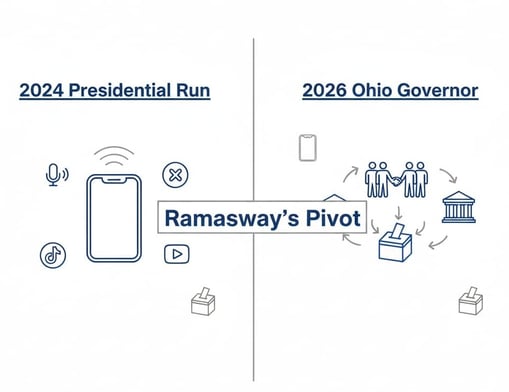
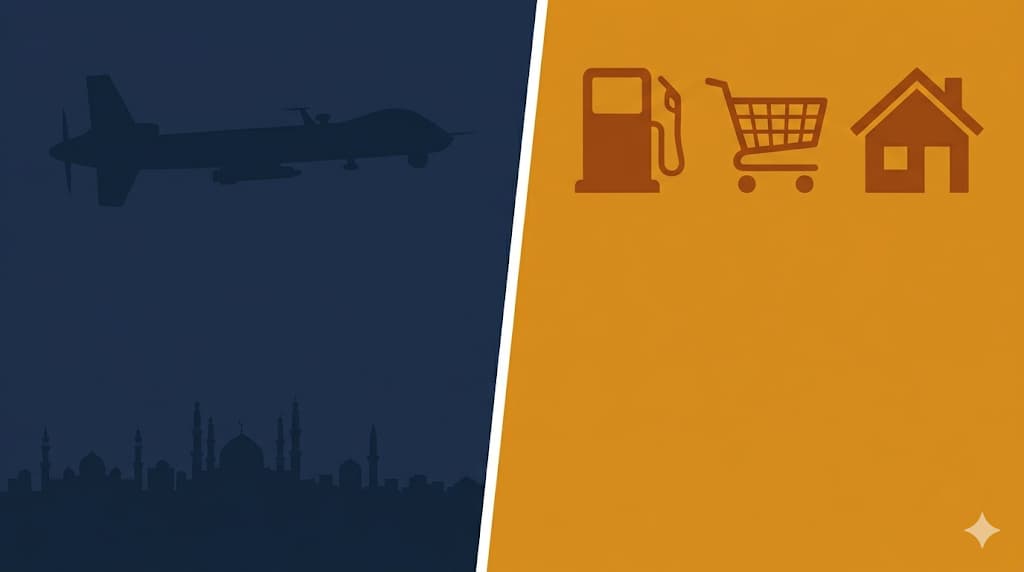
Ramaswamy's own strategic shift for 2026 reflects the lesson: digital must serve offline conversion, not replace it. Created by Campaign Now with Gemini
Here are three operator-level recommendations for 2026:
- Prioritize conversion metrics over engagement metrics. Views and shares are not leading indicators unless they reliably feed supporter ID, volunteer recruitment, donor conversion, and measurable voter contact. Build dashboards around IDs, commitments, doors knocked, phone conversations, event conversions, and turnout chase — then treat content as a means to those ends.
- Ground-truth the electorate with the right measurement. Online signals can be directionally useful, but they can also be structurally biased. Use mixed-method measurement to avoid “phantom momentum,” and ensure your strategy reflects high-propensity voters who actually decide primaries and many midterm contests.
- Treat digital as top-of-funnel and field as bottom-of-funnel. Use digital to scale awareness, recruit volunteers, and raise money — then route that energy into local validators, direct voter contact, and turnout programs that close the loop from attention to ballots. The winning model is not “online-only.” It’s content plus conversion.
Wrap Up
The appeal of digital-first politics is obvious: it’s fast, cheaper than broadcast at scale, and it delivers instant feedback in the form of engagement. But the 2024 primary made a central point unavoidable. Algorithms can build a brand. They cannot, by themselves, build the trust networks, identification systems, and turnout mechanics that win elections.
Vivek Ramaswamy’s 7.7% Iowa finish is a reminder that the election is not held on a timeline. It’s held in precincts, in turnout universes, and in the physical world where voters live. For 2026 candidates, the strategic mandate is clear: build modern content engines — and then build the offline conversion infrastructure that turns attention into votes.
-May-16-2026-10-24-03-9739-PM.jpg)