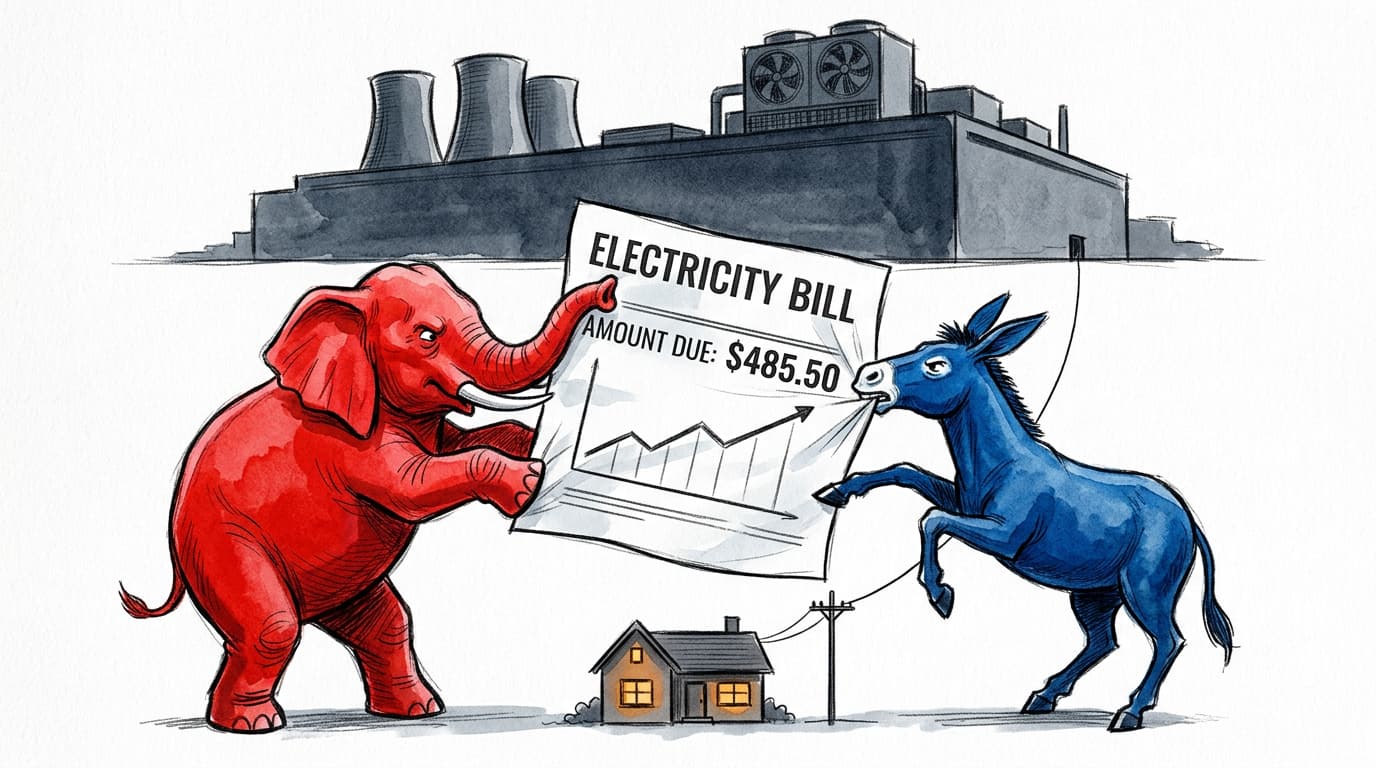

The monthly electricity bill has become the most underused campaign asset in American politics, and Republican campaigns that move first will own the affordability issue through November.
What to Know
- Average retail electricity rates rose 7.1% nationally in 2025, with Washington D.C. up 26.3%, Pennsylvania up 18.9%, and Rhode Island up 16.3%, according to the U.S. Energy Information Administration.
- The average monthly household electricity bill climbed from $121 in 2021 to $156 in 2025, a 29% increase over 4 years, according to the National Energy Assistance Directors Association.
- An estimated 21.5 million U.S. households, roughly 1 in 6, are currently behind on their energy bills.
- 38% of Americans view data centers as "mostly bad" for home energy costs, compared to just 6% who say "mostly good."
- Under President Trump's leadership, 7 major tech companies including Amazon, Google, Meta, Microsoft, OpenAI, Oracle, and xAI signed the Ratepayer Protection Pledge, committing to fully cover all energy and infrastructure costs tied to their data centers.
Something has shifted at kitchen tables across America. Voters who once paid their electricity bill without a second thought are now opening statements that are $30, $40, even $50 higher than just four years ago, and they want a name to put on it. That anger is documented, it is cross-partisan, and for Republican campaigns, it is fully available right now.
The Brookings Institution, in a March 2026 analysis as part of its year-long 2026 midterms series, concluded that public concern over electricity costs "will likely dominate this year's campaign dialogue and could determine which candidates find success at the polls." For Republican campaign professionals, that is not a caution. It is a strategic opening. The White House has acted, the legislation exists, and voter sentiment is fully formed. What campaigns need now is the frame and the discipline to use it.
The Bill Went Up Because Policy Made It Go Up
Voters are not wrong to be angry, and Republicans should not hesitate to tell them exactly why rates climbed. Years of ideologically driven regulation under the Biden administration forced reliable baseload power plants offline, blocked domestic energy production on federal lands, and funneled taxpayer subsidies toward intermittent wind and solar while restricting oil, natural gas, coal, and nuclear capacity. The result was a grid under structural strain before a single data center even broke ground.

The Unleashing American Energy Executive Order, signed by President Trump on his first day back in office, named the cause with precision.
As the order states:
"Burdensome and ideologically motivated regulations have impeded the development of these resources, limited the generation of reliable and affordable electricity, reduced job creation, and inflicted high energy costs upon our citizens."
The order revoked 12 Biden-era climate and energy executive orders, paused disbursement of funds under the Inflation Reduction Act, saved 74 coal power plants from forced shutdown, and preserved 17,000 megawatts of generation capacity, enough to power 12.75 million homes.
-jpg.jpeg?width=736&height=402&name=image%20(4)-jpg.jpeg)
Chart: Energy burden as share of income, data from NEADA, Campaign Now (Gemini)
The National Energy Assistance Directors Association put the household-level damage in concrete terms in its February 2026 report: energy now consumes 8.6% of low-income household income, nearly 3 times the 3.0% burden carried by other households. When 21.5 million families are behind on power bills, that is not an abstraction. It is a message with a street address and a voting precinct attached.
Data Centers Gave Voters a Villain
As AI infrastructure expanded rapidly across Northern Virginia, Central Texas, Arizona, and the Carolinas, utility rates in those corridors climbed and voters began connecting the dots. Data centers require electricity at an industrial scale, and when grid operators struggled to absorb surging demand, ratepayers absorbed the cost instead. The Brookings Institution analysis found that a 2026 Politico national survey showed nearly half of all Americans expect data center energy costs to be a defining campaign issue this cycle, and Pew Research Center confirmed that 44% of Democrats and 33% of Republicans now view data center expansion as "mostly bad" for their home energy expenses.
-jpg.jpeg?width=759&height=412&name=image%20(7)-jpg.jpeg)
Chart: Pew Research Center via Campaign Now (Gemini) — Data centers "mostly bad" for energy costs, by party
The Wall Street Journal has reported that artificially constrained supply on the generation side, a direct legacy of Biden-era regulatory decisions, is the structural driver behind rate instability. Data centers exposed the problem rather than created it. That distinction gives Republicans a precise and accurate argument: the grid was weakened by Democrat policy before AI demand ever arrived, and the solution is to build more reliable supply, not punish the technology sector wholesale. Democrats have responded with construction moratoriums and punitive tax recapture schemes that would stall the same economic development that competitive districts have spent years working to attract.
-jpg.jpeg?width=275&height=347&name=image%20(1)-jpg.jpeg)
Darrell M. West, Senior Fellow, Governance Studies, Brookings Institution
According to Darrell M. West, writing for the Brookings Institution in March 2026:
"We are already seeing 2026 candidates from both parties rail against rising rates, fixing responsibility on wealthy tech companies and the energy needs of their data centers."
Republicans who lead on this issue with a supply-side solution hold a position Democrats cannot match: a path to lower bills that does not require shutting down economic development or penalizing the AI industry central to American technological leadership.
Trump Delivered. Now Campaigns Need to Use It.
While Democrats moved toward moratoriums and punitive legislation, President Trump moved toward accountability with results. On March 4, 2026, the White House secured binding commitments from 7 of the largest AI companies and hyperscalers in the country. According to the White House Ratepayer Protection Pledge Fact Sheet, Amazon, Google, Meta, Microsoft, OpenAI, Oracle, and xAI all signed the Ratepayer Protection Pledge, agreeing to build, bring, or buy all new generation resources and to fully cover every power delivery infrastructure upgrade required to service their data centers.
-jpg.jpeg?width=472&height=321&name=image%20(5)-jpg.jpeg)
The Ratepayer Protection Pledge states the governing principle plainly: "The American people should not be footing the bill for the benefit of private companies." Signatories must pay for committed infrastructure whether they use the power or not, eliminating the risk that residential ratepayers carry stranded costs from data center buildout. Companies additionally committed to hire from local communities and coordinate backup generation resources to strengthen grid resilience during emergencies.
How Campaigns Should Build This Into Their Messaging
The actionable layer of this issue is what separates campaigns that win a news cycle from campaigns that win a vote. Brookings' Darrell M. West warned that grouping all affordability concerns under a single generalized cost-of-living message makes it harder to educate voters about specific remedies. Campaigns that separate energy costs from the broader pile, name the policy failures behind them, and point to a concrete Republican solution will hold a more credible and durable position than opponents running vague affordability lines.
-3.jpg?width=259&height=324&name=image%20(2)-3.jpg)
Congressman Tom Barrett, U.S. Representative, Michigan's 7th Congressional District
Congressman Tom Barrett of Michigan's 7th Congressional District is already running this playbook at the district level.
As Barrett wrote in the Lansing State Journal in March 2026:
"My Republican colleagues and I have unleashed American energy through the Working Families Tax Cuts Act and other common-sense reforms. We cut unnecessary regulations that limited production of reliable energy sources like oil and natural gas."
Barrett also made clear that Michigan's Democratic-passed green energy mandate is projected to double electricity bills for Michigan ratepayers by 2040, even as the state already carries some of the highest electricity rates in the Midwest. That contrast, a state-level Democrat mandate stacked against federal Republican relief, is a replicable template for any campaign operating in a high-cost or high-growth energy region.
-jpg.jpeg?width=461&height=258&name=image%20(6)-jpg.jpeg)
House Committee on Energy & Commerce
The House Energy and Commerce Committee reinforced the federal legislative record in 2025, advancing the GRID Power Act, the National Coal Council Act, and the Cross-border Energy Infrastructure Act as the national grid faces a projected 151 gigawatt demand surge over the next decade. Campaigns in competitive districts should be running that record directly against their opponents' silence or obstruction.
Wrap Up
The electricity issue is not emerging. It is already here, already documented, and already deciding races. The 2025 Democratic gubernatorial victories in Virginia and New Jersey were partly attributed by analysts to candidate messaging against data center energy costs. Republicans who cede that ground by staying silent or running generic affordability lines will lose a winnable issue to an opponent willing to be specific.
The Republican advantage on this issue is structural. The White House has delivered a concrete, named win in the Ratepayer Protection Pledge. Congress has passed grid reliability legislation. The executive order record connects Biden-era policy directly to every dollar of rate increase voters have absorbed since 2021. The remaining work is localization: pull your district's specific rate increases, name the policy failures, and tell voters clearly who acted on their behalf and who did not.
Your opponent's silence on the power bill is your opening. Use it before they find their voice.