
Redistricting has evolved into continuous courts, demographic shifts, and state power struggles that reshape congressional maps years before the next census.
What to Know:
- Redistricting has become a continuous political battle rather than a once-per-decade process.
- Court rulings and litigation now frequently force mid-decade map redraws that can reshape congressional control.
- Each state follows its own redistricting rules, creating fifty separate legal and political battlegrounds.
- Census participation gaps and population shifts quietly alter representation before district lines are even drawn.
- Advances in mapping technology, data modeling, and artificial intelligence are transforming how districts are designed and challenged.
Redistricting is no longer a quiet administrative process that begins after a census and ends once new district lines are approved. It has evolved into a rolling political conflict that shapes congressional control years before ballots are cast. Court rulings, litigation cycles, census participation gaps, demographic shifts, and state-level power structures now interact continuously. The result is a permanent map war.
This pillar consolidates the full redistricting framework driving political outcomes through 2030. It examines where leverage exists, how structural advantages form, and why early investment in data, litigation, and state-level infrastructure matters more than last-minute campaign spending.
Redistricting Did Not End After 2020
The traditional assumption that redistricting ends once new lines are drawn after a census no longer reflects reality. Since the 2020 Census, multiple states have reopened maps due to court rulings, legal challenges, or shifting judicial alignments.
States such as Texas, New York, North Carolina, and Wisconsin have demonstrated that maps can be revised, invalidated, or redrawn several years into a decade. In some cases, state supreme courts have intervened. In others, federal courts have required revisions under Voting Rights Act claims or partisan fairness arguments.
The political implication is straightforward: congressional power is no longer locked in for ten years at a time. It is renegotiated mid-decade, often through judicial mechanisms that receive limited public attention. For campaigns and national committees, this creates volatility. For state-level operators and legal networks, it creates opportunity. The battle is no longer episodic. It is continuous.

The State-Centric Reality of the Map Fight
There is no single national redistricting system. Each state operates under its own constitutional framework. Some allow legislatures to control the process. Others use independent commissions. Many operate under unique court precedents that govern partisan fairness, compactness, or minority representation standards.
This state-centric structure means outcomes vary widely. In one state, a legislature can redraw lines with minimal judicial interference. In another, a court can overturn a map on partisan fairness grounds. National messaging rarely determines map outcomes. Instead, local political control, judicial elections, commission membership, and procedural statutes define the battlefield.
Organizations that treat redistricting as a national campaign often miss this operational reality. Success requires state-specific engagement—understanding court composition, ballot initiative procedures, legislative control, and even judicial election timing. Winning the map war means winning in fifty separate rulebooks.
Litigation as the Primary Battleground
Litigation now functions as the primary tool for reshaping maps after enactment. Lawsuits challenge district lines under claims involving racial representation, partisan gerrymandering standards, or state constitutional provisions.
In multiple states, courts have forced redraws that altered congressional balance mid-cycle. Litigation can delay elections, change candidate filing deadlines, and shift district competitiveness. This dynamic transfers power from legislatures to courts. Judicial elections and judicial appointments therefore carry downstream redistricting consequences.
For political strategists, this reality changes investment priorities. Legal infrastructure, constitutional scholarship, and litigation capacity increasingly shape congressional maps more than floor votes in statehouses. Campaigns that ignore judicial positioning risk losing map leverage without a single voter casting a ballot.

Census Participation and the Undercount Effect
Redistricting relies on population counts. Yet census participation rates vary significantly by region, income level, and urban density. Differential response rates can produce undercounts that quietly shift representation.
The distinction between total population and citizen voting age population continues to influence legal debates. While maps are drawn based on total population, political consequences are distributed unevenly depending on who is counted and where. Urban areas with lower response rates can lose representation weight relative to regions with higher participation. These effects compound over a decade.
Unlike campaign messaging, census participation gaps operate invisibly. The impact is structural and long-term. By the time maps are drawn, the data foundation is fixed. Investment in census infrastructure and response outreach therefore carries strategic implications equal to candidate recruitment.
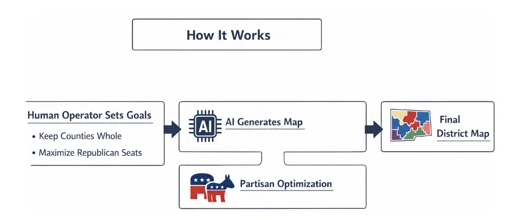
Understanding how it works: A human operator gives the AI a set of goals. These can include neutral criteria, like keeping counties whole or making districts compact.
The Technology Arms Race in Mapping
The process of drawing district lines has also undergone a technological transformation. Modern redistricting now relies on advanced Geographic Information Systems, predictive voter models, and increasingly artificial intelligence.
Political parties and advocacy groups combine census data with detailed voter files, consumer behavior datasets, and turnout models. These systems allow analysts to simulate thousands or even millions of potential district maps in search of those that maximize political advantage.
The result is a new form of computational gerrymandering. District boundaries can be refined with surgical precision, often down to individual neighborhoods or even specific streets. At the same time, the technology that enables partisan optimization also equips watchdog groups and courts with powerful analytical tools. By generating large volumes of neutral map simulations, researchers can identify when a legislative map produces outcomes far outside the statistical norm.
The next phase of redistricting will unfold not only in legislative chambers but also in data centers and courtrooms, where competing algorithms will shape the definition of what constitutes a fair map.
Forecasting the 2030 Map
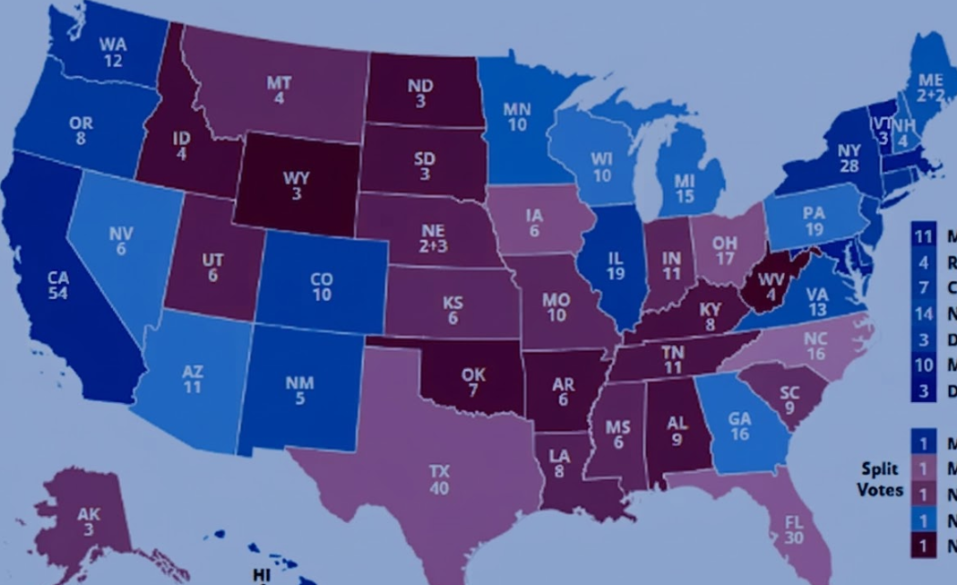
The 2030 redistricting cycle is already taking shape. Migration trends continue to shift population toward Sun Belt states and fast growing metropolitan regions. Suburban expansion and rural population decline are reshaping the geographic balance across the country. States gaining population will likely add congressional seats, while those facing stagnation or decline may lose representation. The allocation of House seats after the 2030 Census will also reset the Electoral College equation.
At the same time, demographic complexity is increasing. Rapid migration into suburban counties has created electorates that no longer fit cleanly within traditional partisan or demographic categories. These evolving regions, particularly across the Sun Belt and Interior West, are becoming the central battlegrounds for both congressional and presidential politics.
The groundwork being laid now in demographic analysis, legal positioning, and institutional preparation will determine which party enters the 2030 redistricting cycle with structural momentum. Map advantages are not built in a single year. They accumulate over multiple cycles.
Wrap Up
The next decade of American politics will not be won in campaign war rooms alone. It is being shaped right now in court filings, demographic models, legislative procedures, and the quiet infrastructure that determines how power is distributed before a single vote is cast. Redistricting has evolved into a permanent, high-stakes arena. It is where long-term advantages are built, defended, and expanded. The organizations that understand this are not treating maps as a technical exercise. They are treating them as the foundation of political power. This is where the donor blind spot becomes strategic risk.
Campaigns are visible, immediate, and emotionally compelling. But maps are durable. A well-funded candidate can win a cycle. A well-built map can control a decade. The gap between those realities is where elections are quietly decided. Structural advantage is not improvised in the final months of a campaign. It is engineered years in advance through legal positioning, data investment, and institutional control. Once those advantages are locked in, they are extraordinarily difficult to reverse. The map war is not approaching. It is active, accelerating, and already separating those who are building long-term leverage from those who are reacting too late. The next majority will not simply be elected. It will be drawn.