
From Meta’s final week blackout to TikTok’s outright ban on paid political ads, platform rules are shaping how campaigns allocate budgets and time their messaging in 2026.
What to Know
- Meta blocks new political ads during the final week before Election Day but allows previously approved ads to continue running.
- Google restricts targeting methods for political ads and prohibits new election ads after polls close.
- X permits candidate and party ads but requires certification and prohibits false or misleading election content.
- TikTok bans paid political advertising altogether.
- Streaming platforms operate under fragmented rules with limited federal oversight beyond required disclaimers.
The 2026 election cycle will not be defined only by candidates and issues. It will also be shaped by platform policies that determine when, where, and how campaigns can advertise. Major tech companies have adopted distinct and increasingly strict political advertising rules. Those rules now function as structural guardrails for campaign strategy.
For candidates, consultants, and advocacy groups, understanding cross platform restrictions is no longer optional. It directly affects budgeting, message timing, crisis response, and voter outreach.
Meta Facebook and Instagram
Meta Platforms continues to allow political advertising from authorized advertisers across Facebook and Instagram, provided campaigns complete the company’s identity verification and disclaimer requirements. Campaigns may run ads related to candidates, elections, ballot measures, and social issues, but only after clearing Meta’s authorization process and including visible “Paid for by” disclosures.
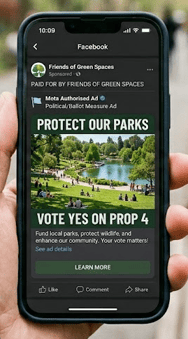
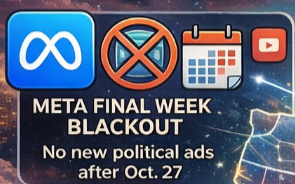
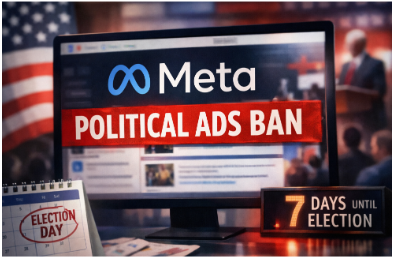
The most consequential restriction for 2026 remains the final week blackout. Meta confirmed in February 2026, according to Campaigns & Elections that it will continue blocking new political, electoral, and issue advocacy ads during the final seven days before Election Day. Ads that received at least one impression prior to the blackout may continue running, but no new creative can be introduced during that period. The company’s stated rationale is that, in the closing days of an election, there may not be sufficient time to contest new claims made in ads.
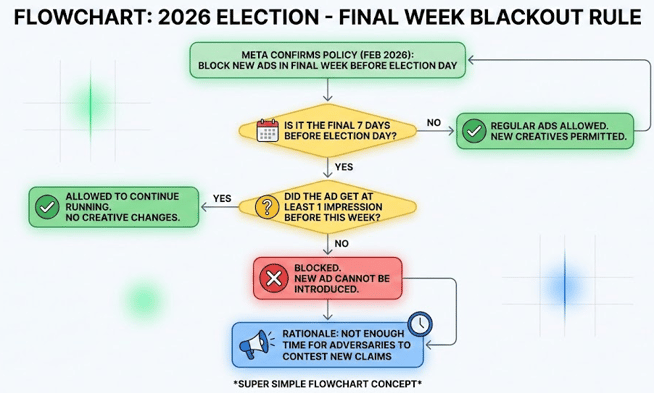
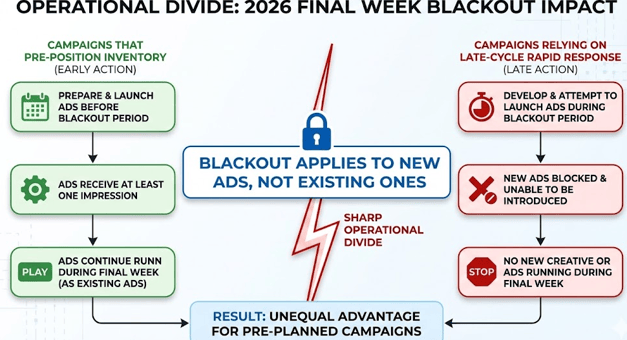
This policy has been in place for multiple cycles, but Meta publicly reaffirmed it ahead of the 2026 midterms, signaling no appetite for loosening restrictions. The blackout applies to new ads, not existing ones, which creates a sharp operational divide between campaigns that pre-position inventory and those that rely on late-cycle rapid response.
Meta has also expanded compliance expectations in adjacent areas. Political advertisers must disclose when artificial intelligence is used to create or alter ad content. The company prohibits ads that misuse public figures to scam or defraud users. In parallel, Meta has shifted its broader content moderation model toward a “Community Notes” system, where user-submitted content is published only after consensus among contributors who typically disagree. While not an ad policy change, this moderation structure affects how controversial political content may be contextualized during the campaign period.
Branded content rules add another compliance layer. Any creator or publisher receiving value to promote a political message must use Meta’s branded content tool and properly tag business partners. Certain categories are outright prohibited in branded content, including weapons, tobacco products, illegal drugs, payday loans, and multilevel marketing.
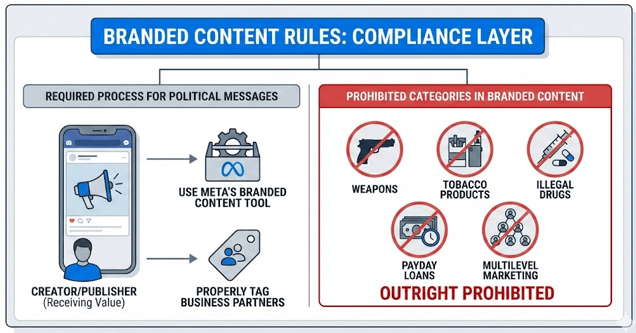
Political advertisers must also avoid exploitative use of controversial political or social issues for commercial purposes. These policies matter for campaigns increasingly using influencer-driven or creator-based amplification strategies. Digital strategy on Meta must be front-loaded. Message testing, persuasion creative, and contrast ads must be deployed before the seven-day window begins. Campaigns that wait to pivot after a late-breaking development risk being locked out of introducing new paid messaging during the most volatile stretch of the race.
For 2026, Meta’s blackout does not eliminate political advertising. It reshapes timing. Campaigns that treat the final week as a holding pattern rather than a launchpad will maintain continuity. Campaigns that rely on last-minute escalation will find the platform’s guardrails immovable.
Google and YouTube
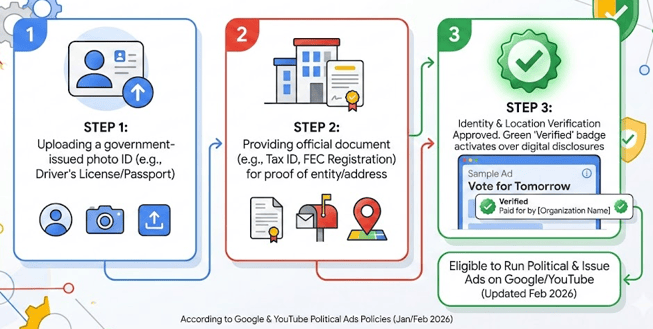
According to Google’s political advertising policies and YouTube’s advertiser-friendly content guidelines (updated January and February 2026), political advertisers must complete identity and location verification before running election or issue ads. Certification typically requires government-issued ID and proof of address tied to the paying entity.
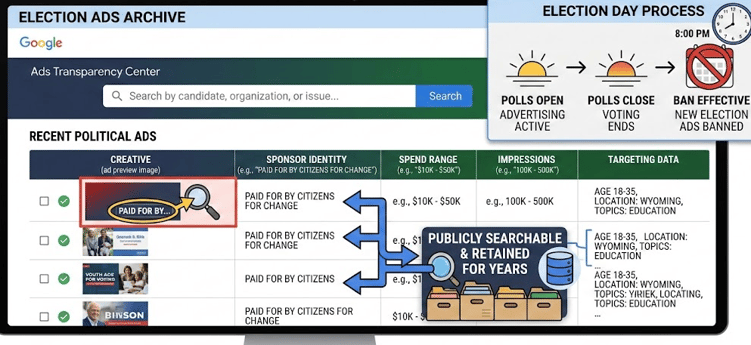
All political ads must include a clear “Paid for by” disclosure and are archived in Google’s Ads Transparency Center, where creatives, sponsor identity, spend ranges, impressions, and targeting data are publicly searchable and retained for multiple years. Google also bans new election ads after the final polls close on Election Day.
Targeting restrictions are among the strictest in digital politics. Political advertisers cannot target based on sensitive attributes such as political affiliation, race, religion, sexual orientation, or inferred ideology. In the United States, Google removed age, gender, and parental-status targeting for political and social issue ads in October 2020, sharply limiting demographic slicing.
Campaigns must rely primarily on geographic targeting, contextual keywords, and properly consented first-party audiences. Ads that mislead voters about voting procedures, impersonate officials, use manipulated media, or violate disclosure rules face disapproval, suspension, or loss of political ad authorization.

Recent YouTube monetization updates signal continued recalibration around sensitive content. In January 2026, YouTube allowed non-graphic, dramatized content focused on controversial issues to qualify for ad revenue, reversing a broader prior limitation.
In February 2026, the platform updated eligibility rules to permit monetization of content featuring 30-round magazines. While these updates apply to creator monetization rather than campaign ad targeting directly, they underscore Google’s ongoing refinement of how political and controversial material is treated within its advertising ecosystem.
X Formerly Twitter
X permits political advertising under its formal X Ads Policies, but all advertisers are subject to an approval and review process before campaigns can run. Accounts must meet eligibility standards to participate in X Ads, and promoted content is reviewed to ensure compliance with platform rules, X’s Terms of Service, and applicable laws. There is no stated seven-day blackout period before Election Day, meaning timing flexibility exists compared to Meta’s final-week restriction.
Political advertising falls under X’s restricted content framework. Ads must comply with all applicable laws and regulatory requirements and may require pre-authorization before launch. The platform prohibits illegal, harmful, deceptive, or fraudulent content, including ads that mislead users or promote unsafe activity. Political advertisers are responsible for ensuring compliance with disclosure obligations and regulatory standards, and campaigns that violate policies may face ad rejection or removal.
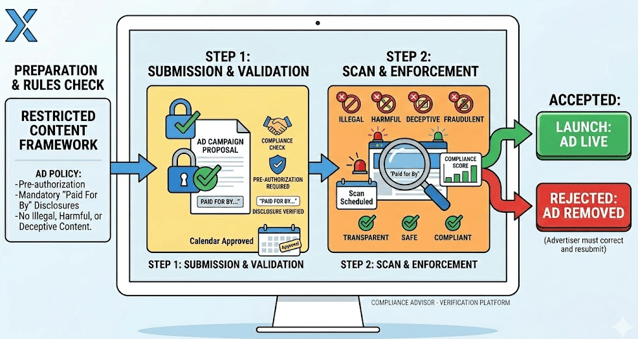
Enforcement includes account eligibility review, ad-level approval, and a formal offboarding process for advertisers removed from the platform. Because policy enforcement operates through an active review system rather than a defined blackout window, risk management centers on compliance and account standing. Campaigns relying on X for 2026 messaging should factor in approval timelines, potential pre-authorization requirements for political content, and the possibility of offboarding if standards are breached.
TikTok
TikTok continues to prohibit paid political advertising, including candidate ads, issue advocacy ads, and compensated branded political content created by influencers. Campaigns cannot purchase political placements through TikTok’s ad platform.
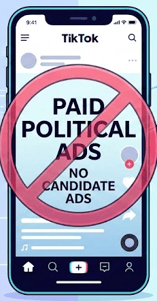
Government entities may advertise in limited circumstances, such as public health messaging, but political advertising tools are disabled for accounts representing candidates, parties, and elected officials. As a result, any political presence on TikTok must rely on organic content rather than paid amplification.
Entering 2026, TikTok operates under a new U.S.-based ownership structure. After a January 2025 federal divestment law temporarily removed the app from U.S. stores, TikTok transitioned on January 22, 2026 to “TikTok USDS Joint Venture LLC,” backed by Oracle, Silver Lake, and MGX. Updated Terms of Service effective January 22, 2026 clarified the new contracting entity, expanded disclosure around geolocation data collection with user permission, and outlined enhanced data protection, algorithm security, and content moderation safeguards.
The transition triggered user backlash over upload disruptions, alleged content suppression, and privacy concerns, though TikTok denied changes to political moderation policies and attributed some issues to technical outages. For 2026 campaigns, the core rule stands: paid political ads remain prohibited. Strategy must rely on organic content, compliant creator engagement, and earned media within a closely monitored moderation environment.
Snapchat
Snap Inc. permits election-related, advocacy, and issue advertising on Snapchat, provided advertisers complete Snap’s political advertiser intake process and comply with all applicable election and campaign finance laws.
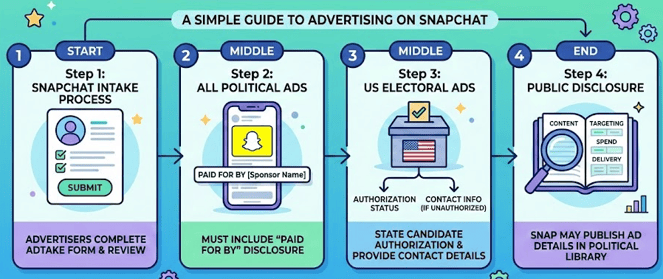
All political ads must include a clear “Paid for by” disclosure naming the sponsoring entity. In the United States, electoral ads must also state whether they were authorized by a candidate, and unauthorized ads must include contact information for the sponsoring organization. Snap may publicly disclose ad content, targeting details, spend, and delivery information in its political ad library.
Content standards mirror broader platform rules. Political ads cannot harass, threaten, mislead, impersonate individuals or entities, violate intellectual property rights, or promote violence. While Snap does not categorically ban contrast or “attack” ads, it prohibits attacks related to a candidate’s personal life. Political ads may not be funded directly or indirectly by foreign nationals or entities, except for limited intra–European Union cases under EU law.
Snap does not maintain a formal pre-election blackout period. Instead, ads are reviewed case by case, and Snap reserves the right to reject or require modifications to content that violates its standards. For 2026 campaigns, Snapchat offers late-cycle flexibility, but strict disclosure, funding, and content compliance rules remain non-negotiable.
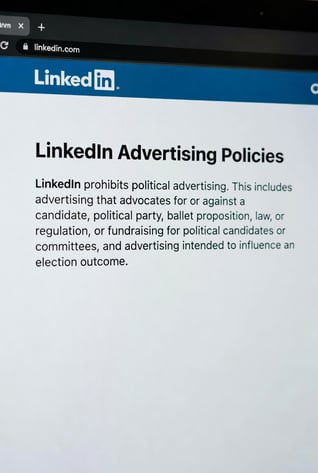
LinkedIn explicitly prohibits political advertising under its Advertising Policies (last revised November 18, 2025). This includes ads advocating for or against a candidate, political party, ballot proposition, law, or regulation; fundraising for political candidates or committees; and ads intended to influence an election outcome.
The ban also extends to ads exploiting sensitive political issues, even if the advertiser does not present an explicit political agenda. In the European Union, political advertising is prohibited under Regulation (EU) 2024/900, and Brazil follows similar restrictions under TSE Resolution 23732/2024.
All ads on LinkedIn are subject to a formal review process, typically within 24 hours, and must comply with Professional Community Policies, anti-discrimination rules, and strict safety and privacy standards. Ads cannot target based on sensitive data categories, including political affiliation or opinions, religion, race, health data, or union membership. LinkedIn reserves the right to reject, remove, suspend, or terminate accounts for policy violations at its sole discretion.
CTV and Streaming Platforms
Connected TV operates under a different legal framework than broadcast television. FCC political advertising rules such as reasonable access (Section 312(a)(7)), equal time (Section 315), lowest unit rate during the 45-day primary and 60-day general election windows, and the no-censorship protection for candidate “uses” apply only to broadcast licensees. They do not apply to streaming or CTV platforms. Services such as Hulu, Roku, and YouTube TV are not subject to those broadcast-era mandates and may accept or reject political ads at their discretion.
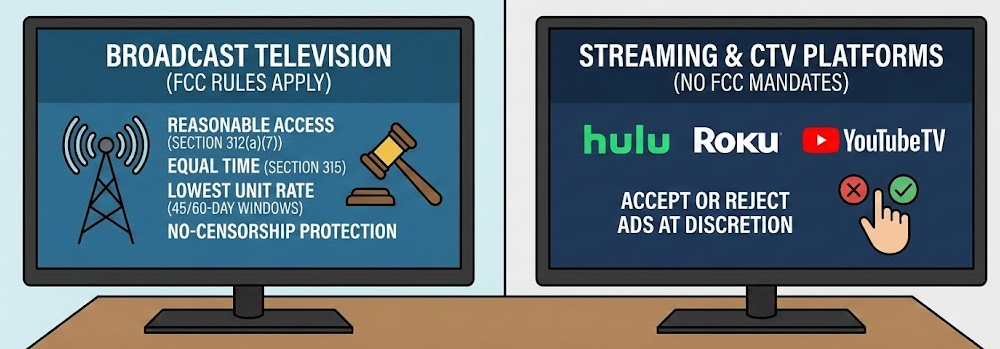
What still applies are Federal Election Commission disclaimer requirements for federal candidates and general truth-in-advertising standards enforced by the Federal Trade Commission. Federal campaigns must still include proper “Paid for by” and “I approve this message” disclaimers regardless of platform. However, there is no equal time rule, no guaranteed access requirement, and no lowest unit rate protection on CTV. Pricing is market-driven, and inventory can tighten significantly in competitive markets. Platforms also retain full authority to review and reject ad content under their internal policies.
Wrap Up
Platform governance now functions as campaign infrastructure. From FCC-regulated broadcast rules to Meta’s seven-day blackout, Google’s targeting limits, TikTok’s paid political ban, LinkedIn’s outright prohibition, and CTV’s market-driven framework, every major channel imposes distinct operational constraints. These policies dictate timing, pricing, targeting precision, creative format, disclosure language, and even whether ads can run at all.
The 2026 cycle will not be shaped solely by message quality or voter mood. It will be shaped by verification windows, lowest unit rate protections on broadcast, content review processes on streaming, and evolving AI disclosure standards at the state level. Campaigns that ignore platform mechanics risk late-cycle disapprovals, inflated rates, or locked-out inventory.
The strategic edge now belongs to campaigns that integrate compliance into media planning from the outset. Policy timelines must anchor production schedules. Disclosure rules must inform scriptwriting. Inventory dynamics must guide budget allocation. In modern elections, platform rules are not background conditions. They define the playable field.