-Sep-11-2026-07-48-51-8837-AM.jpg)

Texas remains Republican territory, but its Senate contest now demands a competitive campaign from both parties.
What to Know
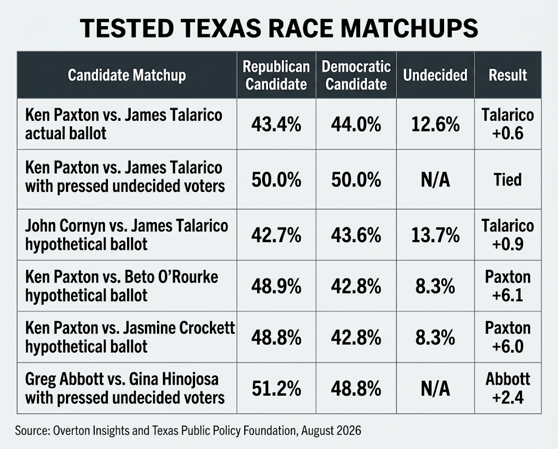
- James Talarico leads Ken Paxton 44.0% to 43.4%, leaving 12.6% of likely voters undecided.
- Initially undecided voters favor Paxton 52.6% to 47.4% when required to choose.
- Adding those voter preferences produces an exact 50% to 50% division between the candidates.
- Paxton trails the generic Republican congressional vote by 3.0 percentage points, revealing a candidate specific challenge.
- Donald Trump’s 55.9% disapproval rating creates another obstacle for Republican consolidation in Texas.
Texas Republicans still hold important structural advantages, but they cannot treat this Senate race as secure. An Overton Insights survey sponsored by the Texas Public Policy Foundation places Democrat James Talarico at 44.0% and Republican Ken Paxton at 43.4% among likely voters. Only 0.6 percentage points separate the candidates before undecided voters make a choice.

James Talarico, Texas House Representative for District 50, via Texas House of Representatives.
Published on September 2, 2026, the poll shows a race shaped by competing political realities. Most respondents still describe Texas as reliably Republican, yet Paxton does not lead the Senate ballot. Campaigns must now explain why the state’s partisan identity has not produced a clear Republican advantage in this contest.
Raw Ballot Reveals a Genuine Persuasion Contest
Overton Insights finds 12.6% of likely voters undecided between Paxton and Talarico. That group is more than 20 times larger than Talarico’s initial 0.6 point advantage. Neither campaign can credibly describe the race as settled while such a large share of the electorate remains available.

Initial Texas Senate ballot leaves many voters undecided, via Overton Insights.
Raw ballot results also expose a gap between Paxton and the broader Republican position. Republican congressional candidates collectively lead Democrats 46.4% to 43.6% on the generic ballot. Paxton receives 43.4%, placing him 3.0 percentage points below that Republican baseline.
Talarico’s 44.0% exceeds the generic Democratic vote by 0.4 percentage points. That difference is modest, but it matters in a contest separated by less than 1 percentage point. Paxton must consolidate Republican leaning voters who have not transferred their party preference to him, while Talarico must protect his current support and win enough remaining persuadable voters.
Pressed Voters Erase Talarico’s Initial Lead
Overton Insights asked undecided respondents which candidate they would choose if required to decide immediately. Paxton wins that group 52.6% to 47.4%. Once those preferences are combined with the initial ballot, however, the entire electorate divides exactly 50% to 50%.
That distinction matters. Paxton performs better among undecided voters, but his advantage within that group only repairs his original deficit. It does not give him an overall lead.
 Pressed undecided voters leave Texas Senate candidates tied, via Overton Insights.

Beto O’Rourke, former United States Representative from Texas, via Powered by People.

Jasmine Crockett, United States Representative for Texas’s 30th District, via Representative Jasmine Crockett.
Alternative matchups reinforce Talarico’s individual strength. Paxton leads Beto O’Rourke 48.9% to 42.8% and Jasmine Crockett 48.8% to 42.8% in hypothetical contests. Talarico, by contrast, reaches a tie with Paxton and records 43.6% against John Cornyn’s 42.7% in another hypothetical matchup.
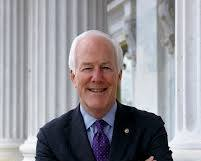
John Cornyn, United States Senator from Texas, via Senator John Cornyn.
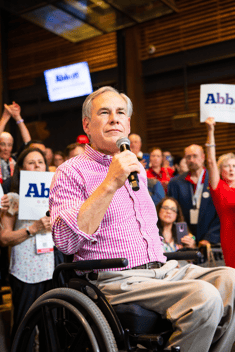
Greg Abbott, Governor of Texas, via Greg Abbott.
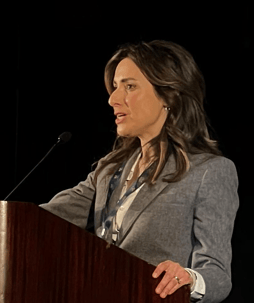
Gina Hinojosa, Democratic nominee for Governor of Texas, via Gina Hinojosa for Texas Governor.
Those results do not prove that Talarico will win. They show that his position cannot be explained entirely by a general Democratic improvement. His campaign has assembled a coalition that performs differently from the other Democratic options tested in the survey.
Republican Identity No Longer Guarantees Candidate Support
Texas voters have not abandoned the state’s conservative identity. According to the survey, 57.0% call Texas a red state, while 38.3% describe it as politically competitive and 4.7% call it reliably Democratic. Republican candidates also maintain a 2.8 point advantage on the generic congressional ballot.
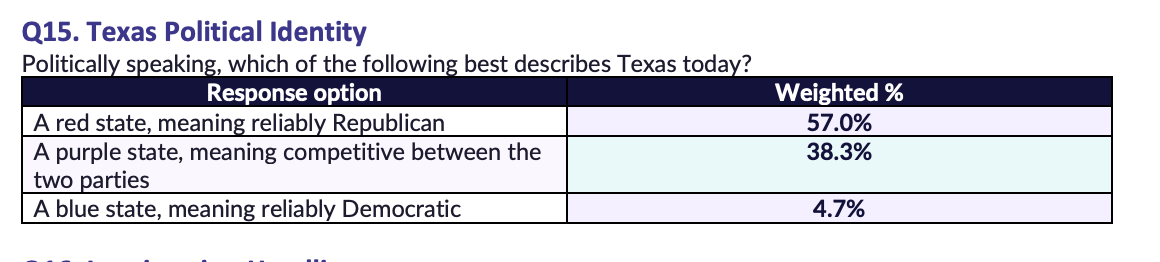
Texas voters still identify the state as Republican, via Overton Insights
Paxton must convert that Republican environment into candidate support. His campaign cannot rely on the party label alone when his ballot share remains below the generic Republican vote. Identifying conservative and moderate voters who support Republicans generally but hesitate over Paxton should become a central persuasion priority.
Talarico faces a different challenge. His campaign must convince voters that this race deserves to be judged separately from their usual statewide voting habits. A tied poll creates an opportunity, but Texas’s underlying Republican advantage still gives Paxton a clear route to recovery.
National Disapproval Adds Pressure to the Statewide Race
Donald Trump’s standing creates another complication for Republicans. Overton Insights finds 44.1% of likely Texas voters approving of his job performance and 55.9% disapproving. Strong disapproval alone reaches 48.6%, exceeding the total approval figure.

Donald J. Trump, President of the United States, via The White House.
Other results show a closely divided electorate rather than a uniform rejection of the administration. Voters divide 49.7% to 49.8% on Trump’s handling of immigration. They oppose his tariff policy 54.1% to 45.9%, however, giving Democrats another opening to connect national policy with household economic concerns.
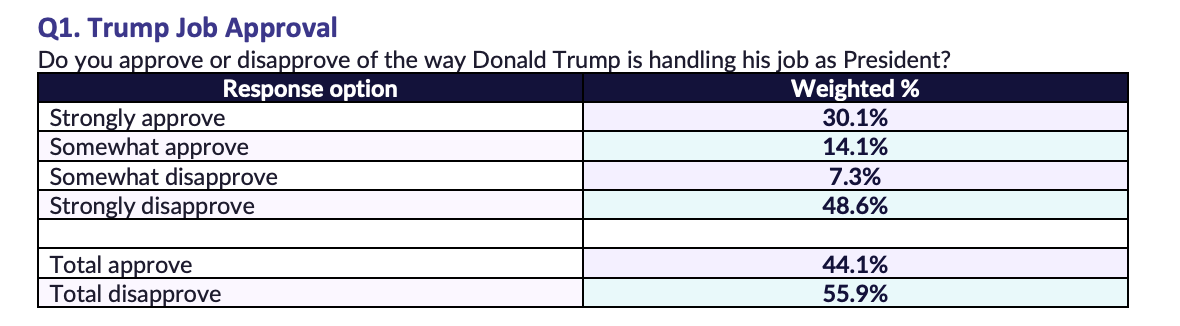
Texas voters split sharply on presidential job approval, via Overton Insights.
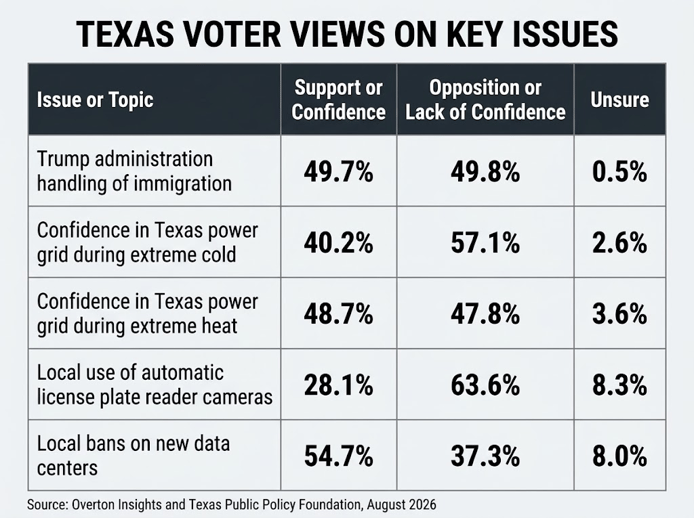
Paxton must keep Trump aligned conservatives engaged without allowing national dissatisfaction to define the Senate contest. Talarico must convert dissatisfaction with the administration into direct support for his candidacy. Neither campaign can assume that attitudes toward Trump will transfer automatically to the Senate ballot.
Survey limitations also matter. Overton Insights surveyed 1,167 Texas likely voters from August 24 through August 26, 2026 using text message recruitment and a self administered online questionnaire in English. Researchers weighted the results by gender, age, education and race, The official release reported a margin of error of ±2.9 percentage points
One survey captures voter opinion during a specific period. It cannot predict turnout or measure every campaign development that may occur before Election Day. Still, an exact tie gives both campaigns an immediate reason to reassess their persuasion and turnout plans.
Wrap Up
Texas remains favorable territory for Republicans, but Paxton has not converted that advantage into a polling lead. Talarico begins at 44.0%, Paxton follows at 43.4%, and 12.6% remain undecided. Pressing those voters produces an exact 50% to 50% contest.
Paxton’s clearest opportunity lies with voters who already lean Republican but have not committed to him. Talarico’s path requires maintaining his unusual strength while persuading voters who do not normally support Democrats statewide. Both campaigns need candidate specific arguments because the party labels have not resolved the race.
Overton Insights does not prove that Texas has permanently changed. It shows that this Senate contest is competitive now. Campaigns that continue treating the state as predictable risk allowing a tied race to move without them.
-Sep-11-2026-10-13-55-7064-AM.jpg)