
New national polling shows Democrats with an 8% congressional advantage, but the economy and cost of living remain at the center of how voters are evaluating both parties heading into the 2026 midterms.
What to Know
- Democrats lead the generic congressional ballot by 8 points, 51% to 43%.
- 60% of Americans say Trump’s economic policies have made conditions worse.
- Economy is the top issue for 37% of likely voters.
- Democrats lead Republicans by 8 points on handling the cost of living.
- 37% of voters still choose neither party or remain unsure on affordability.
Democrats hold an 8-point national lead, but campaigns should not mistake that advantage for a settled economic verdict. Voters are still judging both parties through the bills they pay every week: groceries, rent, utilities, gasoline, insurance, and healthcare.
A campaign that talks only about national economic metrics will miss the argument voters are having at their kitchen tables. Sixty percent of Americans say Trump’s economic policies have made conditions worse. That is the accountability contrast Democrats must press, while also proving how their own agenda will lower specific household costs.
Democrats Lead, but the Economic Fight Is Still Live
Emerson College Polling’s August national survey found Democrats leading Republicans 51% to 43% on the generic congressional ballot. Emerson surveyed 1,000 likely voters from August 16 to 17, 2026, with a margin of error of approximately plus or minus 3 points. Only 6% remained undecided.
That lead establishes the current national climate. It does not guarantee results in every congressional district. Campaigns must turn the national advantage into local economic contrasts that give voters a reason to choose a specific candidate.
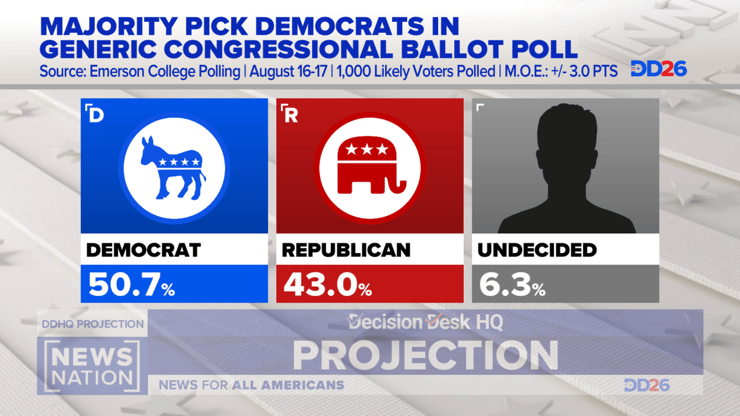
NewsNation and Decision Desk HQ visualization using Emerson College Polling data, via The Hill.
President Donald Trump’s job approval stood at 40% in the same survey, while 56% disapproved. Republican approval remained strong at 86%, but 66% of independents disapproved. Republicans cannot rely on partisan loyalty to protect candidates when independent voters are already looking for a different economic answer.
i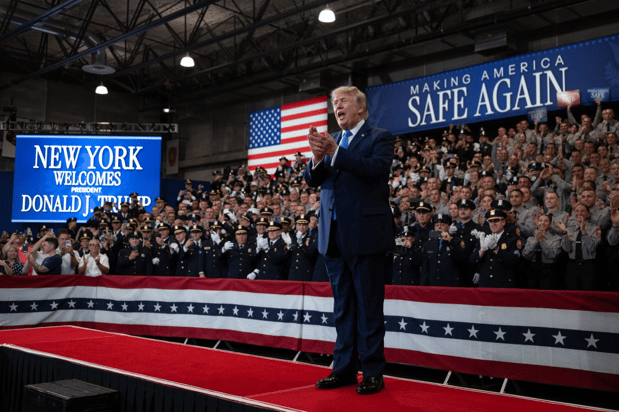
Donald Trump, President of the United States. Photo: Molly Riley.
Economic urgency has returned to the top of the campaign environment. Economy led at 41% in May and 38% in June, then fell behind threats to democracy in July. By August, economy had returned to first place at 37%.
Democrats led by 11 points in July before the margin narrowed to 8 points in August. Campaigns should treat that movement as a warning: voters may reward Democrats today, but they will keep reassessing both parties through the costs they face at home.
Put Accountability at the Center of the Economic Argument
Pew Research Center’s July survey found only 24% of Americans rating national economic conditions as excellent or good. Another 41% called conditions only fair, while 35% called them poor.
Most importantly, 60% said Trump’s economic policies had made economic conditions worse. Campaigns should not bury that number in a policy discussion. Put it at the center of the contrast: voters believe the party in power has made their economic situation harder, and Republican candidates must answer for that record.
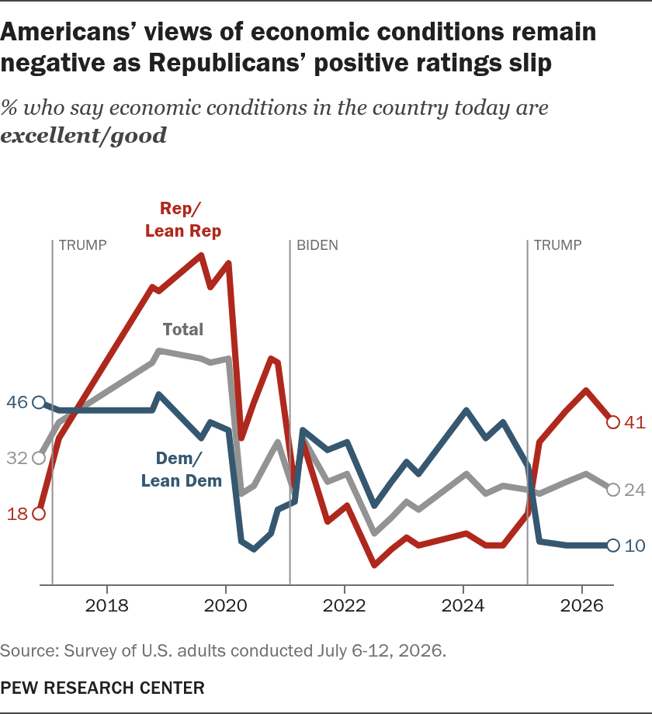
Screenshot of the economic conditions graph from Pew Research Center.
Only 23% expected conditions to improve over the following year, while 36% expected them to worsen. Republicans cannot neutralize this frustration by pointing to broad indicators. They must confront voters who still see pressure in their household budgets.
Democratic campaigns should make the accountability case concrete. Do not simply say that the economy is difficult. Show voters which policies failed to lower their costs and explain what your candidate will do differently.
Groceries, Rent, and Healthcare Are the Real Economic Message
Pew asked registered voters what single issue they most wanted congressional candidates in their district to discuss. Economic concerns accounted for 29% of responses, including 15% naming cost of living or affordability, 7% naming the economy generally, and 4% naming taxes.
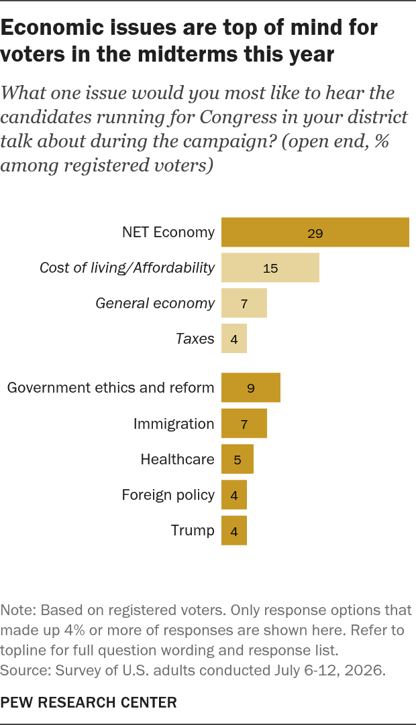
Screenshot of the voter priorities graph from Pew Research Center.
Voters did not choose those answers from a pre-set list. They raised affordability themselves. That gives campaigns a clear instruction: lead with the bills voters recognize immediately.
Start with groceries. Families see food prices every time they check out. Address rent and housing next, especially in districts where working families are being pushed further from their jobs and communities. Then address healthcare, insurance, and prescription costs, where a single unexpected bill can undo a household budget.
Economic language must sound like daily life, not a briefing memo. Talk about the grocery receipt, the rent payment, the electric bill, and the cost of keeping a car on the road. Candidates who make those connections directly will sound more credible than candidates who rely on abstract claims about growth or markets.
Democrats Have an Opening on Affordability, Not a Blank Check
A Reuters and Ipsos poll released on August 25, 2026, found Democrats leading Republicans 36% to 28% on which party has the better plan for handling the cost of living. That is an 8-point Democratic advantage.
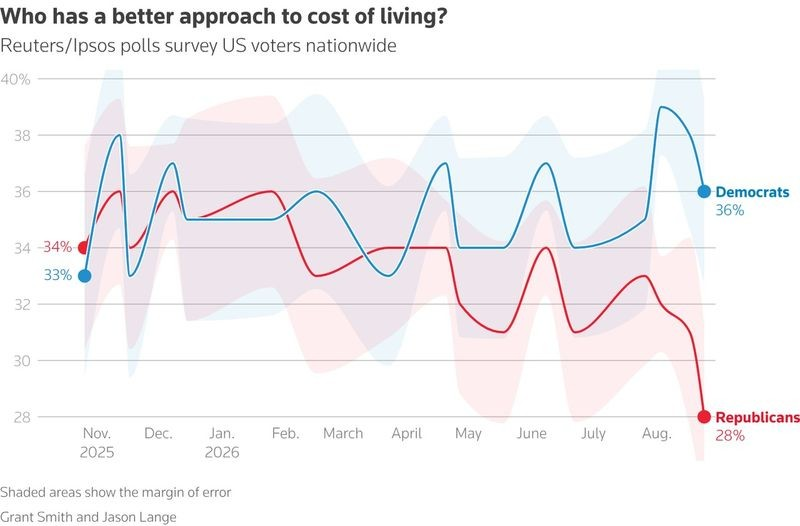
Affordability Has Shifted Toward Democrats, via Reuters and Ipsos.
But 37% chose neither party or remained unsure. Those are undecided voters, not a locked-in Democratic coalition. Democrats have gained an opening, but they must earn trust by showing how they will lower specific bills instead of simply criticizing Republican failures.
Reuters reported that this was the largest Democratic advantage on the question since the polling series began asking it in October 2025. Another Reuters and Ipsos survey found Democrats ahead 37% to 36% on the broader economy.
Campaigns should use that shift aggressively, but carefully. Tell voters what the candidate will do about rent, food, energy, healthcare, and insurance. A general promise to improve the economy will not persuade voters who still doubt that either party understands their costs.
Pew’s July survey showed the same uncertainty. Democrats received 37% on economic policy, Republicans received 36%, and 25% selected neither party.
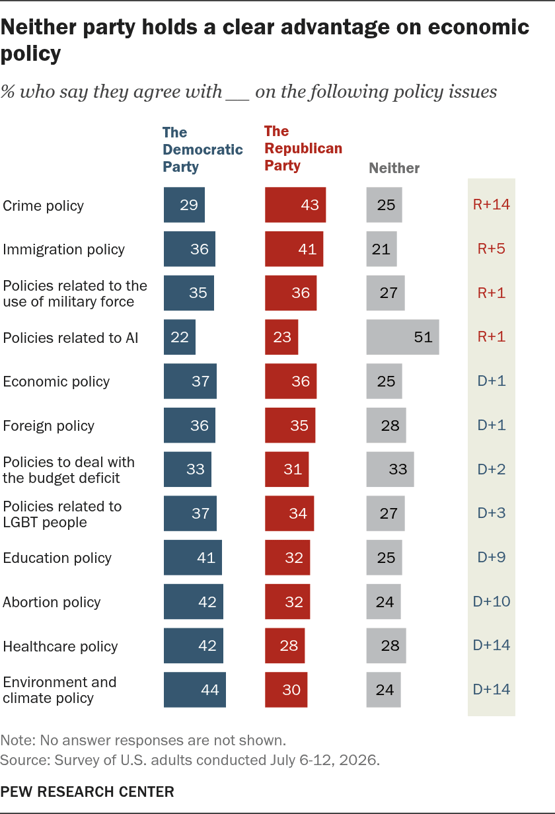
Screenshot of the economic policy comparison from Pew Research Center.
Republicans also face a weakness inside Trump’s own coalition. Reuters found that approximately 80% of Republicans approved of his presidency overall, while only approximately 50% approved of his handling of the cost of living. Partisan loyalty does not erase frustration with household expenses.
Energy Costs Turn National Events Into Household Pressure
Gasoline and utility costs give campaigns another direct connection between national decisions and local budgets. Reuters reported that the conflict with Iran and restrictions affecting oil shipments through the Strait of Hormuz contributed to elevated gasoline prices. The same polling found support for military action declining to 31%.
Voters do not experience this as an abstract foreign-policy debate. They experience it at the gas pump, in delivery costs, and through higher transportation prices. Campaigns should connect those costs to a clear accountability message without overstating what any one policy can change overnight.
Republican candidates must explain why voters should trust them with energy and household costs when many voters already believe the current administration’s economic policies have made conditions worse. Democratic candidates must pair that critique with a practical answer: how they will protect family budgets and keep essential costs from rising further.
Wrap Up
Democrats lead the generic ballot by 8 points, and they hold an 8-point advantage on handling the cost of living. Those numbers matter. But the central story is not the national margin. It is the 60% of Americans who say Trump’s economic policies have made conditions worse.
Campaigns must organize the economic message around the bills voters actually pay. Lead with groceries, rent, healthcare, insurance, utilities, and gasoline. Make the accountability contrast direct, then prove how your candidate will lower specific costs.
Voters have not stopped voting with their wallets. Democrats have an opening, but undecided voters are still waiting for a reason to trust them. Republicans face a harder task: they must defend a record that many voters believe made the economy worse while persuading families that their costs will improve.