
Democrats have gained ground on affordability, yet widespread distrust keeps their advantage from becoming a settled electoral verdict.
What to Know
- Democrats lead Republicans 36% to 28% on living costs, yet 37% remain uncommitted to either party.
- Among independent and other voters, 65% did not select either major party on affordability.
- KFF finds Democrats leading 29% to 16% on health costs among independents, while at least 50% trust neither party.
- Gallup reports a record 55% saying their personal finances are worsening.
- Health costs could strongly influence candidate choice for 63% of independent voters.
Democrats now hold the stronger position on affordability, but the comparison hides the electorate's largest group. A Reuters report finds 36% of registered voters choosing Democrats and 28% choosing Republicans on handling living costs. Another 37% remained unsure or rejected both parties.
With a record 55% saying their personal financial situation is getting worse, campaigns must stop talking about national metrics and start targeting kitchen-table expenses. Ipsos subgroup results show weak attachment among independent and other voters, while KFF finds similar distrust around health costs. Gallup’s historically poor household outlook explains why favorable comparisons may not convert. Democrats can benefit from Republican weakness, but they must earn trust by showing voters believable relief.
Largest Bloc Chose Neither Side
Reuters and Ipsos asked which political party had the better plan, policy or approach to the cost of living. Democrats received 36% among registered voters, Republicans received 28%, and no other response approached either share individually. Ipsos surveyed 951 registered voters from August 21 through 24, 2026, with a margin of error of 3.3 percentage points. Democrats led, but nearly two thirds of voters still withheld support from them on the defining question.
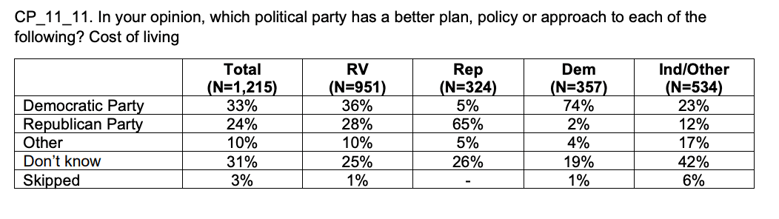
Democrats lead on living costs. Image via Ipsos.
Published categories explain the apparent difference between the Reuters summary and the Ipsos table. Reuters combined undecided voters and voters choosing neither party, reporting 37% as unsure or declining to choose either major party. Ipsos displayed separately rounded registered-voter results of 10% for another party, 25% for don’t know and 1% skipped. Those displayed figures total 36% because each component was rounded independently.
Previous tracking cycles show movement without creating a majority mandate. An Ipsos survey fielded from July 29 through August 3, 2026, placed Democrats ahead 35% to 27% on living costs. Reuters reported the parties were nearly tied in January 2026, when Democrats held 32% and Republicans held 31%. August therefore extended a Democratic improvement while leaving most registered voters outside the party’s column.
Issue advantage is a judgment, not a full endorsement. Voters may decide Republicans have responded poorly without accepting the Democratic prescription on taxes, spending, healthcare, housing or energy. A party can gain because its opponent loses credibility faster than it earns credibility itself. That is the trust gap campaigns must close.
Independent Voters Widen the Trust Gap
Independent and other voters make the unresolved choice more visible. Within that Ipsos subgroup, 23% selected Democrats and 12% selected Republicans on cost of living. Another 17% preferred another party, 42% answered don’t know and 6% skipped the question. Combined, 65% did not choose either major party.
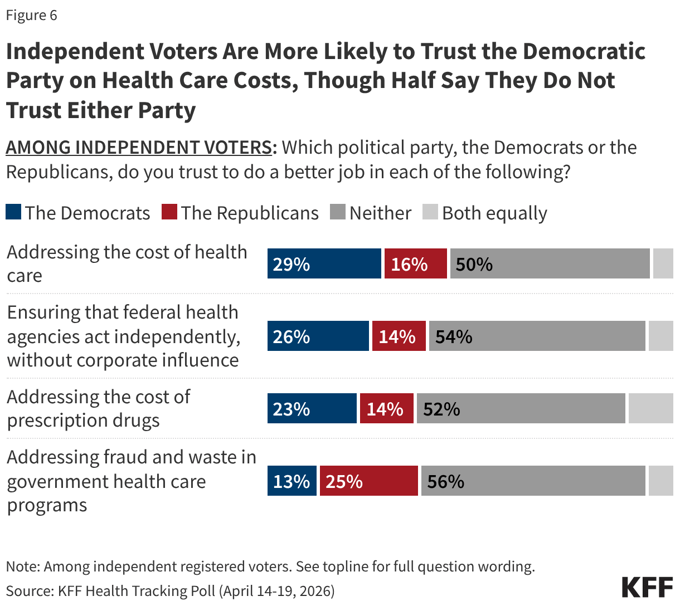
Independent voters still distrust both parties. Image via KFF.
Healthcare affordability reveals a similar pattern inside a specific household expense. An April KFF survey found independent voters trusted Democrats over Republicans 29% to 16% to address health costs. Yet at least 50% trusted neither party on that issue. Democrats again won the comparison while failing to convince a majority.
KFF surveyed 1,343 adults from April 14 through 19, 2026, using online and telephone interviews. Its question and sample differ from Reuters and Ipsos, so the percentages cannot form one trend. Still, both surveys confirm a deep lack of trust: independents can prefer Democrats while remaining more likely to trust neither side.
Uncommitted voters also resist simple targeting. Some may favor government action on healthcare while opposing additional spending elsewhere. Others may blame corporate pricing, energy policy, interest rates, local housing shortages or both parties’ records. Their shared response is uncertainty, not a unified ideology.
Financial Pressure Extends Beyond Inflation
Affordability skepticism rests on personal financial experience, not only partisan messaging. Gallup found 31% naming inflation or high prices as their family’s most important financial problem in an open-response question. Energy and housing costs each followed at 13%, while healthcare reached 8%. Cost concerns have now led Gallup’s list by a wide margin for 5 consecutive years.
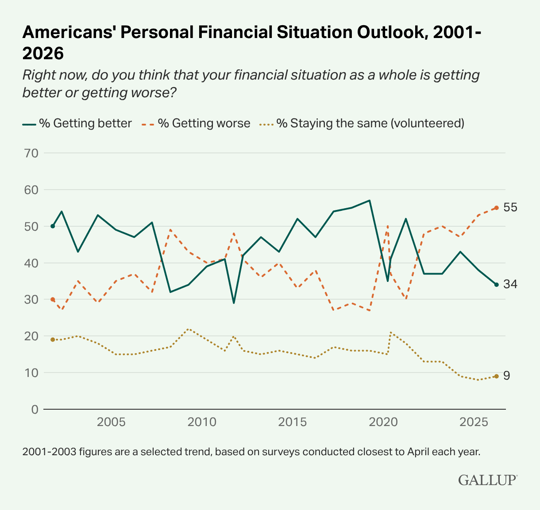
Household financial pessimism remains historically high. Image via Gallup.
Financial expectations make broad economic indicators less persuasive. A record 55% told Gallup their personal financial situation was getting worse, compared with 53% in 2025 and 47% in 2024. Another 55% said recent price increases had created hardship in maintaining their standard of living. Only 46% described their finances as excellent or good.
KFF identifies the expenses giving affordability its political reach. Its April survey found 64% worried about paying health costs and the same 64% worried about gasoline and transportation. Shares describing themselves as very worried included 30% for healthcare, 29% for transportation, 23% for food, and 21% each for housing and utilities. Voters encounter affordability as several overlapping bills, not one inflation statistic.
Broad promises fail when households cannot see their own problem in the message. Renters may prioritize housing, parents may focus on food, drivers may watch fuel, and patients may measure prescription costs. Campaigns must name the expense, explain how a proposal changes it and show when voters would feel the difference. Without that connection, empathy sounds accurate while the solution remains abstract.
Conversion Requires Specific, Credible Relief
Cost concerns can influence voting without automatically benefiting one party. KFF found 52% of independent voters saying health costs would have a major impact on their decision to vote. An even larger 63% said the issue would have a major impact on which party’s candidate they supported. Those results create an electoral opening, but they do not identify its eventual beneficiary.
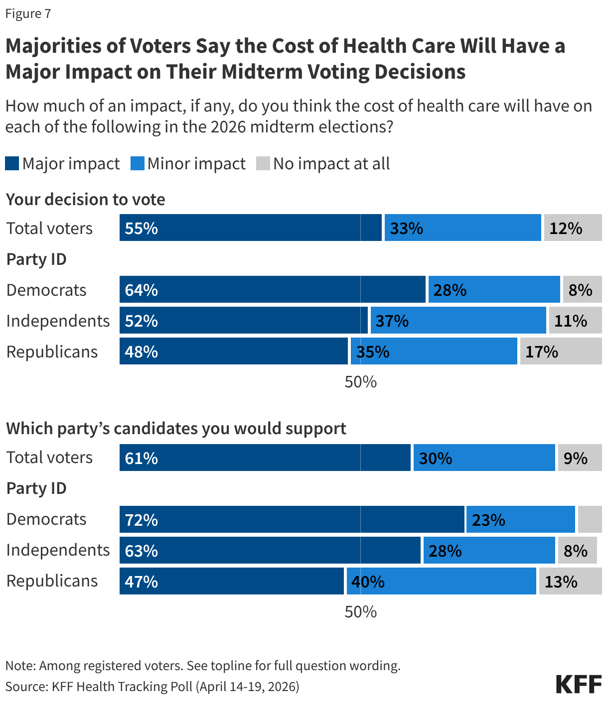
Health costs shape independent voters' choices. Image via KFF.
Current dissatisfaction places Republicans under immediate pressure. Ipsos found only 24% of registered voters approving of President Donald Trump’s handling of their cost of living, while 70% disapproved. Among independent and other voters, approval fell to 12% and disapproval reached 75%. Even Republican respondents divided more sharply on living costs than on Trump’s overall presidency, with 52% approving and 39% disapproving.
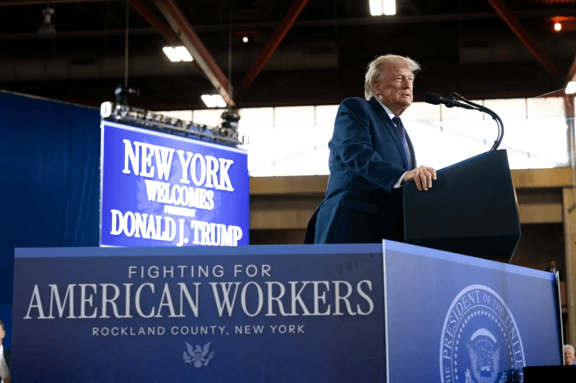
Trump addresses the economy. Photo: Joyce Boghosian via White House.
Economist and YouGov found a comparable fracture in May 2026. Only 16% of independents approved of Trump’s handling of inflation and prices, while 75% disapproved. Among Republicans who did not identify with the MAGA movement, 32% approved and 61% disapproved. Opposition crosses partisan boundaries, but crossed boundaries do not automatically become Democratic votes.
Democratic campaigns must prove how they will lower specific bills instead of just pointing out Republican failures. Every proposal should identify the targeted expense, the policy mechanism, the responsible institution and a credible timetable. Voters who distrust both parties may value feasibility over ideological ambition. Specificity can distinguish a governing claim from another campaign promise.
Republicans still have room to recover. They can blame Democratic spending for earlier inflation, emphasize taxes or energy, and highlight local cost differences. Democrats cannot rely on presidential disapproval because voters may reject current management while distrusting the alternative. Winning requires a positive case that can survive that counterargument.
Wrap Up
Democrats have earned a measurable advantage on cost of living. Reuters and Ipsos place them 8 points ahead of Republicans, and the margin has widened since January 2026. Yet 37% remain outside either party’s affordability case, making undecided voters and voters choosing neither party a larger bloc than either partisan share.
Independent voters show why that advantage remains fragile. Ipsos shows 65% of independent and other voters declining to choose either major party, while KFF finds at least 50% trusting neither party on healthcare costs. Gallup’s record 55% worsening financial outlook explains why these voters demand more than favorable comparisons.
November will test whether Democrats can attach credible relief to their stronger position. Campaigns must prove how their plans would lower rent, food, fuel, healthcare, utility or prescription bills, rather than merely describe Republican failures. Winning the comparison creates an opening. Earning trust from the largest uncommitted bloc remains the harder campaign.