
Changing congressional control may limit sweeping legislation while increasing sector scrutiny, funding disputes and uncertainty after Election Day.
What to Know
- A Democratic House and Republican Senate would restrict major legislation while expanding investigations and fiscal negotiations.
- Ballotpedia’s late September polling index placed Democrats at 44.2% and Republicans at 42.6% on the generic ballot.
- Historical market gains after midterms do not prove that divided government causes stronger returns, especially because high post-midterm averages come from a small sample and macroeconomic indicators remain the main drivers of market direction.
- Technology and energy companies face greater oversight risk even if Congress cannot pass comprehensive new regulations.
- Government funding and debt limit negotiations could create more immediate volatility than the election result itself.
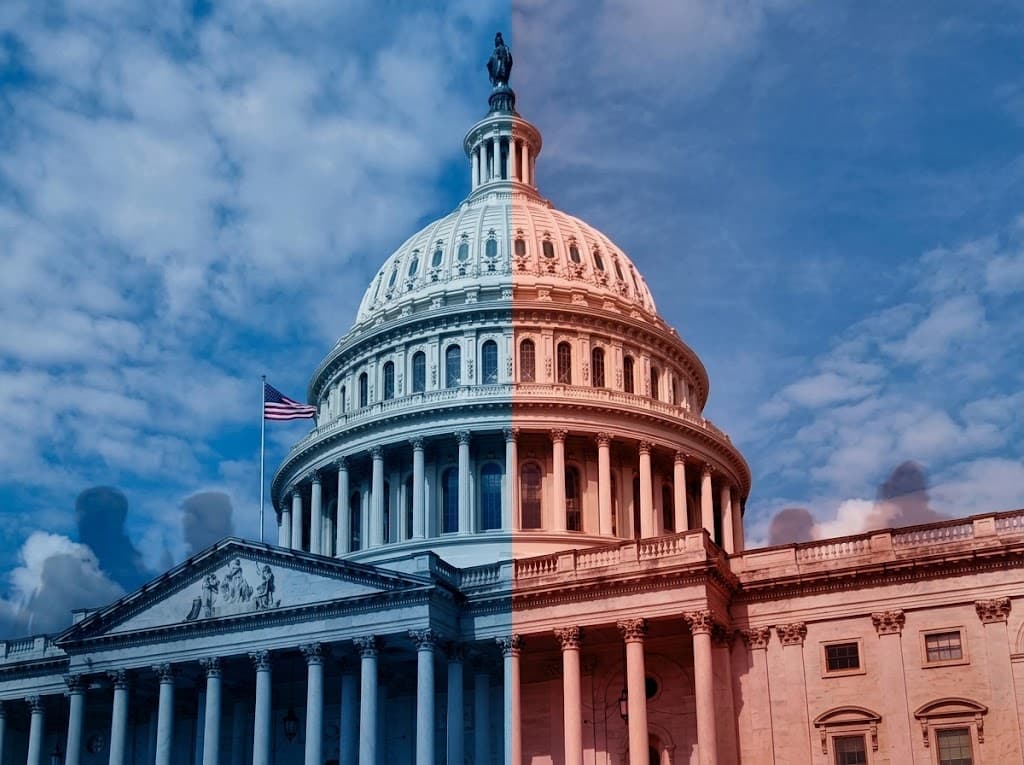
Markets are watching the midterms because congressional control determines which legislation can advance, which industries face investigation and how Washington handles major fiscal deadlines. Current election indicators increasingly support a divided government scenario, with Democrats positioned competitively for the House while Republicans retain a viable path to hold the Senate. That outcome would reduce the likelihood of sweeping legislation without removing political risk from technology, energy, defense or financial markets.
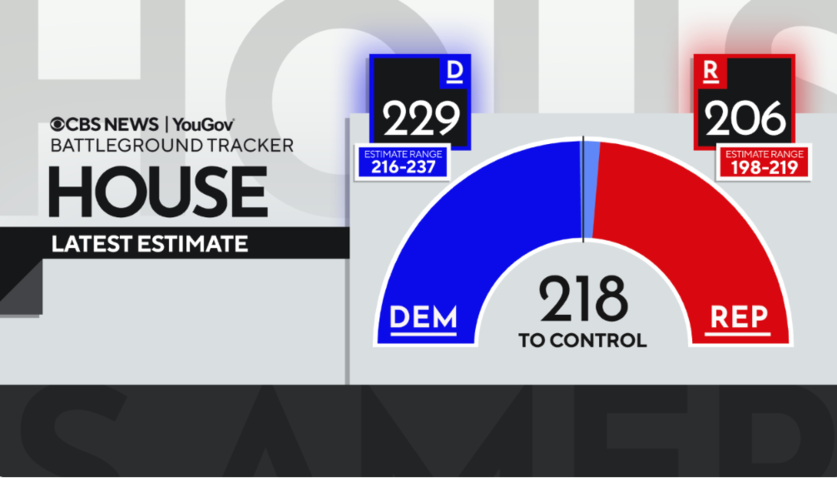
House control shapes the market’s next legislative risk calculation, via CBS News.
Campaigns should resist turning market expectations into a simple promise that one election result will raise or lower stock prices. Interest rates, inflation, corporate earnings, trade policy and geopolitical events usually exert more influence on broad market performance than congressional composition alone. Voters may nevertheless evaluate candidates through the local consequences of federal decisions, including energy prices, defense employment, technology investment and government spending.
Election Indicators Point Toward a Divided Government Test
National polling provides evidence of a difficult political environment for Republicans, but it does not determine control of Congress by itself. Ballotpedia’s polling index placed Democrats at 44.2% and Republicans at 42.6% on the generic congressional ballot at the end of September. That index averages surveys conducted during the previous 180 days, making it a polling average rather than a forecast of individual district outcomes.
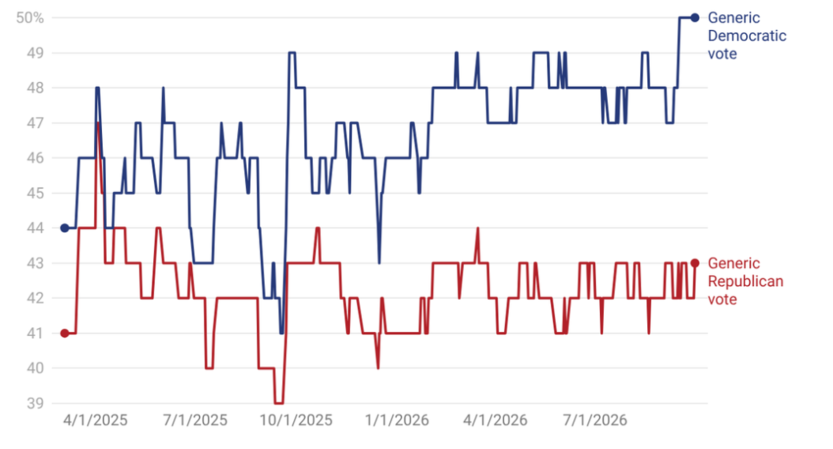
Democrats hold a national polling advantage entering the final month, via Ballotpedia.
House control depends on district level contests rather than the national vote alone. Geographic concentration, candidate quality, turnout and district boundaries can produce a congressional majority that differs from the overall popular vote. Campaigns and market analysts should therefore treat the generic ballot as evidence about the national environment, not as a direct seat projection.
A separate CBS News and YouGov statistical model estimated that Democrats retained an advantage in the contest for a narrow House majority as of October 4. CBS built that estimate from polling, previous election results, district characteristics, demographics and historical patterns. Its reported range reflects model uncertainty and can change as new information enters the calculation.
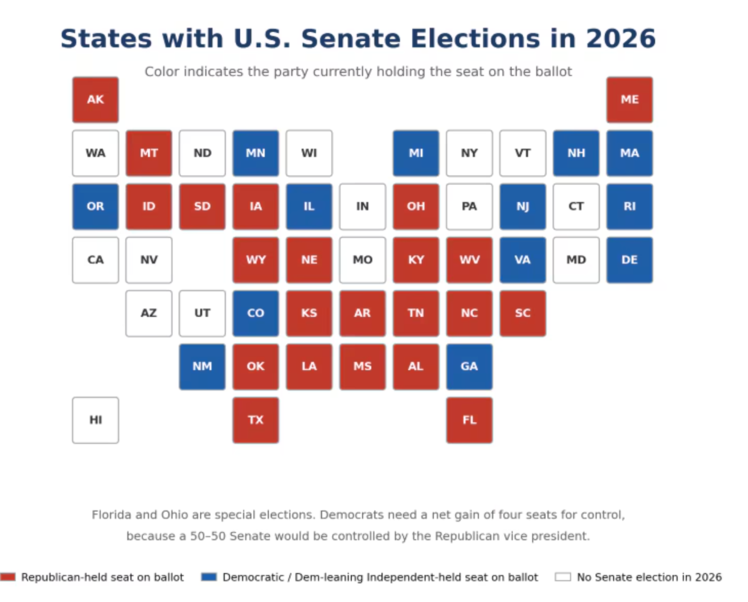
Senate control follows a different electoral map. Republicans began the cycle with 53 seats, while Democrats and aligned independents held 47. In a 53 to 47 Senate, Democrats must secure a net gain of seats to reach a majority; a 50 to 50 Senate would remain effectively Republican-controlled because Vice President JD Vance, the current officeholder, would break ties in favor of Republicans.
Those separate paths make split control plausible without making it certain. A Democratic House could block major Republican legislation and issue subpoenas, while a Republican Senate could preserve control over confirmations and prevent Democratic legislation from reaching the president. Markets would then face fewer opportunities for comprehensive new laws but more attention to investigations, appropriations and debt negotiations.
Campaigns should explain what divided government would change rather than describing gridlock as an abstract outcome. Voters working in regulated industries care about employment, investment and operating costs, not procedural control of congressional committees. Candidates who connect institutional control to those practical consequences will make a stronger argument than those promising that gridlock will automatically protect the economy.
Historical Returns Do Not Prove a Gridlock Premium
Historical market performance offers context, but it cannot establish that divided government produces higher returns. Charles Schwab calculated that the S&P 500 averaged a 1.7% return between August 1 and Election Day across midterm years since 1974. Returns then averaged 5.7% during the following 3 months and 12.4% during the following 6 months, but changes in inflation, interest rates, recessions and earnings also influenced those periods.
Election uncertainty matters, but economic conditions still drive market performance, via Charles Schwab.
Morgan Stanley Wealth Management found that the strongest average S&P 500 return following midterms under a Republican president occurred when Congress was divided between the parties. That average reached 23% during the following year. That figure should be treated as a warning rather than a forecast: high historical post-midterm returns are correlated with a small sample size, and macroeconomic indicators such as inflation, interest rates, earnings, employment and growth remain the primary drivers of market direction.
Reduced legislative activity can reassure investors when it lowers the probability of abrupt tax or regulatory changes. Divided control may prevent either party from enacting its full platform, narrowing the range of possible federal policy. Investors can value that predictability even when they disagree about the policies being blocked.
Gridlock can also transfer risk rather than eliminate it. Congress must still fund the government, address expiring programs and negotiate fiscal deadlines. Failure to reach agreements can produce shutdown threats, delayed contracts and uncertainty in Treasury markets.
Broader economic forces further weaken any claim that congressional division guarantees market gains. Morgan Stanley Research expects trade policy, geopolitics and executive regulation to remain important regardless of the result. Its analysis also found that equity markets have generally shown limited sustained reactions to midterm elections, while interest rate markets respond more directly to Federal Reserve policy.
Campaigns should therefore avoid presenting stock market history as proof that voters must select one party configuration. A defensible argument focuses on policy probabilities: divided government makes large legislative changes harder, increases the importance of executive action and raises the stakes surrounding measures that still require congressional approval. That distinction protects political messaging from promising a market outcome no candidate can control.
Sector Risks Continue Even Without Major New Laws
Divided government changes how political pressure reaches individual industries. Comprehensive legislation may become less likely, but congressional committees can still conduct hearings, demand records and direct public attention toward corporate conduct. Appropriations language, tax provisions and agency budgets can also change sector expectations without producing a landmark law.
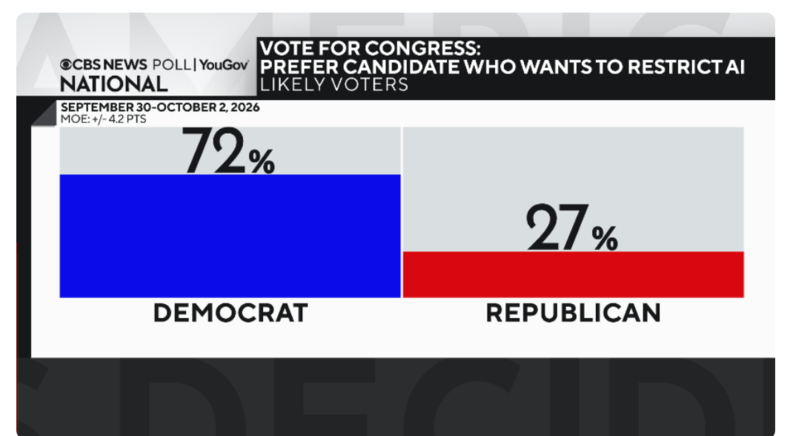
Voters favor candidates who would limit artificial intelligence development, via CBS News.
Technology companies face several distinct pressure points. Democratic control of the House could produce more aggressive hearings on artificial intelligence, data privacy, competition and data center energy consumption. Hearings do not carry the same legal force as enacted legislation, but they can affect public sentiment, regulatory attention and investor assumptions about future compliance costs.
Energy companies face a parallel political risk. High household electricity and gasoline costs give lawmakers a reason to investigate pricing, tax treatment and infrastructure investment. Democratic committees could intensify scrutiny of fossil fuel producers, while the Trump administration would retain substantial executive authority over permitting, leasing and federal regulation.
Defense companies respond more directly to appropriations and procurement decisions. Divided government would not necessarily reverse bipartisan support for national security spending, but it could change funding schedules, program priorities and oversight of individual contracts. Districts with military installations or defense manufacturing would experience those decisions as employment and regional investment questions.
Financial companies may benefit when Congress cannot enact a broad statutory overhaul, but the legislative result does not control every regulatory decision. Banking agencies and the executive branch retain authority over supervision and implementation within existing law. Senate control also matters because it shapes the confirmation process for regulators and senior administration officials.
Market analysis from Morgan Stanley identifies more potential effects at the sector level than across the entire economy. Its researchers expect congressional composition to matter through areas such as Medicaid, nutrition programs, defense spending and data center policy, while tariffs and export controls remain largely driven by the executive branch. That division of authority explains why the election can change specific investment assumptions without redirecting the full market.
Candidates in economically exposed districts should connect congressional control to a defined local result. A technology corridor may care about artificial intelligence rules and electricity capacity, while a defense community may focus on procurement certainty. Sector specific evidence gives voters a clearer choice than broad claims about whether markets prefer Republicans, Democrats or divided government.
Wrap Up
Midterm results will change the route through which Washington influences markets, but they will not determine market direction alone. A divided Congress would make sweeping legislation more difficult while increasing the importance of oversight, appropriations and fiscal negotiations. Investors would still respond primarily to earnings, inflation, interest rates, trade decisions and geopolitical developments.
Campaigns should treat market reaction as a consequence of policy expectations rather than a partisan scorecard. Technology, energy, defense and financial companies face different forms of exposure depending on committee control, agency authority and federal spending decisions. Voters need to know which of those consequences will reach their jobs, utility bills and regional economies.
Election indicators make divided government a credible scenario, not a settled outcome. Polling averages describe national voter preference, statistical models estimate seat ranges and historical returns describe what happened under earlier conditions. Candidates who preserve those distinctions can explain the economic stakes without turning uncertain market behavior into an unsupported campaign promise.