-Jun-09-2026-10-20-14-3968-PM.png)

Affordability is becoming the underlying force driving voter sentiment, cutting across partisan lines and complicating political strategy heading into November.
What to Know
- National consumer sentiment fell to a historic all-time low of 44.8 in May.
- Annual inflation hit 3.8% in April, representing the highest annual rate in three years.
- Over 57% of consumers cite high prices as actively eroding their personal finances.
- Executive net approval on cost-of-living management has dropped below negative 30% this term.
- Republican and independent sentiment fell to the lowest readings of the current administration.
Political coverage of the 2026 midterm landscape has fixated on President Trump's approval ratings, but a different signal is emerging from voter sentiment data. Cost of living pressure is the underlying force shaping the electorate, moving voters across party lines in ways traditional partisan loyalty cannot offset. EyesOver's June 3 Weekly Snapshot identifies economic pressure points as one of the top surging frames in public discussion, with inflation, fuel costs, and financial uncertainty tied directly to voter frustration.
Voter intelligence from the University of Michigan and Bureau of Labor Statistics reinforces this alarming picture. Both data sources show affordability concerns intensifying as congressional majorities struggle to defend their current legislative positions. For a political party that ran on widespread economic frustration in 2024, this same dynamic now cuts in the opposite direction.
How Deep the Sentiment Collapse Has Gone
Consumer sentiment has plummeted to 44.8 on the University of Michigan tracker, marking its third consecutive monthly decline and the lowest level since tracking began in 1952. This exceptionally low figure breaks the previous record low established just one month earlier. Survey results reveal that over 57% of consumers cited high prices as actively eroding their personal finances, climbing from 50% in April.

Joanne Hsu, Director of the Surveys of Consumers
Joanne Hsu, Director of the Surveys of Consumers, explained the record-breaking economic anxiety:
“Affordability and cost of living continue to be first-order concerns, with 57% of consumers spontaneously mentioning that high prices were eroding their personal finances, up from 50% last month.”
Year-ahead expected inflation climbed to 4.8% in May, and long-run expectations rose to 3.9%, compared to a 2.8% to 3.2% range across 2024. This increase reflects sizable jumps among independents and Republicans, with Republican long-run inflation expectations now more than double their February 2025 reading. Lower-income consumers and those without college degrees posted the steepest sentiment declines.
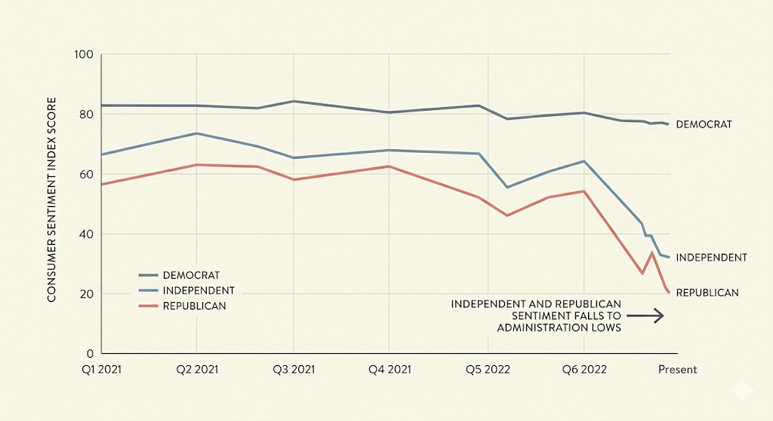
Campaign Now (Gemini), tracking historical consumer sentiment by party
Independents and Republicans both saw sentiment fall to the lowest readings of the current administration, while Democratic sentiment was little changed. This distribution carries strategic weight for political operators heading into November midterm contests. Sentiment collapse concentrated in the base suggests that economic pressure is hitting the exact coalition needed to defend congressional advantages.
What the Inflation Data Confirms
Recent macroeconomic data published by the Bureau of Labor Statistics confirms the harsh experience of American families. Consumer prices rose by 0.6% on a seasonally adjusted basis in April and 3.8% over the prior 12 months, representing the highest annual rate since May 2023. Prior to the late-February strikes on Iran, annual inflation had eased to 2.4%, meaning the headline rate jumped 1.4 points in roughly two months.

Erica Groshen, Senior Economics Advisor at Cornell University
Erica Groshen, Senior Economics Advisor at Cornell University and former Commissioner of the Bureau of Labor Statistics, explained the impact of public trust in economic reports:
“Statistical agencies live and die by trust, and if the numbers are not trustworthy, people will not use them to make important decisions, meaning you might as well not publish them.”
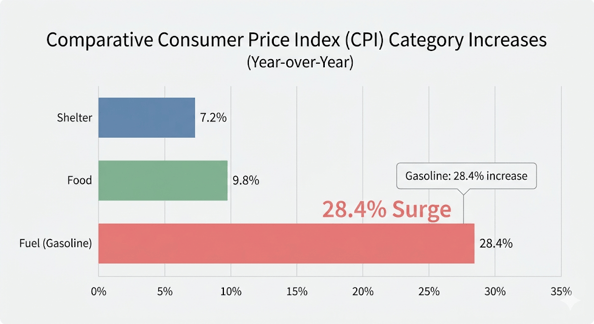
Campaign Now (Gemini), data from Bureau of Labor Statistics, tracking monthly consumer price changes
Energy prices rose 3.8% in April, accounting for over forty percent of the monthly increase. Gasoline climbed 28.4% over the prior 12 months, while shelter rose 0.6% and food at home prices increased 0.7%, the largest monthly gain since August 2022. Real average hourly wages slipped 0.5% monthly and fell 0.3% annually, ending a three-year stretch during which wages outpaced inflation.
How Approval and Affordability Are Now Linked
Presidential job approval ratings are heavily correlated with voter perceptions of daily cost-of-living management. Recent issue-specific tracking from Nate Silver's Silver Bulletin shows that executive popularity has fallen sharply as fuel costs squeeze households. As of early June, Trump's overall net approval sits at negative 18.7 points, rebounding slightly from a late-May low of negative 21.2 points.

Nate Silver, Bestselling Author and Publisher of the Silver Bulletin
Nate Silver, Bestselling Author and Publisher of the Silver Bulletin, highlighted the growing political risks for incumbents:
“Sustained weakness in presidential approval often feeds directly into legislative risk, tax uncertainty, and the market's reading of the midterm map.”
Issue-level tracking is even more challenging, as Trump's net approval on the economy recently dropped below negative 30 points. Net approval on inflation specifically sits at negative 17.5 points, while net approval on immigration has held closer to negative 10 points. This distinct split suggests that political damage is concentrated where rising prices are felt directly in daily life.
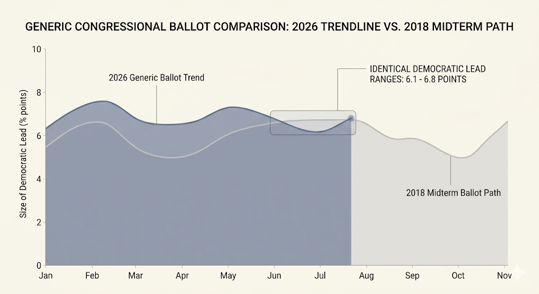
Campaign Now (Gemini), data from RealClearPolling, tracking generic ballot parallels
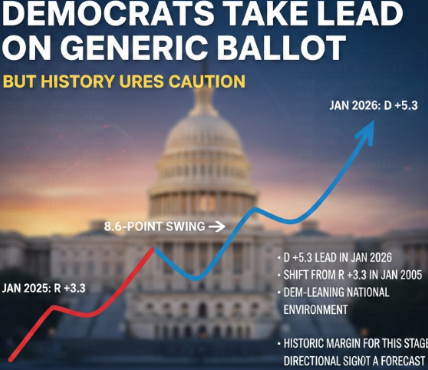
Congressional generic ballot data from RealClearPolling reinforces the deep-seated electoral implications of this public discontent. Democrats currently lead the generic ballot by 48.1% to 42.0%, representing a 6.1-point advantage. At this parallel point in the 2018 midterm cycle, the generic ballot was virtually identical at a 6.8-point Democratic lead, and Democrats picked up forty House seats that November.
Wrap Up
Political strategists face a fundamentally different electoral landscape than the one their 2024 coalition was designed to win. Economic frustration that fueled previous political victories is now hitting core voters directly, with sentiment among independent and Republican cohorts at administration lows. Historical parallels to previous midterm cycles add extreme urgency for congressional incumbents who must defend their records in November.
Retaining legislative majorities through approval rating defense alone will prove highly insufficient. Voter sentiment tracking points to daily affordability as the underlying political force, meaning that message discipline on fuel costs and household pressures matters more than any single popularity metric.
-Jun-13-2026-04-15-39-6417-PM.png)