
High-end voter modeling and micro-targeting are no longer exclusive to multi-million-dollar statewide campaigns - generative AI is making big-budget operations standard for local races.
What to Know
- Total political spending for the 2026 cycle is projected at $10.8B, with CTV receiving $2.5B (a 20% jump from 2022), allowing local candidates to execute high-impact digital buys on smaller budgets.
- Automated media platforms drop minimum spend thresholds to as low as $50, making localized programmatic advertising and micro-targeting accessible for local campaigns.
- AI-driven match engines achieve 50% to 70% voter file match rates on streaming and digital devices, enabling precise local voter contact operations.
- Up to 25% of political budgets are deployed during the final 10 days of a race; AI creative generation and automated platforms compress setup times from weeks to hours.
- CTV is set to command 23% of total political ad spend - conservative operations and Campaign Now clients adopting integrated AI tools can secure a strong competitive edge in local races.
Historically, local and state-level political campaigns faced a persistent structural constraint: sophisticated micro-targeting, continuous predictive voter modeling, and high-quality creative production were restricted to campaigns with multi-million-dollar war chests. Down-ballot races for state legislative seats, county commissions, and school boards relied heavily on broad door-knocking pushes and generic direct mail.
As detailed in industry analysis, political ad spending for the 2026 midterms is projected to reach $10.8B according to AdImpact, with digital channels, self-serve CTV, and programmatic automation driving rapid evolution. Lowering entry barriers through AI-driven platforms allows small-budget campaigns to run targeted operations previously limited to statewide races.
Generative AI Is Lowering the Barriers to Entry for Local Campaigns
The primary barrier for down-ballot campaigns has rarely been a lack of strategy; it has been the high overhead of professional implementation. Retaining specialized data strategists, copywriters, and video production teams often consumed the majority of a local candidate's budget before a single ad aired.
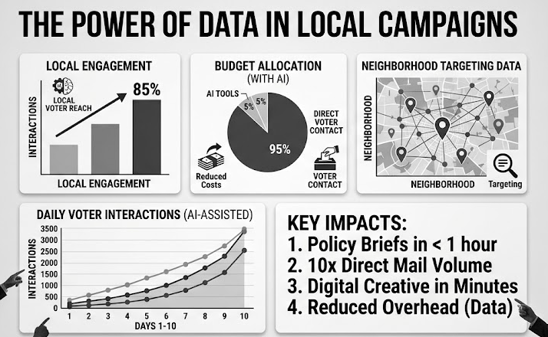
Generative AI platforms eliminate much of this setup friction. Campaign teams can now draft policy briefs, write localized direct mail pieces, and generate tailored digital creative in minutes rather than days.
According to campaign advertising research from Adwave, self-serve platforms allow campaigns to launch targeted Connected TV (CTV) and digital campaigns with minimum spends as low as $50, bypassing traditional high agency minimums. This shift democratizes access to sophisticated tools, enabling down-ballot candidates to allocate more capital directly to voter contact.
Voter Modeling and Micro-Targeting at Scale on Smaller Budgets
Mass outreach is yielding to granular precision. With access to voter files integrated into modern DSPs and AI platforms, such as integrations with L2, Aristotle, and i360, down-ballot operations can model voter universes with high accuracy.
- Household-Level Precision: School board and state legislative candidates can isolate specific precincts, zip codes, or custom geographic boundaries to avoid wasted ad spend outside their district lines.
- Dynamic Voter Modeling: AI tools continuously process voter responses and behavioral signals, updating target lists in real time to focus efforts on key swing voters.
- Omnichannel Matching: Modern platforms match voter files directly to streaming device IDs and digital profiles, boasting 50% to 70% match rates for local voter contact.
Automated Phone Scripts and Digital Ad Creative
The operational core of voter persuasion is turning dynamic. Traditional phone banking relied on static scripts that ignored voter preferences. Today, AI-driven conversational frameworks allow campaigns to quickly adjust phone scripts and text-messaging responses based on specific issues, such as local tax rates, school choice, or public safety.
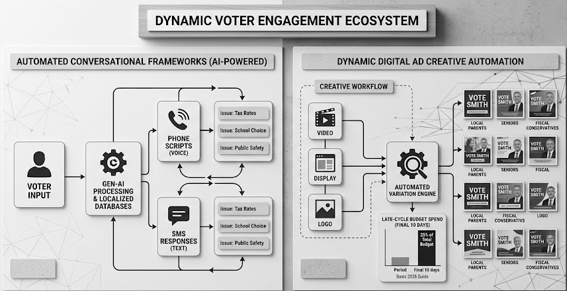
On the digital front, dynamic ad creative automation lets local campaigns generate variations of video and display assets designed for different audience segments. As noted in the 2026 Political Advertising Guide from Basis, rapid activation and automated creative workflows are critical during late-cycle pushes, where 25% of total budget is spent in the final 10 days, allowing teams to react instantly to local breaking news or opponent attacks.
Shift in Down-Ballot Competitiveness
This technological shift alters down-ballot dynamics. Previously, incumbent candidates maintained a strong advantage through name recognition and traditional donor networks. AI-powered automation balances the field by allowing challengers to execute professional outreach on modest budgets.
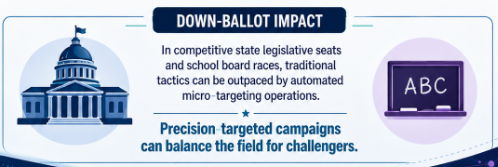
In competitive state legislative seats and school board races, candidates using traditional broadcast-style tactics risk being outpaced by opponents deploying automated, multi-touch micro-targeting campaigns. Precision-targeted operations ensure every dollar spent reaches an intended, persuadable voter.
Wrap Up
To capture market share and lead in 2026, conservative campaigns must abandon legacy vendor models and integrate automated, AI-driven data platforms directly into their core strategy. Winning operations will seamlessly unite voter files across CTV, programmatic audio, and SMS, replacing static voter lists with real-time, dynamic modeling that adapts to ongoing voter interactions. Paired with automated creative tools that generate digital ads in hours rather than days, campaigns can outpace tech-enabled opponents while maintaining maximum financial efficiency.
By drastically lowering production overhead and democratizing sophisticated predictive modeling, AI automation enables local candidates to execute data-driven campaigns on par with statewide operations. For Campaign Now clients, embedding these automated workflows into day-to-day operations maximizes return on investment, ensures high-impact voter contact, and secures decisive victories in key down-ballot races.
.png)
.png)