
Adam Hamilton’s strength with Kansas independents has narrowed Roger Marshall’s advantage, making a long Republican Senate streak vulnerable.
What to Know
- A September survey placed Adam Hamilton ahead of Senator Roger Marshall by 45% to 43%, a narrow result within the poll’s uncertainty range.
- Hamilton led among independent likely voters by 42% to 27%, giving him an opening in a Republican-leaning state.
- Marshall’s 41% favorable rating trailed his 48% unfavorable rating, complicating his argument for another term.
- Nearly half of Kansas likely voters named the economy as their top issue, putting household and farm costs at the center of the contest.
- A Hamilton victory would give Kansas its first Democratic U.S. senator elected since 1932.
Kansas rarely offers Democrats a plausible path to the U.S. Senate. Republican Senator Roger Marshall is nevertheless facing a competitive challenge from Adam Hamilton, a Methodist pastor whose appeal to independents has narrowed a race that might otherwise have followed the state’s familiar partisan pattern.

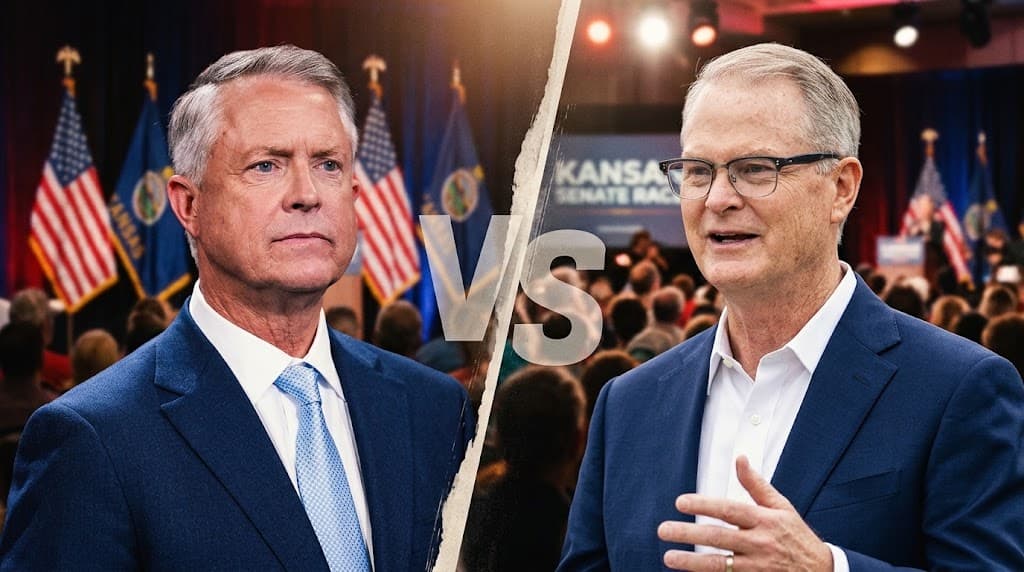
Adam Hamilton campaigns in western Kansas as the Senate race tightens, via Reuters.
An Emerson College Polling and Nexstar Media survey conducted on September 15 and 16 placed Hamilton at 45% and Marshall at 43% among 750 likely voters. Its 3.6-point credibility interval makes the 2-point lead too small to establish who is ahead. Reporting from Kansas has continued to describe the contest as close, but no single survey can determine whether voters will break with nearly a century of Senate voting history.
Independents Give Hamilton a Path
Hamilton’s strongest opening in the Emerson survey came from voters identifying as independents. They favored him over Marshall by 42% to 27%, a 15-point margin. That subgroup result deserves caution because its sample is smaller than the full survey, but it helps explain how a Democrat could compete in a state that President Donald Trump carried comfortably in 2024.
Independent voters did not simply favor Democrats across the ballot. In the same survey, they preferred Republican gubernatorial candidate Ty Masterson over Democrat Cindy Holscher by 47% to 45%. The contrast suggests that candidate perceptions matter in Kansas, although polling on separate races cannot establish how every individual will mark both choices in November.
Libertarian David Graham received 4% in the Senate matchup, while 8% of likely voters said they were undecided. Emerson reported that Graham’s supporters heavily favored Masterson in the governor’s contest. That pattern suggests Marshall has potential votes to recover on his right, but it does not prove those voters would choose him in a two-candidate Senate race.
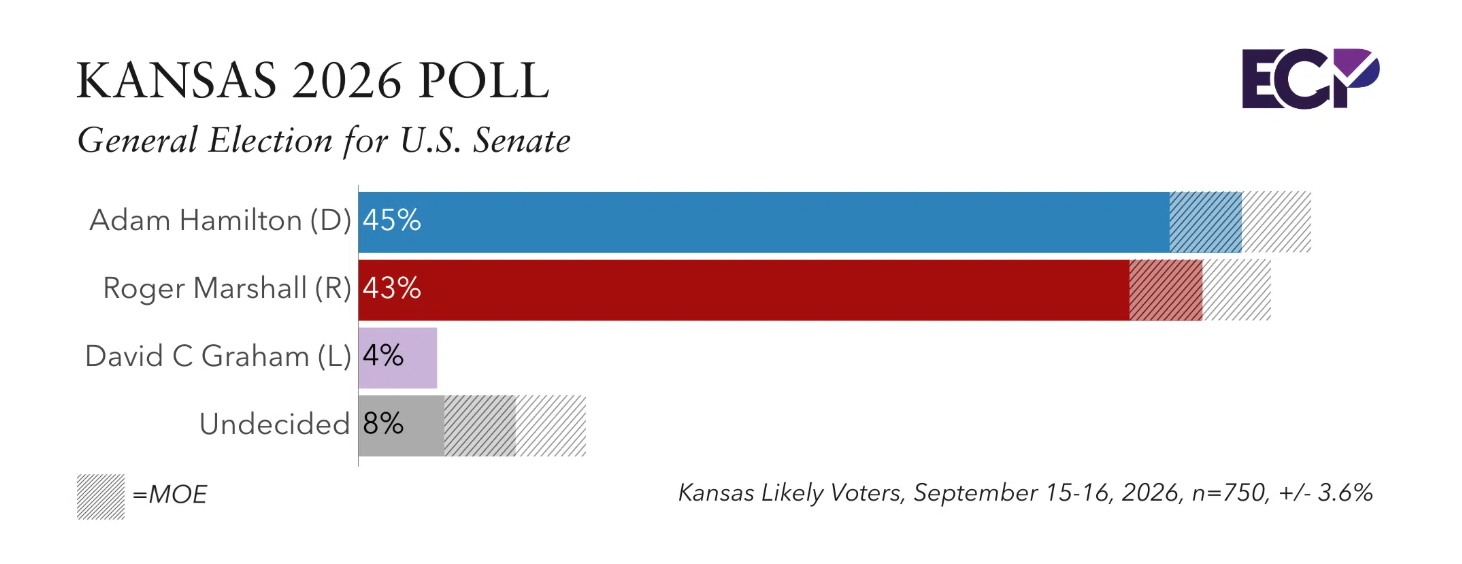
The Senate matchup shows a narrow Hamilton lead, via Emerson College Polling.
Marshall’s task is to consolidate Republicans without treating independents as an afterthought. Hamilton must retain voters willing to cross party lines while giving Democrats a reason to participate. A close topline depends on both parts of that coalition holding through Election Day.
Candidate Ratings Complicate Marshall’s Defense
Marshall’s standing with likely voters helps explain why incumbency has not settled the race. Emerson found 41% viewed him favorably and 48% unfavorably, a 7-point negative net rating. Hamilton also had a 41% favorable rating, but only 30% viewed him unfavorably; another 16% were neutral and 13% had not heard of him.
That difference offers Hamilton room to introduce himself, not proof that undecided voters will eventually support him. Marshall remains a known incumbent with an established Republican base. Hamilton’s lower unfavorable rating could narrow that advantage if his campaign persuades voters who are still forming an opinion.
National politics adds pressure without fully explaining the contest. In Emerson’s Kansas survey, Trump’s job performance drew 40% approval and 53% disapproval. Democratic Governor Laura Kelly registered 46% approval and 39% disapproval, a reminder that Kansas voters can evaluate state and federal officeholders differently.

Kansas voters rate state and national leadership differently, via Emerson College Polling.
Marshall has sought to connect Hamilton to national Democrats, while Hamilton has presented himself as a more independent-minded alternative. Neither message can rely on party identification alone. Voters’ mixed assessments of prominent officeholders make personal credibility and issue-specific arguments especially important.
Economic Pressure Gives the Race Local Stakes
Economic concerns offer both candidates a way to reach beyond partisan identity. The Emerson survey found 48% of Kansas likely voters naming the economy as their top issue, far ahead of healthcare at 14%. For agricultural communities, that broad category includes the price of diesel, fertilizer and other inputs that determine whether a harvest remains profitable.
Reuters reporting from western Kansas described farmers facing steep fuel and fertilizer costs. Those accounts make the campaign’s economic argument more concrete than a general promise to lower prices. Marshall must show how his record and proposals would ease those pressures, while Hamilton must show how a first-term senator could deliver relief.
Immigration policy also intersects with the local economy. Reuters reported that federal raids in southwest Kansas meatpacking communities disrupted operations as some workers stayed home. The effects give both campaigns a practical question to answer: how should enforcement operate in places where processing plants and surrounding businesses depend on a stable workforce?
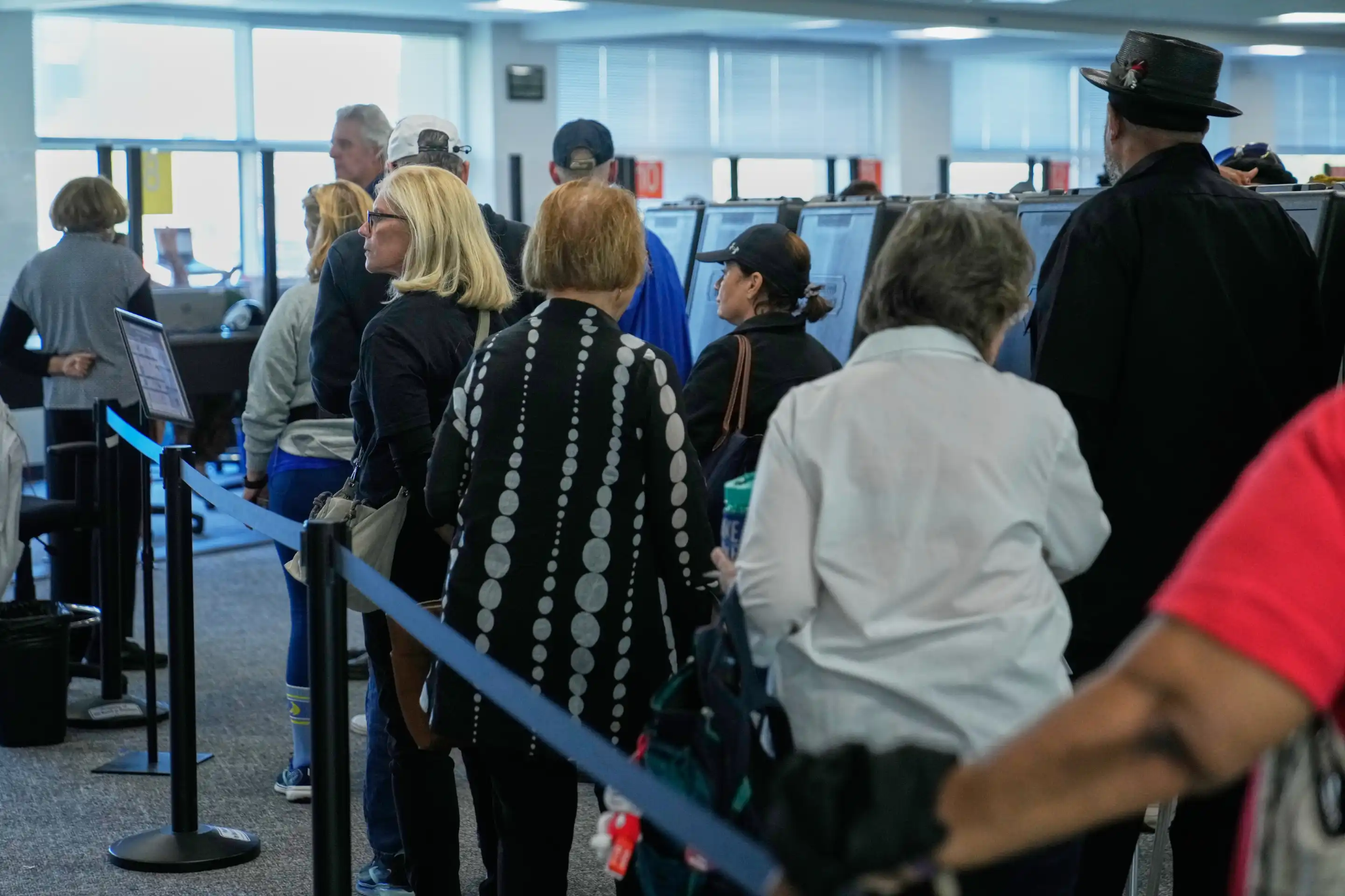
Early participation rises as Kansas voters weigh a competitive contest, via Associated Press.
Higher early participation cannot identify a partisan beneficiary on its own. Voters can turn out because they support an incumbent, want a change or feel strongly about another race on the ballot. Campaigns still have to convert attention into votes, particularly among independents whose preferences have made the Senate contest unexpectedly close.
Wrap Up
Kansas last elected a Democrat to the U.S. Senate in 1932, when George McGill won another term. He lost his reelection bid in 1938, and the state has sent only Republicans to the chamber since his service ended. A Hamilton victory would therefore be historically significant, but Kansas’s Senate history is a measure of the obstacle he faces, not evidence that he will clear it.
Hamilton’s path runs through independent support, a favorable first impression and an economic case that reaches Republican-leaning communities. Marshall’s path depends on bringing wavering conservatives back into his coalition while improving his position with voters who already know him. Graham’s presence and the undecided share leave both campaigns work to do.
One verified September poll showed a close race, not a certain Democratic lead or a final outcome. Later reporting on the contest confirms that Republicans are treating the seat as competitive, yet Kansas remains a difficult state for Democrats to win. Whether this contest becomes a historic upset will depend on which candidate turns a narrow polling opening into a durable Election Day coalition.