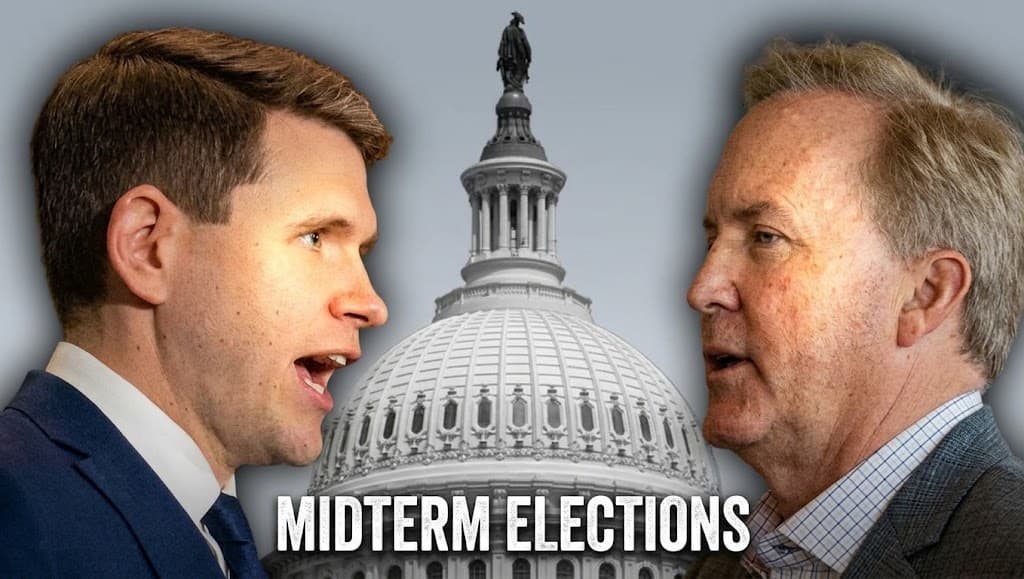

Talarico’s Hispanic advantage gives Democrats an opening, but affordability, immigration and turnout will determine whether that movement lasts.
What to Know
- James Talarico received 56% support from Texas Hispanic voters against Ken Paxton’s 37%.
- A later survey placed Talarico ahead among Latino likely voters by 54% to 41%.
- In a Hart Research survey, 65% of Latino registered voters disapproved of Trump’s handling of prices and the cost of living.
- Approximately one-third of Latino Trump voters reported second thoughts about their 2024 choice: 14% expressed some doubts, 7% reported serious doubts and 12% said they regretted their vote.
- Talarico spent approximately $2.6 million on Spanish language advertising through September.
Texas Republicans entered 2026 hoping Donald Trump’s gains with Hispanic voters would become a durable political realignment. Current polling instead shows Democratic Senate nominee James Talarico rebuilding an advantage among those voters against Republican nominee and Texas Attorney General Ken Paxton. Movement across several individual surveys has transformed the open Senate contest from a Republican defense into a genuinely competitive statewide race.
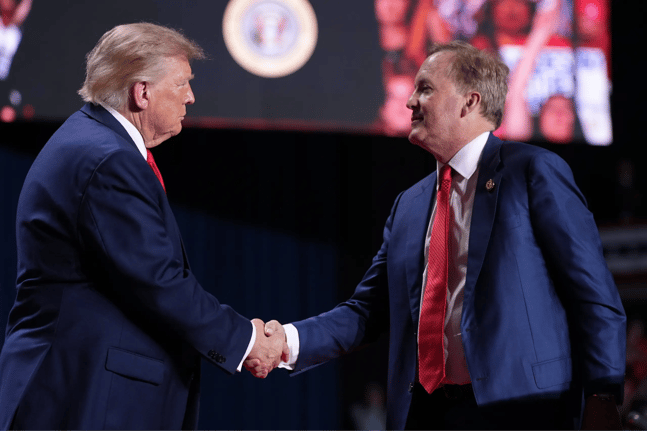
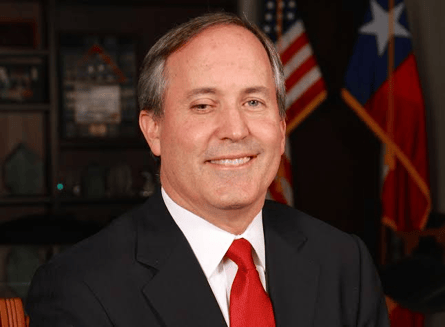
Donald Trump greets Ken Paxton during a Texas campaign event, via Click2Houston.
No single poll proves that Hispanic Texans have permanently returned to the Democratic coalition. An N+ Univision and YouGov survey found substantial Democratic movement, while later polling from the University of Texas showed a similar but somewhat narrower advantage. Together, the surveys describe a persuadable electorate responding to living costs, immigration enforcement, candidate reputation and campaign attention rather than returning automatically to an old partisan identity.
A Hispanic Advantage Is Reshaping the Senate Contest
Talarico’s largest Hispanic advantage appeared in the N+ Univision survey conducted from August 27 through September 4. Hispanic registered voters supported him by 56% to 37%, creating a 19 point margin over Paxton. Statewide registered voters favored Talarico over Paxton by 48% to 43% in the N+ Univision/YouGov survey.

Survey design matters when interpreting that result. YouGov interviewed 1,000 registered voters and included an oversample of 564 Hispanic registered voters, with an equivalent margin of error of 5 percentage points for the Hispanic sample. That larger uncertainty means the exact margin should not be treated as a fixed prediction, but the direction of the advantage is difficult to dismiss.
Later evidence suggests that the movement has persisted. An October University of Texas and Texas Politics Project survey found Talarico leading Paxton by 54% to 41% among Latino likely voters. Emerson College had previously measured a 19 point Talarico advantage among Hispanic voters, even as its statewide result placed Paxton ahead by 47% to 46%.
Those are separate individual polls using different samples and field dates. They should not be combined into an informal average. Their agreement nevertheless shows that Talarico’s Hispanic strength is not limited to one survey.
Movement Reflects Reconsideration Rather Than Permanent Loyalty
Republican advances in 2024 were real. Trump expanded his Hispanic support nationally and carried Hidalgo and Cameron counties, two anchors of the Rio Grande Valley with long Democratic histories. Treating those gains as permanent, however, underestimated how quickly issue conditions and candidate choices could change.
N+ Univision found that approximately 33% of Latino Trump voters expressed some degree of doubt, uncertainty or regret about their 2024 vote. Another 64% felt good about their decision and said they would make the same choice again. Republican support therefore retains a substantial base, but the coalition contains enough uncertainty to affect a close statewide contest.
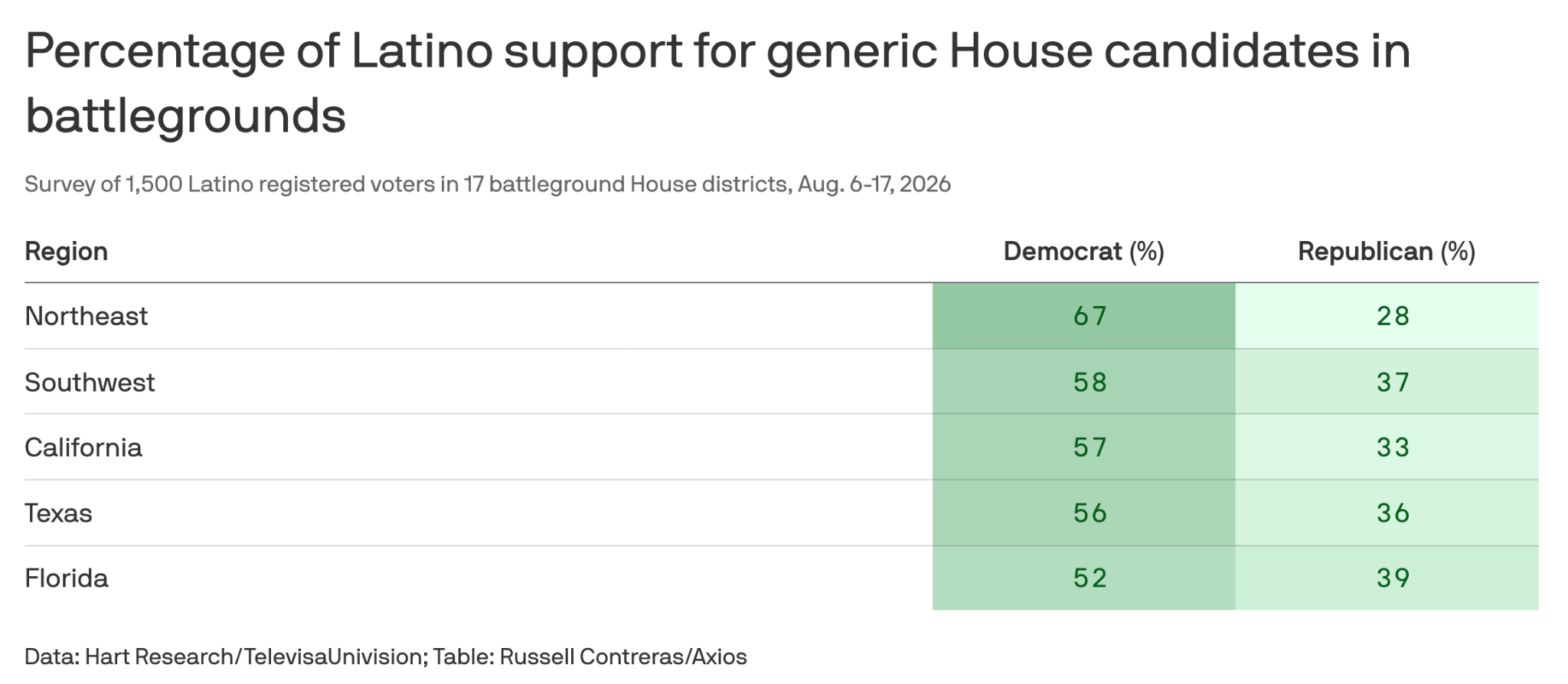
Latino voters across battleground regions are moving toward Democratic candidates, via Axios.
Comparable movement appears beyond the Texas Senate matchup. A Hart Research and TelevisaUnivision survey of Latino voters in 17 competitive House districts found Democrats leading the generic congressional ballot by 58% to 35%. Within three Texas battleground districts, respondents’ recalled 2024 presidential vote was evenly divided at 44% to 44%, while their 2026 congressional preference favored Democrats by 56% to 36%.
Such movement does not establish a lasting Democratic realignment. Hispanic voters remain divided by age, gender, geography, language preference and economic position. Candidate performance will depend on whether either party addresses those differences instead of treating Hispanic Texans as a single ideological bloc.
Affordability Leads the Reversal
Economic pressure provides the clearest explanation for the shift. N+ Univision found that 70% of Hispanic voters disapproved of Trump’s handling of both living costs and gasoline prices. Inflation ranked as a major national concern for 53% of Hispanic respondents, while jobs and the economy followed at 46%.
Cost pressures also dominate the wider Texas electorate. Economic anxiety extended across household expenses, but the available University of Texas polling did not provide a verified breakdown matching those four percentages. In the October University of Texas/Texas Politics Project survey, 24% of Texas voters said the state economy was better than one year earlier, while 48% said it was worse.
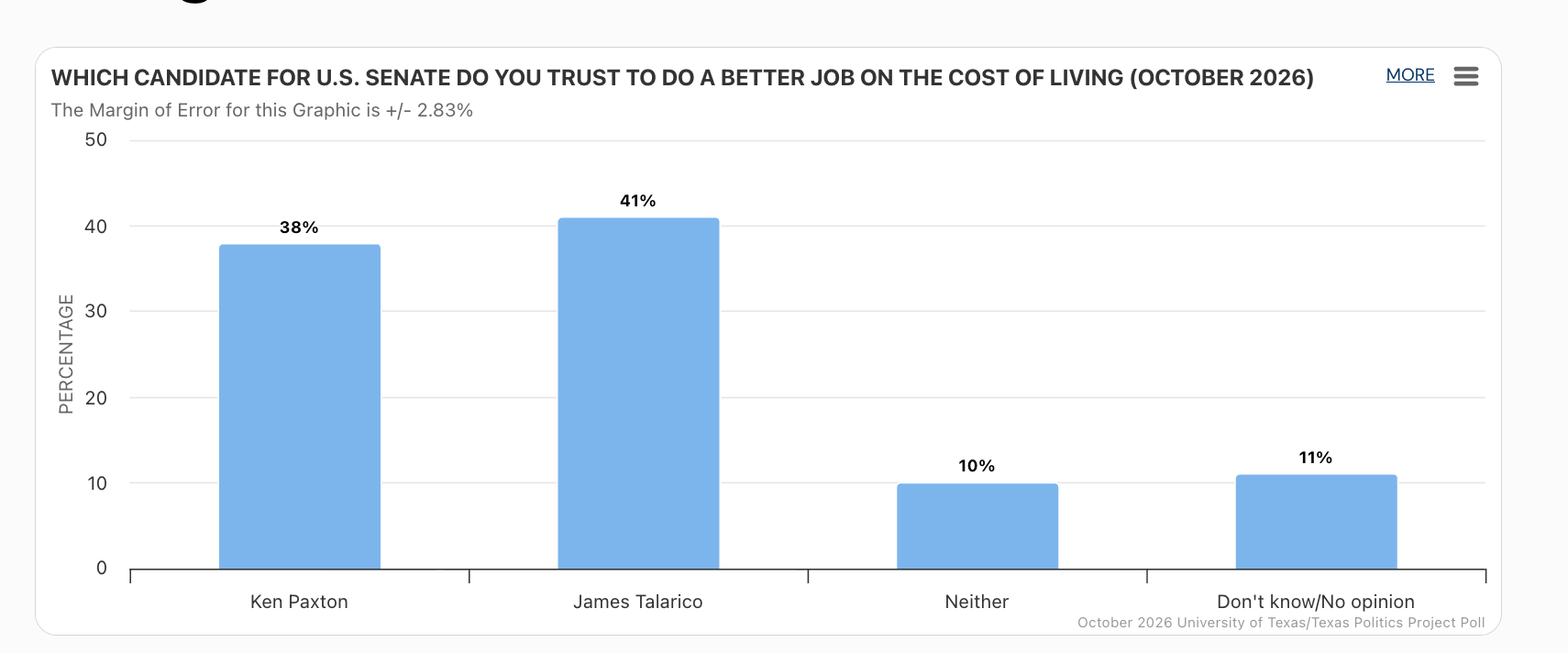
Cost pressures now shape candidate trust across the Texas electorate, via Texas Politics Project.
Talarico held only a modest statewide advantage on handling living costs in that October survey. Voters trusted him over Paxton by 41% to 38%, while 21% selected neither candidate or expressed no opinion. Economic dissatisfaction creates an opening for Democrats, but that trust gap remains too narrow to guarantee victory.
Immigration still matters, particularly along the border, but it no longer operates independently from economic experience. N+ Univision found 58% of Hispanic voters supporting an approach that combined border security with a path to citizenship, compared with 34% prioritizing border security alone. Talarico must therefore acknowledge public demand for an orderly border while connecting enforcement choices to jobs, family security and local economic conditions.
Local Presence Must Convert Movement Into Turnout
Polling movement has value only if campaigns translate it into votes. Hispanic turnout has varied across Texas elections, and statewide Democratic candidates cannot rely on favorable subgroup percentages without sustained field operations. South Texas, San Antonio, Houston and the Interstate 35 corridor require distinct messages, media plans and turnout programs.
Talarico has invested more heavily in Spanish-language communication. A Texas Tribune analysis reported that, as of October 2, Democratic groups supporting Talarico had reserved approximately $2.6 million in Spanish-language advertising, compared with $4.2 million from Paxton-aligned groups. However, the Republican investment represented only about 2% of the nearly $188 million those groups had reserved across all advertising, while Spanish-language placements accounted for a larger share of the Democratic side’s overall spending.
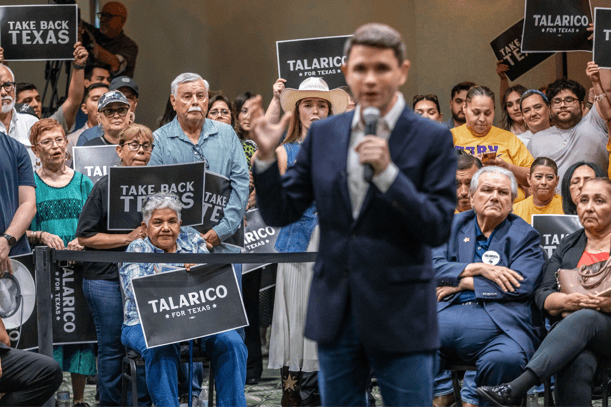
South Texas outreach turns statewide polling movement into local persuasion, via Texas Tribune.
Language alone does not create trust. Talarico has combined Spanish advertising with visits to Eagle Pass, Del Rio, Laredo and the Rio Grande Valley, emphasizing affordability, healthcare and border management. Paxton has answered with his record challenging federal immigration policies, promises of lower taxes and appeals to socially conservative voters.
Each strategy contains risk. Talarico could lose persuadable voters if national Democratic language appears disconnected from border conditions. Paxton could surrender ground if his campaign assumes Trump’s 2024 gains will transfer automatically to a different candidate under different economic conditions.
Wrap Up
Texas Hispanic voters are not simply reversing their 2024 choices. Polling shows a bloc reevaluating candidates as living costs remain high, immigration enforcement becomes more personal and campaign attention changes. Talarico’s advantage is significant because it appears across multiple individual surveys, but every measured margin still represents opinion before votes are counted.
Democrats now have an opening that did not exist when Republicans believed their Hispanic gains had become permanent. Converting that opening requires more than opposition to Trump or Paxton. Talarico must demonstrate that his economic and border proposals address the daily experiences of voters throughout South Texas and the state’s major metropolitan regions.
Republicans still possess strong statewide infrastructure, a durable conservative base and decades of electoral advantage. Paxton’s task is to rebuild enough Hispanic support without assuming party identity will complete the job. Texas is not undergoing a settled realignment; it is experiencing a competitive test of which campaign understands its changing electorate first.