


Paxton’s weak standing with crossover Republicans gives Talarico an opening, but Texas history still demands exceptional Democratic turnout.
What to Know
- A 51% to 49% likely voter result places Talarico’s lead inside the survey’s 3 percentage point margin of error.
- A separate registered voter survey gives Talarico a 6 percentage point advantage and 55% support among independents.
- Approximately 20% of likely voters who supported John Cornyn in the Republican primary now back Talarico.
- Talarico holds an 8 point net positive favorability rating while Paxton stands 18 points underwater.
- Cost of living ranks as extremely important to 68% of likely voters and divides candidate support along financial lines.
Texas no longer looks like a routine Republican Senate defense. A Fox News survey conducted from September 24 through September 28, 2026, placed Democratic state Representative James Talarico at 51% and Republican Attorney General Ken Paxton at 49% among 881 likely voters. That result falls inside the survey’s 3 percentage point margin of error, making the poll evidence of a competitive race rather than proof of a settled Talarico lead.
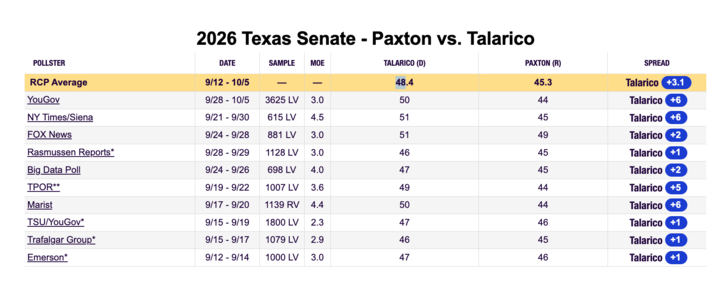
Talarico leads Paxton across recent Texas Senate polls.via realclearpolling
Another statewide survey from Marist found Talarico leading 50% to 44% among 1,139 registered voters interviewed from September 17 through September 20. Its 4.4 percentage point margin of error also requires caution, but the direction matches a broader pattern. A RealClearPolling average covering surveys completed through October 5 placed Talarico at 48.4% and Paxton at 45.3%, giving the Democrat an average advantage of 3.1 percentage points.
Crossover Support Makes a Republican State Competitive
Talarico’s opening depends on attracting voters beyond the Democratic base. Fox found that he received 10% of Republican support among likely voters, while Paxton captured only 1% of Democrats. That imbalance matters in a state where Republicans still possess the stronger recent electoral history.

James Talarico, Democratic Senate nominee and Texas state representative, via texastribune.
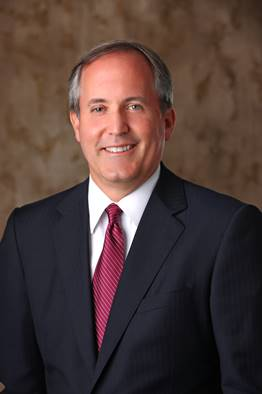
Ken Paxton, Republican Senate nominee and Texas attorney general, via Office of the Texas Attorney General.
Republican divisions become clearer inside the Fox survey. Talarico received 22% among Republicans who did not identify with the MAGA movement, compared with 4% among MAGA Republicans. Approximately 20% of likely voters who supported incumbent Senator John Cornyn during the Republican primary also said they planned to vote for Talarico.

Republican crossover support gives Talarico his narrow statewide opening, via Fox News.
Those subgroup findings carry larger margins of error than the statewide result, so campaigns should treat them as warning signals rather than precise population estimates. They nevertheless identify Paxton’s most immediate political problem. Republican voters do not need to become Democrats for a meaningful number of defections to damage him in a close race.
Talarico also led among Black voters by 79% to 21%, Hispanic voters by 64% to 35%, moderates by 65% to 34%, and voters younger than 35 by 62% to 38% in the Fox survey. Paxton countered with 74% support among White evangelical Christians, 65% among White men without college degrees, and 57% among rural voters. Each campaign has a recognizable base, but only Talarico currently shows the stronger evidence of crossover growth.
Texas history still places the larger burden on the Democrat. Voters last elected a Democratic United States senator in 1988, and no Democrat has won any statewide Texas office since 1994. Talarico must therefore convert unusual polling strength into turnout across urban centers, diverse suburbs, and communities that have repeatedly fallen short of breaking Republican control.
Paxton’s Image Problem Narrows His Persuasion Ceiling
Candidate reputation separates this contest from an ordinary partisan race. Fox measured Talarico at 52% favorable and 44% unfavorable among likely voters, producing an 8 point net positive rating. Paxton received a 40% favorable and 58% unfavorable rating, leaving him 18 points underwater.
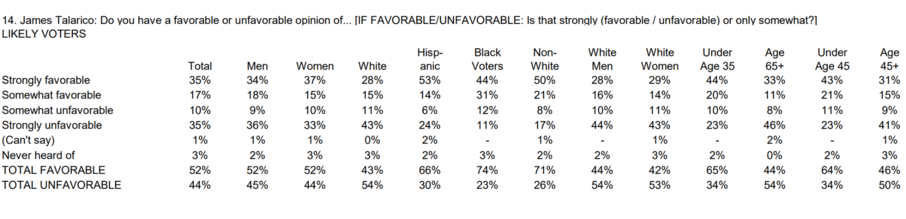
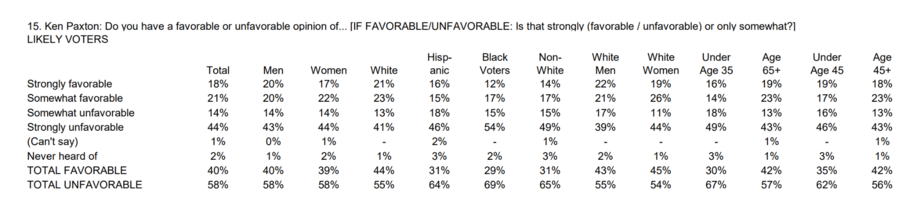
Candidate favorability exposes Paxton’s deeper persuasion problem among Texas voters, via Fox News.
Republican opinion explains part of that gap. Fox found 32% of Republicans viewed Paxton unfavorably, while only 5% of Democrats held an unfavorable view of Talarico. Paxton still retained 90% of Republicans in the direct matchup, but his negative standing creates more potential defectors and reluctant supporters than Talarico faces within his party.
Talarico cannot treat favorable personal ratings as permanent protection. Republican groups have committed substantial resources to defining him as too liberal for Texas, and 53% of likely voters told Fox they were concerned about his ideology. His campaign must preserve his appeal among moderates and dissatisfied Republicans without weakening enthusiasm among Democrats.
Paxton faces the opposite task. He must consolidate Republicans who preferred Cornyn while maintaining the support of voters closely aligned with President Donald Trump. Reuters reported that Trump made repeated campaign visits to Texas as Republicans tried to stabilize Paxton and other candidates in unexpectedly competitive races.
National attention confirms the strategic cost of Paxton’s weakness. A Texas seat that Republicans once expected to defend comfortably now demands presidential appearances, major advertising commitments, and time that could otherwise support candidates elsewhere. Even a narrow Paxton victory would force Republicans to spend defensively in a state that normally supplies resources to other battlegrounds.
Household Costs Turn Personal Finances Into Vote Choice
Economic pressure gives the Senate race its strongest issue based divide. Fox found 68% of likely voters considered cost of living extremely important to their decision, while another 24% called it very important. Combined concern reached 92%, placing affordability at the center of both campaigns’ persuasion efforts.
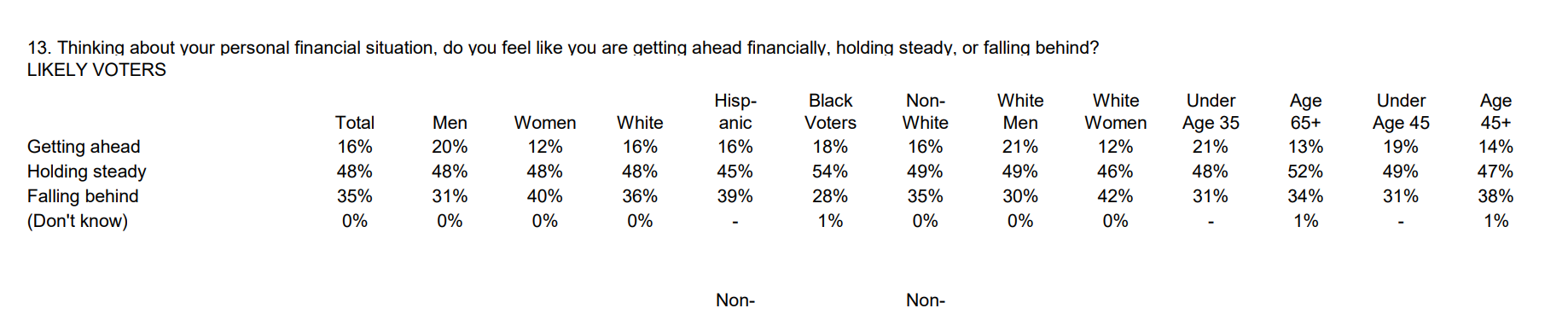
Household financial strain reshapes candidate support across the Texas electorate, via Fox News.
Only 16% of likely voters said they were getting ahead financially, while 35% reported falling behind and 48% said they were holding steady. Voters who felt they were falling behind favored Talarico by 32 percentage points. Those getting ahead supported Paxton by 48 points, while financially stable voters favored him by only 3 points.
Those divisions give Talarico a result oriented economic argument. He can connect household dissatisfaction to Republican control without depending entirely on Paxton’s personal controversies. Fox found Talarico leading by 19 points among voters who considered cost of living extremely important, while Paxton led by 20 points among voters most focused on immigration.
President Trump’s standing adds another layer to that economic divide. Marist measured his Texas approval at 43%, with 55% disapproving. Fox produced a similar 44% to 55% result and found that 51% of likely voters worried Paxton was too closely aligned with the president.
Paxton therefore needs more than Republican identification to erase Talarico’s advantage. His campaign must persuade financially strained voters that Republican control will improve their household position while keeping immigration focused voters engaged. Talarico must convert dissatisfaction into a specific economic choice without assuming opposition to Trump will automatically produce Democratic turnout.
Wrap Up
Texas has become competitive because several disadvantages now reinforce one another for Paxton. His negative personal rating creates room for Republican defections, while household frustration weakens the party’s usual economic advantage. Talarico has used those pressures to build narrow leads across several recent surveys.
Polling does not make Texas a Democratic state. Fox’s likely voter result remains inside the margin of error, and decades of Republican statewide victories demonstrate the turnout advantage Talarico must overcome. His support among independents and disaffected Republicans must survive both late advertising and Election Day participation.
Paxton’s immediate challenge is coalition repair. Talarico’s challenge is converting an unusual opening into an electorate that looks different from recent Texas elections. Whoever closes that gap will determine whether this race becomes a historic realignment or another close Democratic loss.
-Aug-31-2026-01-05-26-0671-PM.jpg)
-Sep-11-2026-07-48-51-8837-AM.jpg)