-Aug-31-2026-01-05-26-0671-PM.jpg)

Texas becoming plausible matters less as forecast than as evidence that the Senate battlefield has crossed old boundaries.
What to Know
- Texas carries a Toss Up rating despite a R+6 Republican voting history.
- One statewide survey gives James Talarico a 3 point lead over Ken Paxton.
- A 7 point gap separates that Senate contest from the same survey’s generic congressional ballot.
- Voters under 50 favor Talarico by 15 points in one statewide survey.
- Federal filings show a $59.3 million fundraising difference between the nominees through June 30, 2026.
Texas has not suddenly become a Democratic state. Republican candidates still hold advantages across several statewide contests, and the Cook Political Report assigns the state a R+6 voting history. Yet Cook moved the open Senate contest from Lean Republican to Toss Up on August 20, 2026. That combination creates the real warning: competitiveness has arrived before realignment.
Silver Bulletin identified Texas as the individual race most likely to become the Senate tipping point in its simulations, appearing in 13% of modeled outcomes. That does not mean Texas will flip or that a Democratic victory is more likely than a Republican one. It means enough paths to Senate control now run through Texas that campaigns can no longer treat it as background territory.
Texas Became Too Competitive to Ignore
Several signals now point toward the same conclusion. James Talarico, the Democratic nominee, has appeared competitive against Republican nominee Ken Paxton in repeated public polling. Independent handicappers then moved the contest, with Cook rating it Toss Up and Sabato’s Crystal Ball making the same change on August 26, 2026.
Campaigns should respond to that change immediately. Expand the field map, test messages across the state and reserve the target flight window before national money becomes more expensive. Waiting for a confirmed Democratic lead would surrender the advantage of early organization.
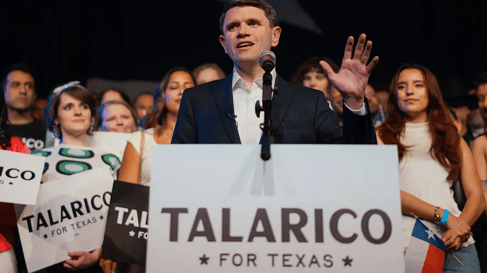
James Talarico, Democratic nominee for United States Senate.

Ken Paxton, Republican nominee for United States Senate.
The Washington Post reports that no Democrat has won a Texas Senate election since 1988. Texas Tribune results show that the Republican presidential ticket carried Texas by 13.68 points in 2024. A Toss Up rating against that record does not prove permanent partisan change. It shows that this Senate contest is operating outside the boundaries established by recent statewide results.

Screenshot of Texas Senate 2026 race rating from the Cook Political Report.
A rating change also attracts attention. More surveys appear, more local developments receive national coverage and more donors evaluate the contest alongside established battlegrounds. That attention gives both campaigns opportunities to raise money, test messages and build organizations capable of surviving the next shift.
Texas has crossed a campaign threshold even if voters ultimately preserve the existing Republican pattern. National committees must now decide how much to defend, how much to challenge and how much pressure the state can place on the opposing side. Old boundaries weaken before election results change.
A Tipping Point Is Not a Prediction
Forecast language can make uncertainty sound more certain than it is. A tipping point is the contest that supplies the decisive Senate seat in a particular simulated election path. It is not a promise that Texas will deliver that seat in November.
Decision Desk HQ generates 1 million simulations using polling, political data and prediction markets. Each run produces a possible election outcome. Texas matters when enough combinations make its result decisive, but other simulations can still leave the state Republican or make another contest determine control.
Different forecast systems can reach different conclusions from similar evidence. One may emphasize polling, another may give more weight to state voting history and another may consider fundraising or expert ratings. That disagreement shows where campaigns face uncertainty. It does not identify a single guaranteed result.
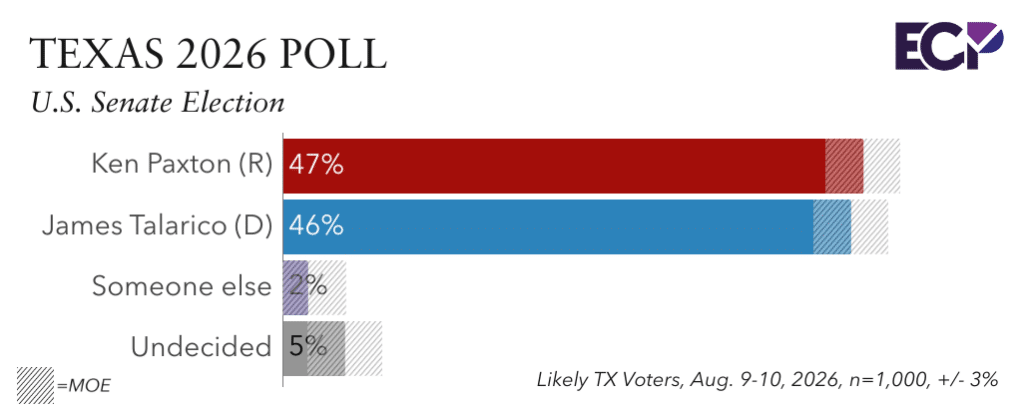
Screenshot of August Texas Senate poll results published by Emerson College Polling.
An Emerson College Polling survey of likely voters placed Paxton at 47% and Talarico at 46%, with 5% undecided. The survey reported approximately 3 points of uncertainty, making the observed 1 point difference too small to identify a winner.
FiftyPlusOne describes its forecast as a range of possible outcomes rather than a prediction. Its system combines polls, historical voting patterns and expert ratings before accounting for how similar inputs performed in past elections. Texas sitting near the center of that range is the signal. Certainty is not.
Party Strength and Candidate Strength Are Pulling Apart
Texas polling shows that this contest is not simply following a uniform Democratic wave. An August 2026 FOX 7 Austin report on the UT poll placed Talarico at 42% and Paxton at 39%. Yet the same respondents preferred a generic Republican congressional candidate by 48% to 44%.
That movement from a 4 point Republican generic advantage to a 3 point Democratic Senate advantage creates a 7 point difference inside one survey. Candidate strength is changing the contest even while Texas remains Republican in broader statewide voting.
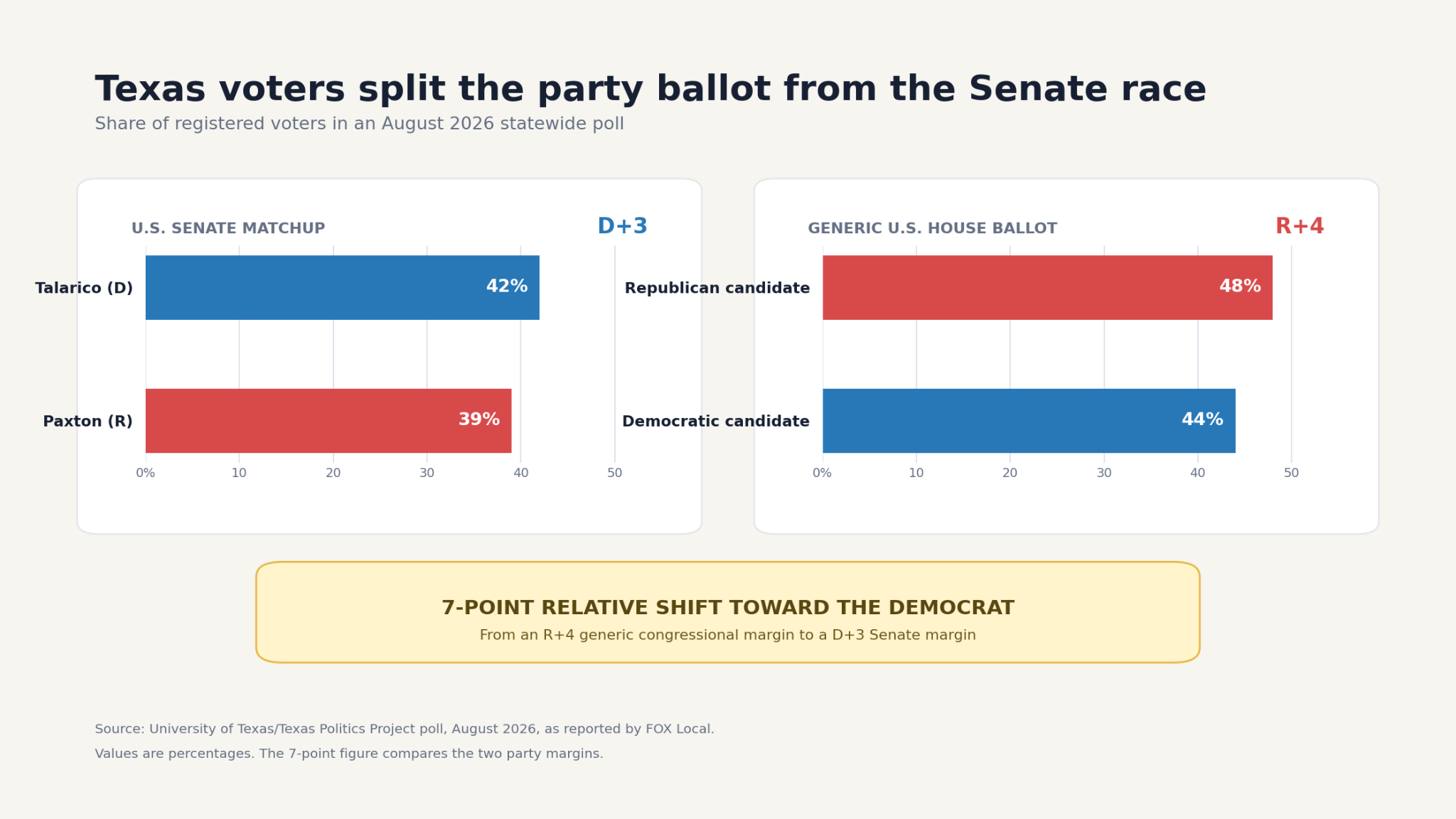
Texas voters separate party preferences from the Senate matchup in statewide polling.
Talarico secured 91% of Democrats in the survey, while Paxton held 79% of Republicans. Independents preferred Talarico by 37% to 11%, while 43% had not formed a preference. Those figures show Democratic unity and Republican leakage helping Talarico perform above the broader party ballot.
Republican campaigns should treat the 79% retention figure as a messaging problem. Run high contrast ads aimed at moderate conservatives and Republican voters who support a generic Republican candidate but hesitate over Paxton. Define Paxton’s weaknesses directly, then connect Republican control to the priorities those voters still support.
The age split creates a second immediate opportunity. Voters younger than 50 favored Talarico by 15 points, while voters older than 50 favored Paxton by 11 points. Field directors should launch targeted digital mobilization campaigns aimed at the under 50 demographic, build contact lists now and match online persuasion with early turnout work.
Those numbers do not prove statewide realignment. They show where campaign choices can change the result. Talarico’s strength depends partly on Democratic unity, independent support and Paxton’s weaker hold over Republican voters. A Republican state can still produce a competitive Senate contest when one nominee loses voters his party usually carries.
An Expanded Map Changes Campaign Behavior
A larger battlefield changes decisions before any ballot is counted. National parties must decide whether to defend Texas, challenge it or force the opposing side to spend there. Every dollar committed to one large state becomes unavailable for another close contest.
Federal records show why Texas cannot be treated as a symbolic Democratic target. Through June 30, 2026, the Federal Election Commission reported $68.6 million in receipts for Talarico and nearly $9.3 million for Paxton. That produces a difference of approximately $59.3 million.
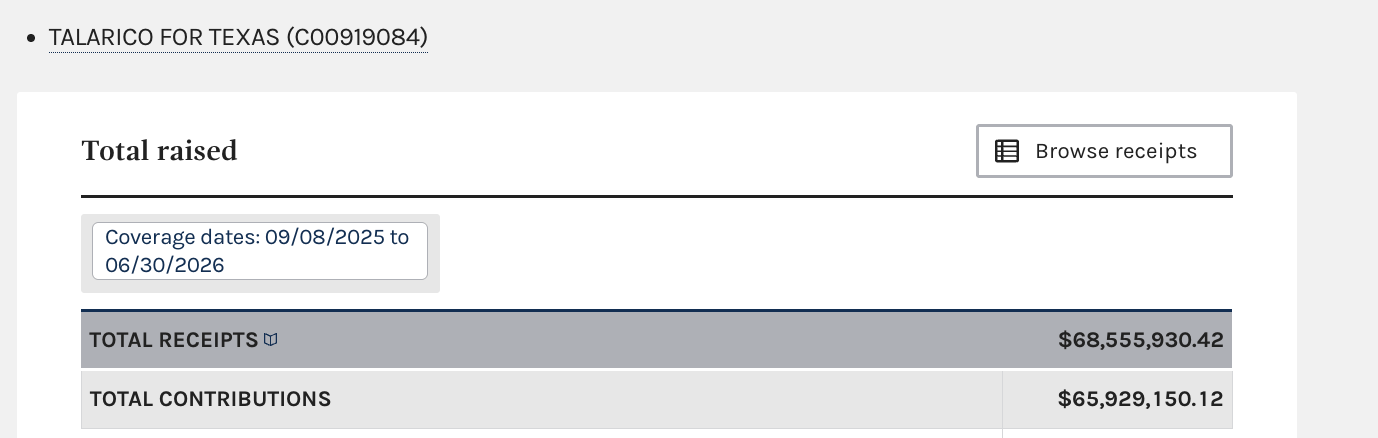
Official financial summaries for James Talarico through June 2026*.*
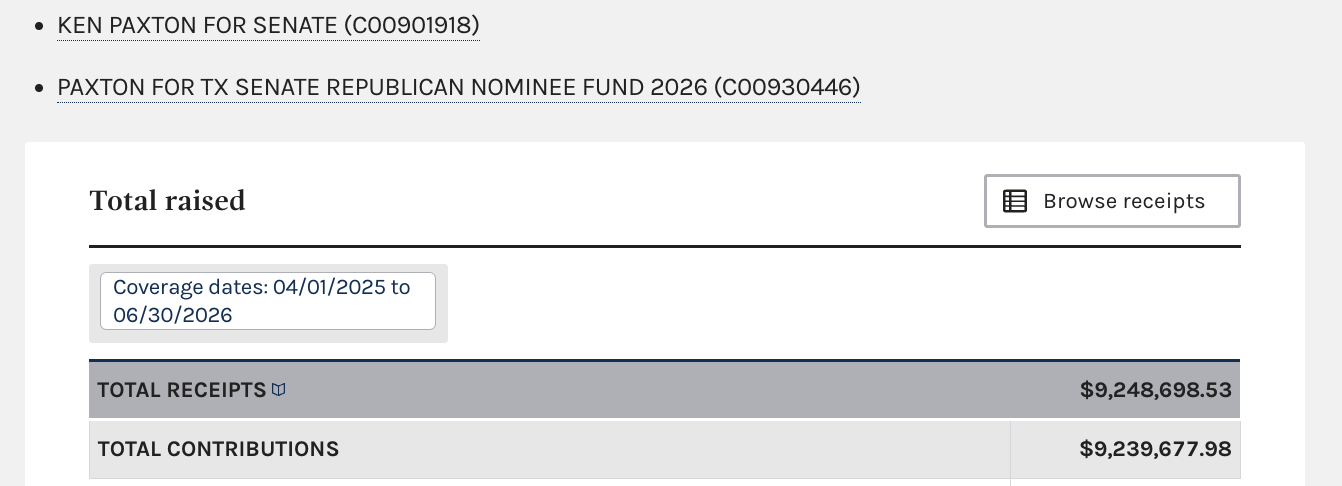
Official financial summaries for Ken Paxton through June 2026*.*
Money does not guarantee persuasion or turnout. It determines whether a campaign can communicate across an enormous and expensive state, defend its candidate and respond when an opponent changes the subject.
Democrats must decide whether Texas deserves money that could travel farther elsewhere. Republicans must decide how much protection a state with a R+6 voting history now requires. Those choices make Texas consequential even if neither side spends at the maximum level suggested by current fundraising.
Democratic expansion also changes the national map. Traditional battlegrounds remain essential, but relying only on familiar states gives the party little tolerance for a missed opportunity. A credible Texas contest creates another route to power while forcing Republicans to defend terrain they once expected to hold cheaply.
Republicans still have structural reasons for confidence. Texas remains right of the country, Paxton can consolidate voters who usually support the party and late spending can narrow Talarico’s financial advantage. Democrats face the harder task of converting unusual competitiveness into a statewide majority. An expanded map creates options, not shortcuts.
Wrap Up
Texas does not need to flip for the 2026 Senate map to change. Its Toss Up status already forces both parties to spend, organize and plan beyond the familiar battlegrounds. That pressure is measurable evidence that old boundaries no longer control the national contest.
Current evidence still supports caution. Republicans lead the generic congressional ballot, while Talarico’s advantage depends partly on stronger Democratic unity, independent support and Paxton’s weaker Republican retention. Under 50 voters give Talarico a 15 point advantage, but turnout and voter demographics will determine how much that margin matters.
Campaigns should act on the opening before the map closes again. Republican teams should run high contrast ads for moderate conservatives, repair Paxton’s 79% Republican retention problem and protect the target flight window. Democratic teams should turn under 50 enthusiasm into verified contacts and turnout. Texas belongs inside Senate majority calculations, and neither party can safely build its strategy around yesterday’s map.
-Sep-11-2026-10-13-55-7064-AM.jpg)