

In race after race, the party is overperforming in districts that should not be close, raising fresh questions about whether the GOP’s apparent strength is softer than it looks.
What to Know
- Republicans held Georgia’s 14th District, but the final margin was far narrower than Trump’s dominant 2024 performance in the district.
- Wisconsin’s Supreme Court election delivered a decisive liberal victory in one of the country’s most evenly divided battleground states.
- Democratic-aligned candidates significantly outpaced recent presidential benchmarks in both WI-03 and WI-01.
- The results suggest off-cycle turnout energy currently favors Democrats in several key regions.
- If the trend continues into 2026, Republicans may be forced to defend districts that were previously considered politically secure.
Georgia’s 14th District was expected to be a comfortable Republican hold. Instead, the GOP candidate won by just 12 points in a district that had recently delivered one of the party’s strongest margins. Republicans still secured the seat, but the shrinking margin quickly became the real story. Districts that reliably vote deep red are not supposed to tighten this dramatically without broader political movement underneath the surface.
This dynamic underpins the “red mirage” concept. While Republicans continue to secure victories in various special elections, the narrowing margins in otherwise safe districts indicate a potentially fragile coalition that may underperform in lower-turnout settings. As this pattern manifests across diverse states and electoral contests, it prompts serious inquiries into whether the GOP faces significant turnout and enthusiasm hurdles as the 2026 cycle approaches.
Democrats Are Not Just Competing. They Are Overperforming.
Inside Elections did not treat the Georgia result as an isolated surprise. It explicitly framed it as part of a “long string” of Democratic overperformances across the country over the last year That matters because overperformance is often one of the clearest early signs of a changing political environment.
Special elections are useful for that reason. They do not always predict exact November outcomes, but they are strong indicators of which side is more motivated, more organized, and more likely to punch above its normal weight. Right now, those indicators are favoring Democrats. Wisconsin is the clearest example.
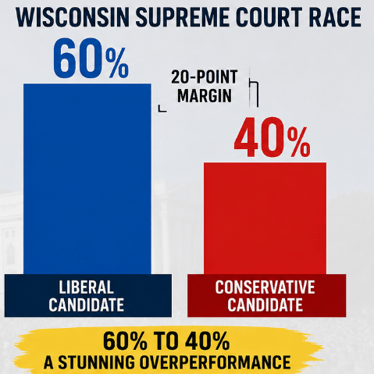
In a state where elections are usually decided by tiny margins, a liberal Supreme Court candidate secured a stunning 20-point victory, winning 60 to 40. This massive overperformance serves as a major warning flare.
Even more important, the down-ballot geography told the same story. In Wisconsin’s 3rd District, Trump had carried the seat by 7 points in 2024, yet the liberal candidate ran 21 points ahead there. In the 1st District, where Trump won by 4.5 points, the liberal candidate finished ahead by 15 points. Those are district-level signs that the Republican coalition may be less stable in off-cycle environments than it appears in presidential year snapshots.
This Is an Intensity Problem Before It Becomes a Map Problem
What the data suggests instead is a widening enthusiasm gap. Democratic voters are acting like every election matters. Republican voters, at least in some of these lower-profile contests, are not. That kind of gap can sit quietly in the background for months before suddenly becoming visible in a much larger race.
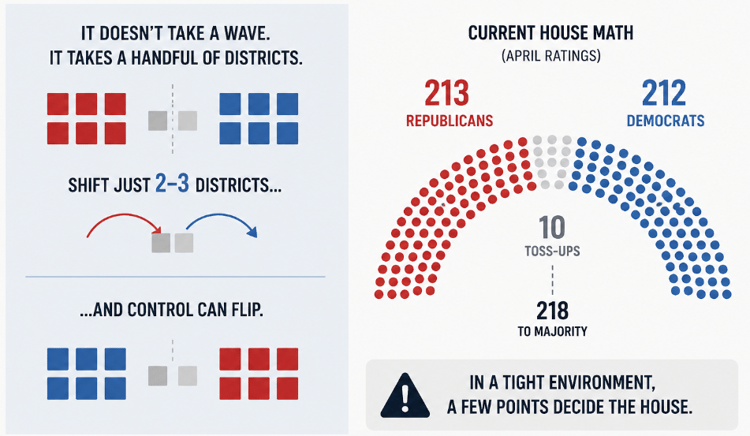
It does not take a partisan earthquake to change control of the House. It takes a handful of districts where one side underestimates how soft its turnout really is. And that vulnerability becomes more dangerous when the broader House math is already tight.
Inside Elections’ April House ratings show Republicans at 213 seats and Democrats at 212, with just 10 toss-ups on the board and 218 needed for a majority In an environment like that, a turnout slippage of even a few points can have national consequences.
Why This Should Worry Republicans in “Safe” Territory
Georgia’s 14th Congressional District became an early warning sign for Republicans after Representative Marjorie Taylor Greene vacated the seat, triggering a special election runoff between Republican candidate Clay Fuller and Democrat Shawn Harris.


Republican candidate Clay Fuller and Democrat Shawn Harris.
Republicans ultimately held the district, but the margin tightened far more than expected in a deeply Republican area. Harris’ stronger-than-expected performance reinforced a growing trend Democrats have shown in several recent special elections: outperforming baseline expectations even in districts considered politically safe for Republicans.
That is why these results matter. If Republicans are forced to spend money and resources defending districts that normally would not be competitive, the overall House battlefield expands and leaves less room for error in tighter swing districts.
Republicans Still Have a Counterargument
Republicans would argue that special elections and off-cycle races often produce distorted turnout environments that favor Democrats. Lower-profile elections tend to attract highly engaged voters, and Democratic voters have historically performed better in those conditions. Republicans also point out that they still held Georgia’s 14th District despite the tighter margin.
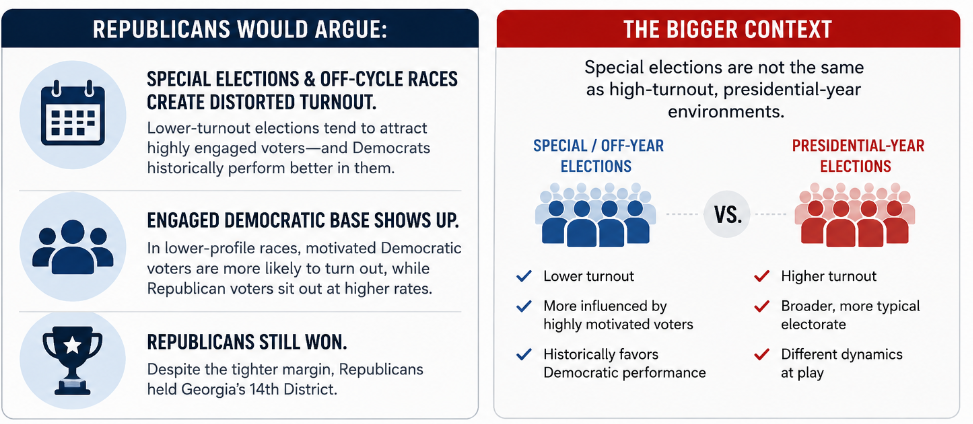
But the concern for strategists is not necessarily immediate losses. It is the repeated pattern of Democrats outperforming expectations across multiple states and election types. In a House environment already separated by only a handful of seats, even small shifts in turnout intensity can dramatically expand the battlefield.
Wrap Up
The red mirage is not that Republicans are fake strong. It is that their strength may be overstated by outdated assumptions about turnout, intensity, and district security. Winning deep red seats by smaller margins and watching Democrats post huge overperformances in competitive states is not normal background noise.
It is the kind of data campaigns ignore at their own risk. If this trend continues, the next fight for House control will not be decided only in the usual toss-up districts. It will be decided in places Republicans assumed were already locked down.

-May-16-2026-10-24-03-9739-PM.jpg)