-Sep-03-2026-09-50-31-2388-AM.jpg)

South Carolina remains Republican territory, but an unusually narrow runoff exposed vulnerabilities worth tracking through November's Senate election.
What to Know
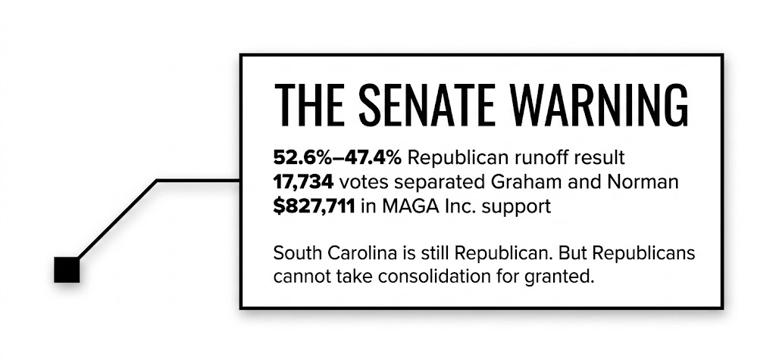
- Darline Graham beat Ralph Norman only 52.6% to 47.4%, a margin of 17,734 votes.
- MAGA Inc. spent $827,711 to reinforce Graham after Donald Trump endorsed her.
- Graham led a 10-candidate primary field with only 32.8% before the runoff.
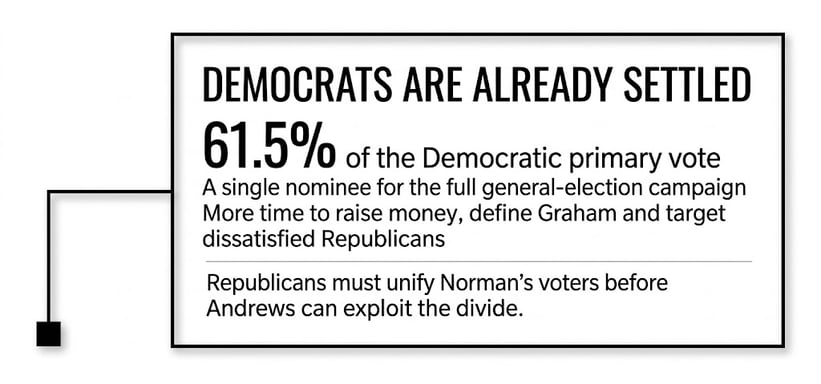
- Annie Andrews won 61.5% of the Democratic primary vote, giving Democrats a settled nominee.
- South Carolina remains Likely Republican, but Republicans cannot take unity, turnout or resources for granted.
South Carolina is not a Senate toss-up. Republicans should not treat it like one. But they also cannot dismiss it as safely settled.
Inside Elections reached the right conclusion after appointed Republican Senator Darline Graham defeated Rep. Ralph Norman in the special Republican runoff. Graham won 52.6% to 47.4%. She survived. She did not dominate.
That difference matters. Republicans hold South Carolina’s Senate seat only if they unify the voters who split during the runoff, define Graham before Democrats do and prevent a manageable contest from becoming an expensive statewide defense. If Republicans take South Carolina for granted, they risk forcing national resources into a state that should help secure the Senate majority, not drain it.
Graham remains favored against Democratic nominee Annie Andrews. South Carolina has not elected a Democrat to the Senate since 1998, and Donald Trump carried the state by approximately 17.9 percentage points in 2024. Those facts matter. So does this one: Graham enters the general election as a first-time candidate who received the seat through appointment, not a statewide election.
Republicans must now turn an appointed senator into a credible statewide choice for a full 6-year term.
Graham Won the Nomination, but Norman’s Voters Sent a Message
Graham’s path to the ballot moved quickly. Her brother, the late senator, died on July 11 after winning the regular Republican primary in June. South Carolina’s governor appointed Graham temporarily, then voters selected a nominee through a special Republican process.
Appointment gave Graham the office. It did not give her a mandate.
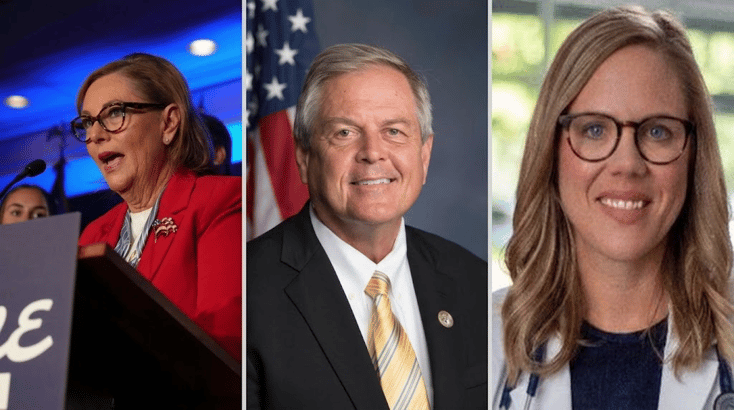
From left: Darline Graham, senator; Ralph Norman, representative; Annie Andrews, Democratic nominee.
Ballotpedia’s certified results show Graham led the August 11 special primary with 32.8% in a field of 10 candidates. Norman finished second with 23.5%, forcing a runoff because neither candidate won a majority. Graham then reached 52.6%. Norman reached 47.4%.
The final margin was 17,734 votes: Graham received 180,231, while Norman received 162,497.
Graham won a hard nomination fight. But nearly half of participating Republicans selected another candidate even after Graham benefited from appointment, a famous political name and presidential support. That is not a reason to predict a Democratic victory. It is a reason to act.
Norman gave conservative voters a clear alternative. He had served nearly a decade in the House and carried a firmly conservative record. His past support for Trump’s 2024 primary rival also created tension with the president’s loyalists, giving Trump’s political operation a reason to defeat him. Graham still had to work for every vote.
Republican strategists should not ask whether Norman’s 47.4% automatically transfers to Andrews. It will not. They should ask a more useful question: will those voters become active Graham supporters, remain disengaged or require a serious effort to win back?
Reuters reported that Norman performed well around his Greenville base while Graham ran strongly near Myrtle Beach, where Trump campaigned. The runoff therefore reflected more than a statewide protest vote. Regional networks, candidate familiarity and local political relationships shaped the result.
Republicans must rebuild those relationships before November. A close runoff becomes dangerous only when a party leaves its divisions unresolved.
Trump’s Support Helped Graham. It Did Not End the Argument.
Trump did more than issue a routine endorsement. He encouraged Graham to seek the full term, appeared beside her at a Myrtle Beach rally and told supporters he was effectively on the ballot.
Reuters reported that MAGA Inc. spent exactly $827,711 supporting Graham, based on Federal Election Commission filings. Trump’s intervention and outside spending helped Graham secure the nomination.

Donald Trump, President of the United States, campaigned for Graham.
But the result also showed the limit of late reinforcement. Norman stayed within 5.2 percentage points after Trump turned the contest into a test of his influence and allied spending arrived in the closing days.
That does not weaken Trump’s value to Republican campaigns. It shows that endorsement alone cannot settle every voter concern. Republicans still need a candidate who can explain why she deserves a full term, withstand scrutiny and unite the voters who preferred a different option.
Experience gives Democrats one opening. Associated Press reporting documented Graham acknowledging limited knowledge of national security during a runoff debate. Her background includes disability advocacy and vocational rehabilitation, but she had never held elected office before her appointment.
Andrews will use that contrast. Republicans should answer it early, not after it becomes the defining general-election frame.
National conditions could amplify the problem. Reuters reported Trump’s national approval at 33% when the runoff occurred. That figure does not measure South Carolina, where Trump remains far stronger among Republican voters. Still, difficult conditions for the president’s party can make candidate weaknesses more costly in races once considered routine.
Democrats Have a Settled Nominee. Republicans Must Build Unity.
November will bring a different electorate. Republican runoffs draw fewer voters, more partisan voters and more politically attentive voters than general elections. Norman’s 47.4% cannot simply become Andrews’ vote total.
But Andrews has already cleared an important hurdle: Democratic voters chose her decisively.
She is a pediatrician and former congressional nominee who won 61.5% of the Democratic primary vote, according to certified election results. Democrats now have one nominee, one message and a full general-election campaign to raise money, define Graham and seek out dissatisfied Republicans.
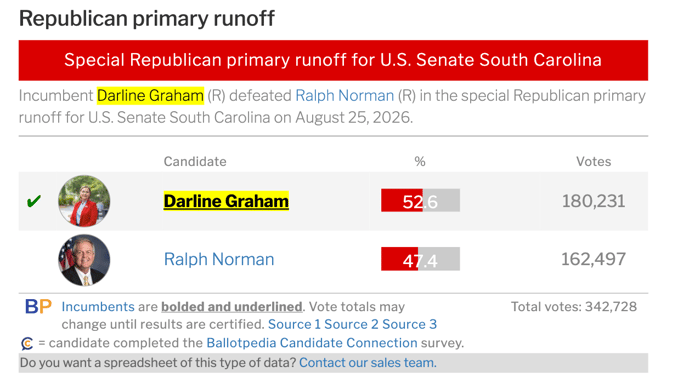
Graham’s 180,231 votes exceeded Norman’s 162,497 by 17,734 votes.
Andrews will likely focus on legitimacy, experience and Republican division. She can contrast her primary victory with Graham’s appointment without adopting Norman’s ideology. That argument could appeal to independents and to Republicans who felt excluded from the succession process.
Republicans must not leave that contrast unanswered. Graham needs to show voters that she earned the nomination, understands the job and can deliver a clear conservative case for the full term.
South Carolina’s political history still creates a high barrier for Democrats. Official state election records show Trump winning the state by about 17.9 points in 2024. The Republican Senate nominee also won by roughly 10 points in 2020, despite a nationally watched and heavily financed Democratic challenge.
Those numbers explain why South Carolina remains Likely Republican. They do not excuse a passive campaign.
The Watchlist Is About Action, Not Panic
South Carolina belongs on the watchlist because Republicans can still prevent a costly problem.
Inside Elections retained its Likely Republican rating after the runoff. That rating recognizes the state’s Republican fundamentals while acknowledging that Graham’s narrow nomination victory created more risk than a commanding result would have.
Republicans should track three indicators.
First, watch post-runoff consolidation. Are Norman’s supporters publicly backing Graham, giving money, volunteering and turning out? Endorsements matter, but sustained participation matters more.
Second, watch Andrews’ resources. She needs enough money to communicate statewide and define Graham before the senator establishes herself as a conventional incumbent. Republicans should not wait for a fundraising gap to become a media gap.
Third, watch independent polling and voter sentiment. One partisan survey will not prove the race is changing. Repeated, credible surveys showing Andrews within striking distance would signal that the runoff division has survived into the general election.
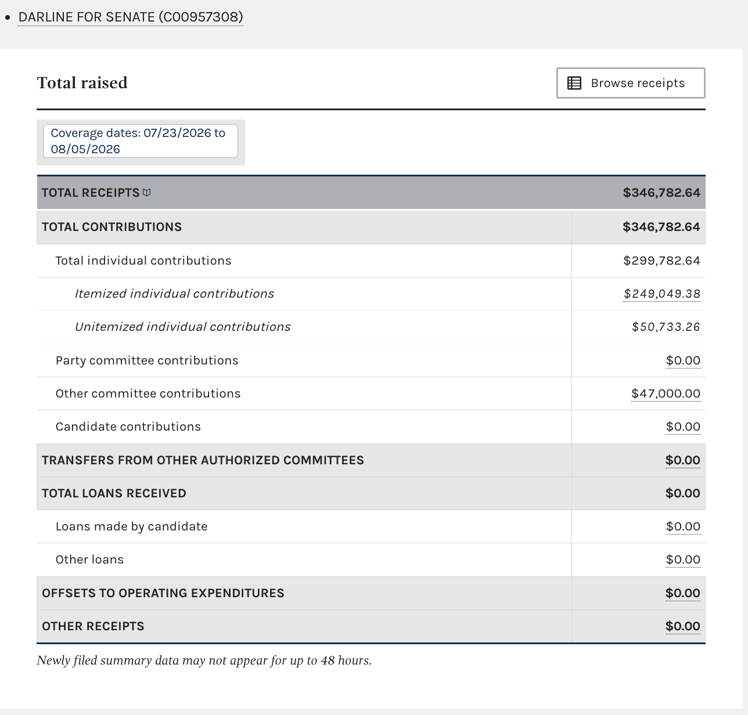
Federal filings show Graham’s reported campaign money and spending.
Money must follow evidence. South Carolina should not pull resources from genuinely closer Senate contests without proof that the state is moving. But Republicans should fund the work that prevents a self-inflicted scare: unify Norman voters, strengthen Graham’s case for office and define Andrews before she defines herself.
The alternative is simple. Wait, assume the state will remain safely Republican and discover too late that a narrow August runoff became a November liability.
Wrap Up
Graham won the nomination, but she did not leave the runoff with an unquestioned mandate. Trump campaigned for her. MAGA Inc. spent $827,711. Graham still defeated Norman by only 17,734 votes.
That result does not make South Carolina a toss-up. It makes Republican unity a campaign priority.
Andrews enters the general election with 61.5% of the Democratic primary vote, a settled nomination and a clear argument against an appointed first-time candidate. She still faces a state Trump carried by 17.9 points and a Republican Senate tradition that Democrats have not broken since 1998.
Republicans can keep this seat. They must not assume they will. The task now is to unify the coalition, answer Graham’s vulnerabilities and stop a narrow runoff from becoming an expensive fight for Senate control.