Two veteran political operators, a record-shattering war chest, and one Senate seat that could decide who controls Congress.
What to Know
- Cooper raised $21.1 million versus Whatley's $6.3 million in total fundraising so far.
- Senate Leadership Fund pledged $71 million for Whatley, part of a $342 million national GOP investment.
- Cooper leads Whatley 49.8% to 38.7% in the latest Harper Polling survey of likely voters.
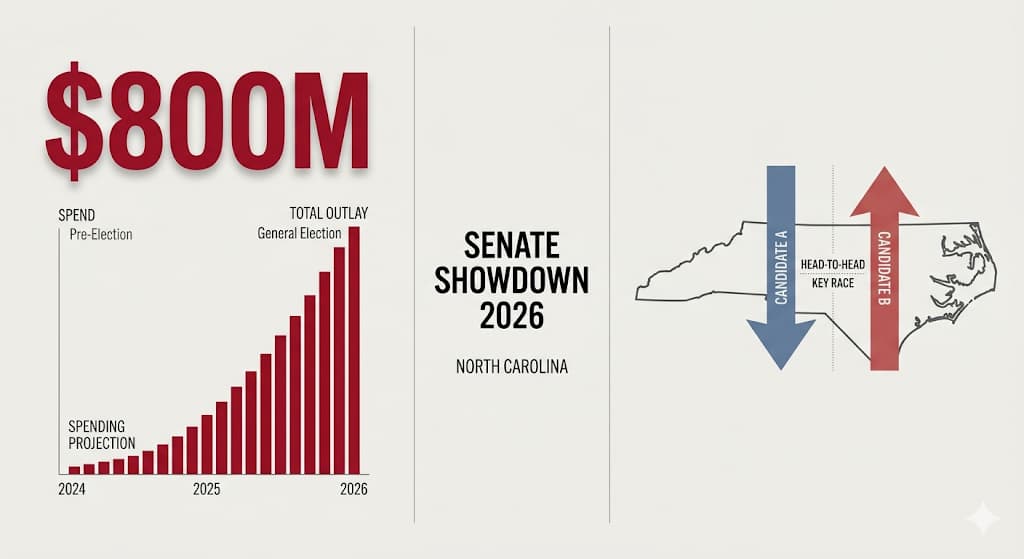
- Total race spending could reach $800 million, shattering the $500 million record from Georgia in 2022.
- Cook Political Report, Inside Elections, and Sabato's Crystal Ball all rate the race Toss-up.
According to Politico, North Carolina's open Senate seat is shaping up as the most expensive in American political history. With Republican Senator Thom Tillis retiring, both parties have identified the state as a must-win battlefield. Private estimates from both parties, reported by Politico's Elena Schneider, project total spending between $650 and $800 million, eclipsing the nearly $500 million spent in the 2022 Georgia Senate race.
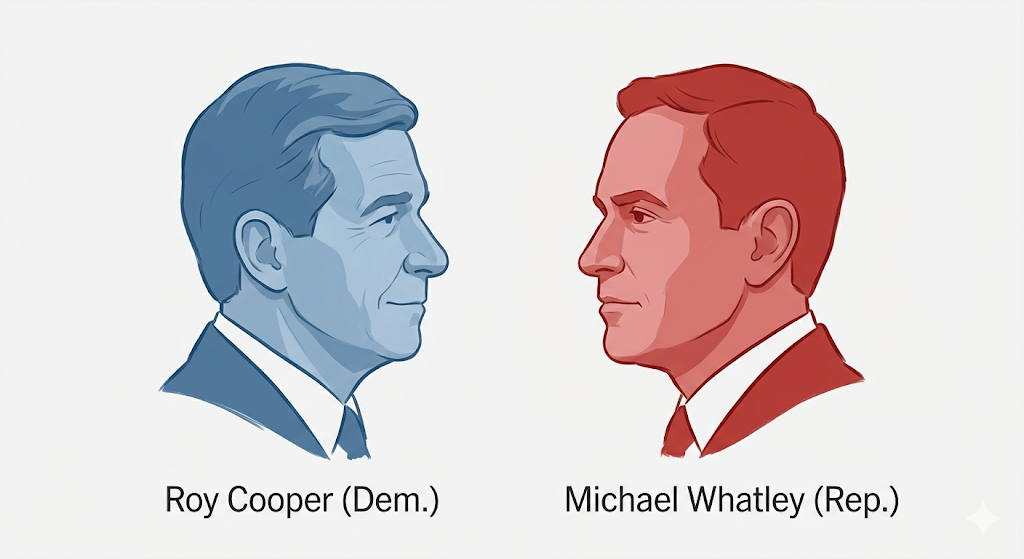
Michael Whatley enters as the Trump-endorsed nominee and former chair of the Republican National Committee. His opponent, Roy Cooper, served two terms as governor and has never lost an election in 30 years. Prof. Chris Cooper of Western Carolina University called it "a true test of where the state is."
Money on the Table
Fundraising numbers tell a story of asymmetry that outside money is moving to correct. Cooper raised $21.1 million and spent $6.8 million through the most recent filing period, per Ballotpedia. Whatley raised $6.3 million and spent $3.7 million. Cooper outraised Whatley $13.8 million to $5 million in Q1 2026 and held $18.4 million cash on hand entering May, compared to Whatley's $2.5 million.
Senate Leadership Fund moved to close that gap. Run by Senate Majority Leader John Thune, the group pledged $71 million for Whatley in April, second only to its $79 million Ohio commitment. WRAL reported donors include Elon Musk, Paul Singer, Stephen Schwarzman, Stephen Wynn, and Jude Reyes.
-jpg-May-31-2026-04-38-43-2880-PM.jpeg?width=760&height=415&name=image%20(1)-jpg-May-31-2026-04-38-43-2880-PM.jpeg)
Campaign Now (Gemini), Cooper vs. Whatley fundraising and cash on hand
-jpg-May-31-2026-04-38-58-3383-PM.jpeg?width=200&height=300&name=image%20(4)-jpg-May-31-2026-04-38-58-3383-PM.jpeg)
Michael Whatley, Republican Senate Nominee, North Carolina
Senate Leadership Fund Executive Director Alex Latcham framed the investment aggressively:
"A failed governor, Roy Cooper spent eight years releasing violent criminals into North Carolina's communities, drove up costs for working families, and deserted thousands of victims devastated by Hurricane Helene. Michael Whatley is a successful entrepreneur and strong ally of President Trump who always puts North Carolina's families first."
Cooper's campaign manager Jeff Allen acknowledged the steep climb. "A Democrat has not won statewide federal office in North Carolina in nearly two decades," Allen said, pledging to "earn every vote."
Whatley's Name ID Problem
Whatley's central challenge is name recognition. Only 11.7% of May Harper Polling respondents had no opinion of Cooper, compared to 52.7% who said the same about Whatley, per Newsweek. Cooper is viewed favorably by 49.8% of North Carolina voters. Whatley's favorability sits at 25.4%, with 21.9% viewing him unfavorably.
Whatley campaign spokesperson DJ Griffin pushed back, telling Newsweek it is unsurprising that a career politician leads "in polls 6 months out from an election where no money has been spent on ads yet."
-jpg-May-31-2026-04-39-22-1244-PM.jpeg?width=683&height=373&name=image%20(2)-jpg-May-31-2026-04-39-22-1244-PM.jpeg)
Campaign Now (Gemini), data from Newsweek, Cooper vs. Whatley favorability gap
-jpg-May-31-2026-04-39-49-6574-PM.jpeg?width=225&height=225&name=image%20(5)-jpg-May-31-2026-04-39-49-6574-PM.jpeg)
Roy Cooper, Democratic Senate Nominee, North Carolina
Cooper campaign manager Jeff Allen drew the contrast plainly:
"Roy Cooper has spent his career putting North Carolinians first, while Washington insider Michael Whatley spent his delivering for billionaires and special interests at the expense of the middle class."
Griffin responded: "Roy Cooper has underperformed polls in each of his past elections. We expect Whatley to close the Name ID gap and emerge victorious in November."
Stakes for Senate Control
North Carolina carries outsized weight in the national Senate map. Republicans hold a 53-47 majority, and Democrats must flip four seats for control. North Carolina is the only GOP-held seat Trump won by single digits up this November.
Trump carried North Carolina in all three presidential runs, most recently by 3.2 points in 2024. His approval in the state now stands at 41.5% approve versus 56.6% disapprove, per Harper Polling. Just 39.1% of North Carolina voters said the country is heading in the right direction.
-jpg-May-31-2026-04-40-07-5660-PM.jpeg?width=716&height=391&name=image%20(3)-jpg-May-31-2026-04-40-07-5660-PM.jpeg)
Campaign Now (Gemini), data from Ballotpedia, 2026 Senate majority map and competitive races
-jpg-May-31-2026-04-40-22-9175-PM.jpeg?width=183&height=275&name=image%20(6)-jpg-May-31-2026-04-40-22-9175-PM.jpeg)
Vice President JD Vance, Vice President of the United States
Vice President JD Vance, rallying Republican voters in Rocky Mount in March 2026, offered the administration's stake in the outcome plainly:
"He constantly is pressing on the gas. He wants us to do more."
Prediction markets give Cooper an 83% chance of victory on both Kalshi and Polymarket as of mid-May 2026. Republicans are still favored to hold the Senate overall, with Kalshi giving the GOP a 55% chance of retaining the majority.
Wrap Up
Whatley's path to victory runs through the $71 million Senate Leadership Fund commitment and the ad war it will fund. Name recognition gaps close when money floods the airwaves, and North Carolina voters who know little about Whatley today will be fully saturated before November. Republicans have closed bigger gaps in this state before.
Cooper's lead is real, but the seat has not been held by a Democrat in nearly two decades. North Carolina's race will not be decided by who starts ahead but by who converts an $800 million investment into the votes that matter on November 3.
-Sep-03-2026-09-50-31-2388-AM.jpg)