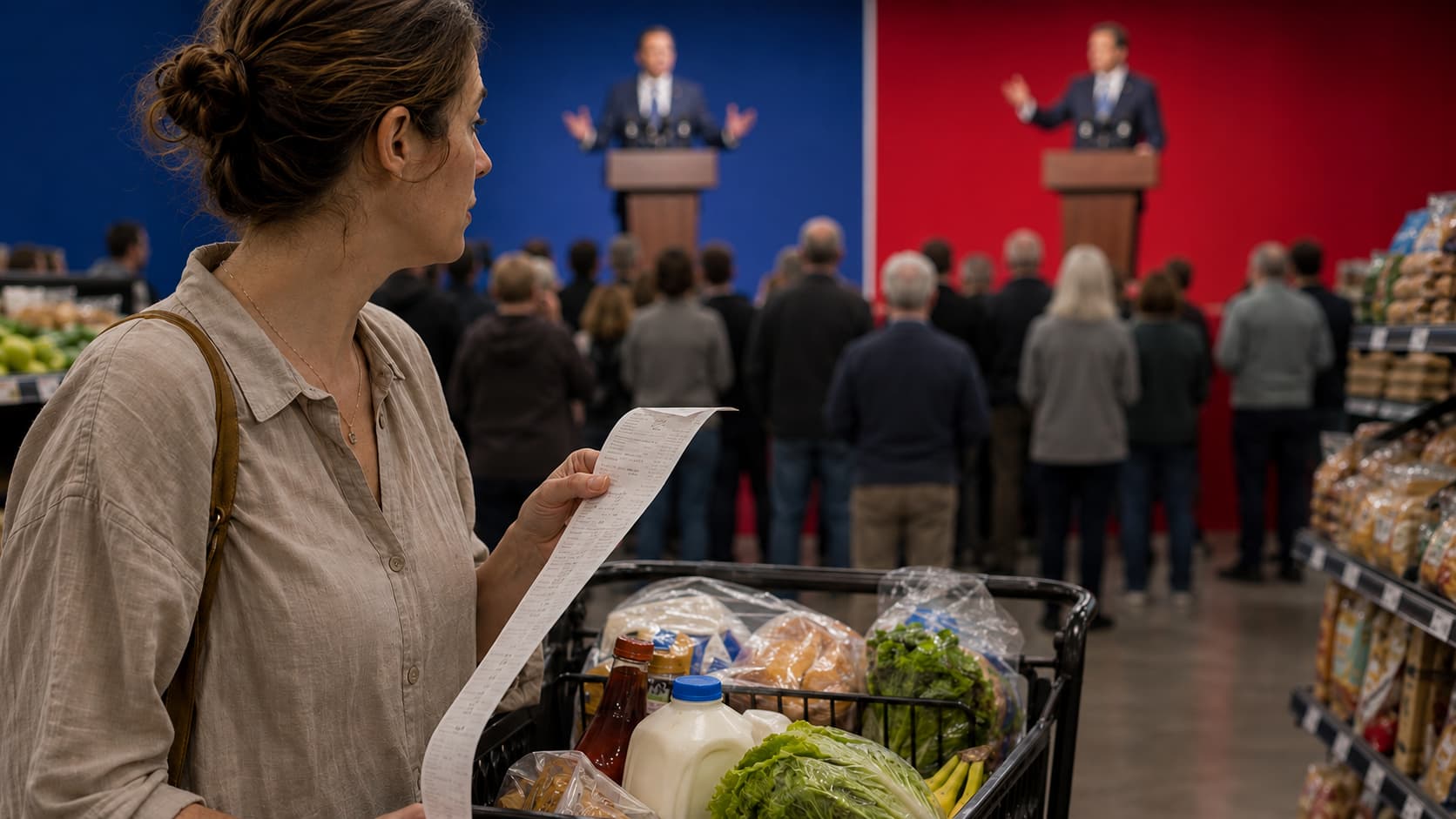
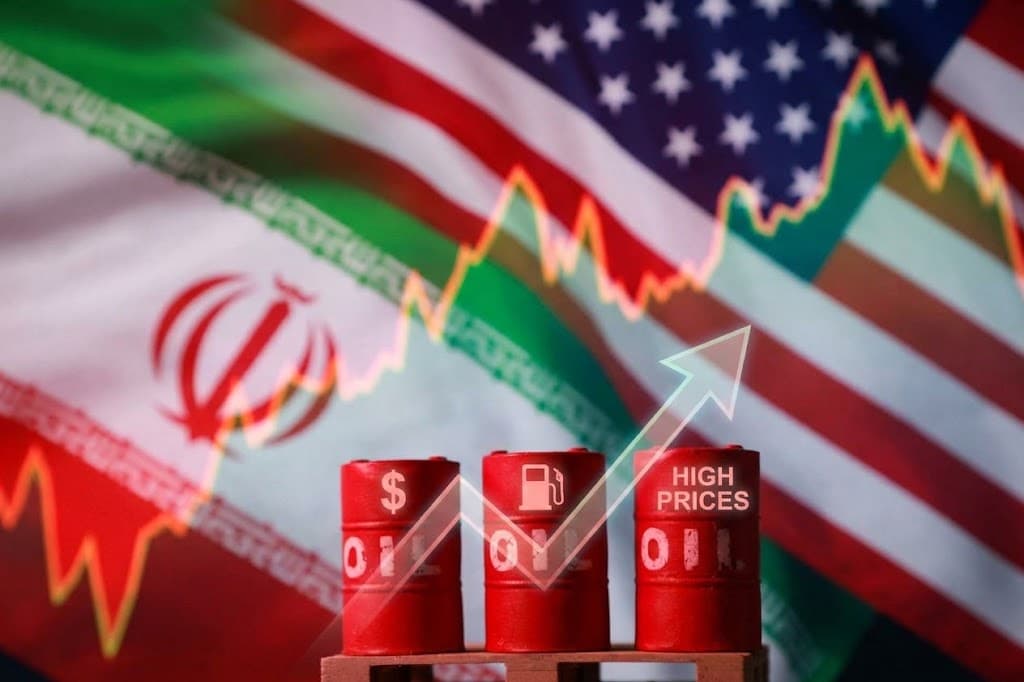

Americans see no quick exit from Iran as unclear goals and rising fuel costs deepen opposition to the campaign.
What to Know
- Prolonged military involvement now defines the expectations of 83% of Americans.
- Approval of the administration’s handling of Iran has fallen to 33%.
- Strategic objectives remain unclear to 69% of the public.
- Higher gasoline and fuel prices concern 73% of Americans.
- Republican approval of the administration’s handling fell from 69% to 63%.
American voters no longer appear to view military involvement in Iran as a limited operation with a visible endpoint. An August Reuters and Ipsos survey found that 83% expected an extended commitment, while only 12% believed it would end within weeks. That expectation now shapes how voters judge every new deployment, policy explanation and economic consequence.
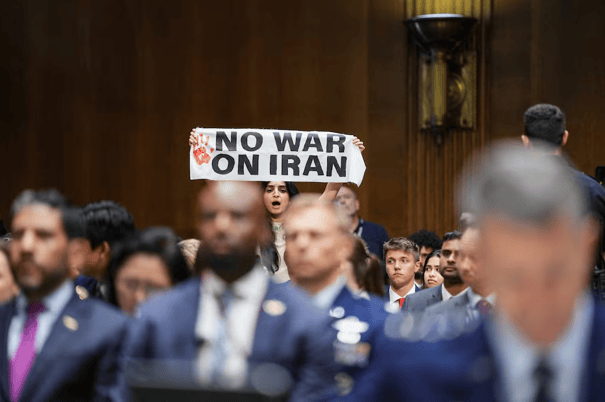
Public skepticism follows months of unresolved questions about military objectives, via Military Times.
Three separate national surveys document different parts of that deterioration. Reuters and Ipsos measured expectations about duration in August, Pew Research Center measured approval and confidence from September 28 through October 4, and an earlier Reuters and Ipsos poll examined whether the administration had explained its goals. Those findings should not be blended into one polling average, but they point toward the same political problem: Americans see a conflict without a convincing endpoint.
Expectations Have Shifted From Weeks to Years
Expectations about the duration of military involvement have changed substantially since the opening weeks of the conflict. Reuters and Ipsos found that the share expecting an extended commitment rose from 60% in early March to 83% in late August, a movement of 23 percentage points. Only 12% expected the operation to conclude within weeks.
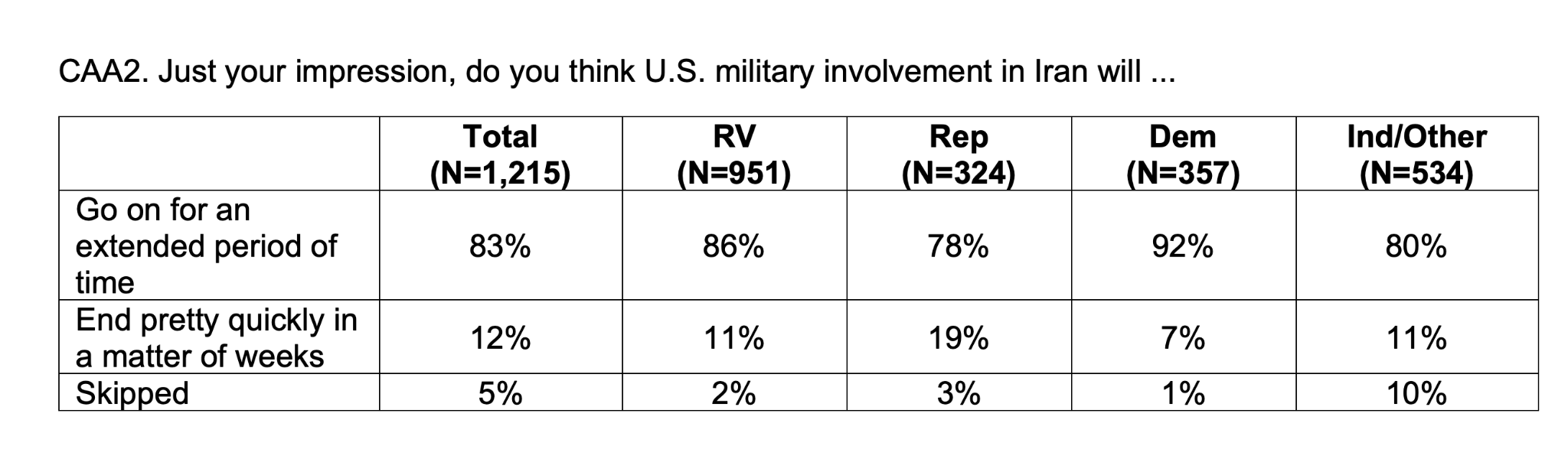
Extended military involvement has become the public’s dominant expectation nationwide, via Ipsos.
Partisan differences remain, but they do not overturn the central result. Extended involvement was expected by 92% of Democrats, 78% of Republicans and 80% of independents or respondents identifying with another political affiliation. Skepticism about a quick conclusion therefore reaches well beyond the administration’s political opponents.
Duration matters because voters evaluate an open commitment differently from a short operation. Every additional month creates new questions about military objectives, casualties, resources and the conditions required for withdrawal. Campaigns cannot address that concern with a general appeal to strength because voters increasingly want a specific definition of success.
Strategic Confusion Turns Duration Into Political Risk
Strategic uncertainty compounds the fear of an extended commitment. A Reuters and Ipsos poll reported by Military Times found that 69% believed President Donald Trump had not clearly explained the goals of American military involvement. Even 4 in 10 Republicans shared that assessment, revealing dissatisfaction inside the president’s governing coalition.
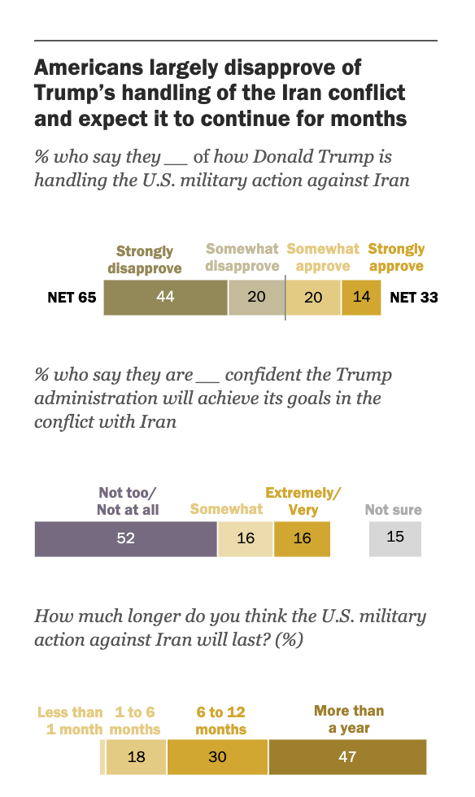
Low approval and weak confidence reinforce expectations of prolonged involvement, via Pew Research Center.
Pew’s later survey shows how that uncertainty has affected public confidence. Only 33% approved of Trump’s handling of the military action, while 65% disapproved. Another 52% had little or no confidence that the administration would achieve its goals, compared with 16% who were extremely or very confident.
Approval also weakened among Republicans. Pew found that Republican approval of Trump’s handling declined from 69% in March to 63% in October, while Democratic opinion remained overwhelmingly negative. Republican support for the initial decision to use force also fell from 71% to 65% during that period.
Campaign consequences emerge from that erosion rather than from the national topline alone. Republican candidates must defend the administration without appearing indifferent to unanswered questions about objectives and duration. Democratic candidates can criticize the absence of a clear endpoint, but they still need to explain what congressional oversight, funding decisions or diplomatic conditions they would support.
Fuel Prices Turn Foreign Policy Into Household Pressure
Foreign policy becomes politically immediate when voters encounter its consequences at the gasoline pump. Pew found that 73% were extremely or very concerned about higher gasoline and fuel prices resulting from the Iran conflict. Concern about American service members being wounded or killed followed closely at 71%, placing household costs and human risk at the center of public anxiety.

Higher fuel costs bring foreign policy into household budget decisions, via Associated Press.
Associated Press reporting shows why that concern has persisted. Regular gasoline averaged $2.98 per gallon before the conflict and reached $4.33 by October 16, an increase of 45%. Diesel rose from $3.76 to $6.33, increasing the cost of freight, agriculture and product distribution even for households that do not buy diesel directly.
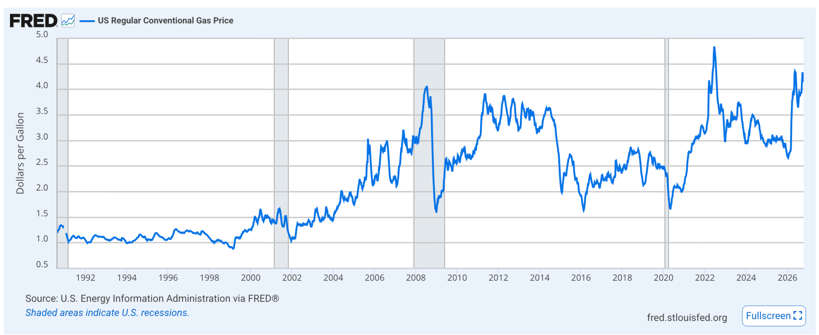
Weekly gasoline prices show how energy costs climbed during conflict, via FRED.
Broader household costs extend beyond the pump. Moody’s Analytics chief economist Mark Zandi estimated that the conflict had cost the average household almost $2,000, including approximately $1,100 in higher energy expenses, $540 in increased interest costs and $360 in military costs. AP also reported that domestic airfares were approximately 22% higher in September than one year earlier, while transportation and warehousing prices charged to businesses increased 10.2%.
Higher prices change how campaigns must discuss Iran. Republican candidates need to explain why the strategic objective justifies the household cost and what developments could reduce that burden. Democratic candidates need to connect criticism to a credible alternative rather than implying that a congressional election alone can quickly reverse global energy pressures.
Political Sustainability Depends on a Credible Endpoint
Public skepticism does not prove that Americans oppose every military action or diplomatic objective involving Iran. It shows that support weakens when voters cannot identify the purpose, expected duration or practical standard for success. A policy can be strategically defensible and politically unsustainable at the same time.
Congressional candidates therefore face questions that reach beyond whether they support or oppose the administration. Voters need to know what conditions would justify continued funding, what reporting requirements Congress should impose and what diplomatic outcome would permit a reduction in military involvement. Those questions place legislative authority, oversight and accountability directly inside the midterm debate.
Political communication cannot substitute for a defined policy. Repeating that the operation protects national security will not resolve public concern if the administration does not explain the threat, objective and exit conditions. A convincing argument requires measurable goals and an honest account of the likely costs.
Wrap Up
Public opinion now reflects a conflict that Americans expect to continue rather than conclude. 83% anticipate extended involvement, 69% say the administration has not clearly explained its goals and only 33% approve of Trump’s handling. Separate surveys using different questions have reached a consistent conclusion: patience is shrinking as uncertainty grows.
Republican candidates carry the heavier immediate burden because their party controls the executive branch. They must reconcile support for the administration with voter demands for clarity, limits and accountability. Distance without an alternative will appear tactical, while unconditional support risks tying local campaigns to every additional cost and setback.
Democratic candidates still need more than opposition. They must explain how congressional oversight, appropriations authority and diplomatic pressure could produce a more accountable strategy. Voters are not merely asking whether the United States should remain involved in Iran; they are asking what continued involvement is supposed to accomplish.