

Once treated as nonpartisan civic posts, school boards are increasingly serving as recruitment, training, and launchpads for candidates headed toward higher office.
What to Know
- School board races are producing a growing share of future state and federal candidates.
- Education fights have become proxy battles for national political issues.
- Both parties are using school boards to identify, test, and groom talent.
- Local visibility is translating into donor networks and volunteer bases.
- The pipeline effect is reshaping campaign benches ahead of 2026.
School boards rarely make national headlines, but they are quietly becoming one of the most important proving grounds in American politics. What were once low-turnout, low-salience races focused on budgets and curriculum are now contested political arenas where future candidates learn how to campaign, fundraise, and govern under pressure.
As education has moved to the center of cultural and political conflict, school boards have become incubators for political talent. Candidates who survive these fights emerge battle-tested, locally known, and increasingly attractive to party recruiters. Heading into 2026, this pipeline is altering how both parties think about candidate development.
From Civic Service to Candidate Training
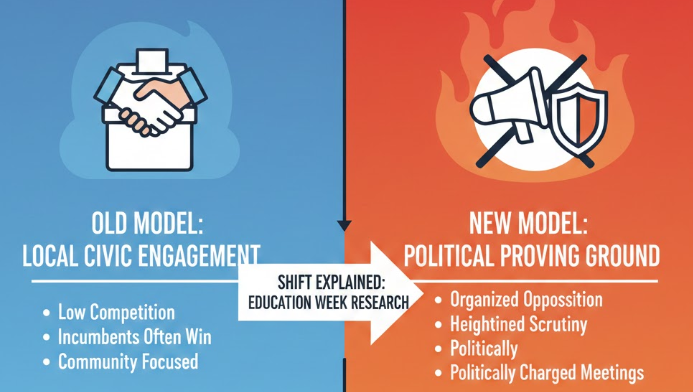
School board service now functions as a low-cost proving ground for future candidates, not just a form of local civic engagement. Research summarized by Education Week shows that while most board elections are not especially competitive and incumbents usually win when they run, the environment surrounding boards has changed. Candidates increasingly face organized opposition, heightened scrutiny, and politically charged public meetings. That combination forces even first-time candidates to learn campaign fundamentals early: how to fundraise, build coalitions, control messaging, and withstand public and media pressure.
Crucially, the intensity of modern school board politics is uneven but real. Most meetings remain civil, yet the districts that do experience conflict tend to be larger, more visible, and more politically activated. In those places, board members routinely navigate contentious debates over curriculum, labor contracts, and cultural issues, mirroring the pressures of higher office. The discipline, targeting, and conflict management needed to win a school board seat directly translate to skills useful in legislative races.
As teachers’ union endorsements prove decisive and outside groups increasingly track board races, school boards have become a reliable signal of candidate viability. The bench-building effect is no longer incidental. It is strategic. School boards now serve as early-stage candidate training programs, producing officeholders who have already tested their resilience, built donor networks, and learned how to survive political conflict before ever running for state or federal office.
Candidate Training Moves Downstream
What was once an informal talent pipeline has become increasingly professionalized. Both parties are now investing directly in candidate training programs that treat school board races as intentional entry points rather than incidental civic stops.
On the right, organizations such as American Majority and Leadership Institute have expanded programming tailored to local offices, including school boards. These groups offer campaign boot camps, issue framing workshops, voter targeting instruction, and governance training designed specifically for first-time candidates.
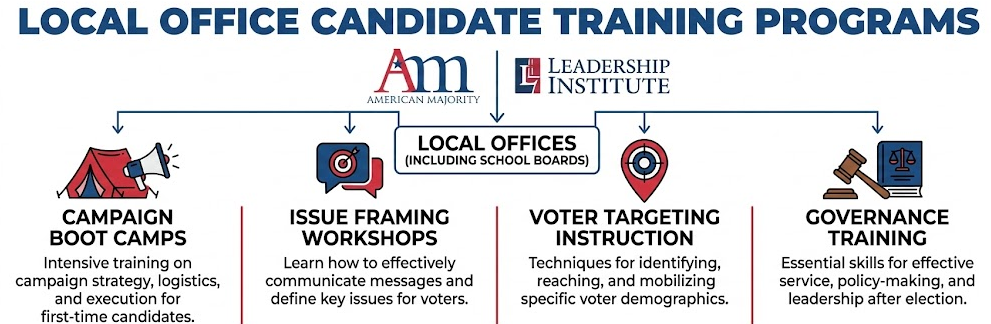
The goal is not simply to win isolated races, but to build a bench of disciplined candidates who can scale up to city councils, state legislatures, and eventually Congress. School boards offer a controlled environment to test messaging, fundraising ability, and resilience under public pressure before higher-stakes races.
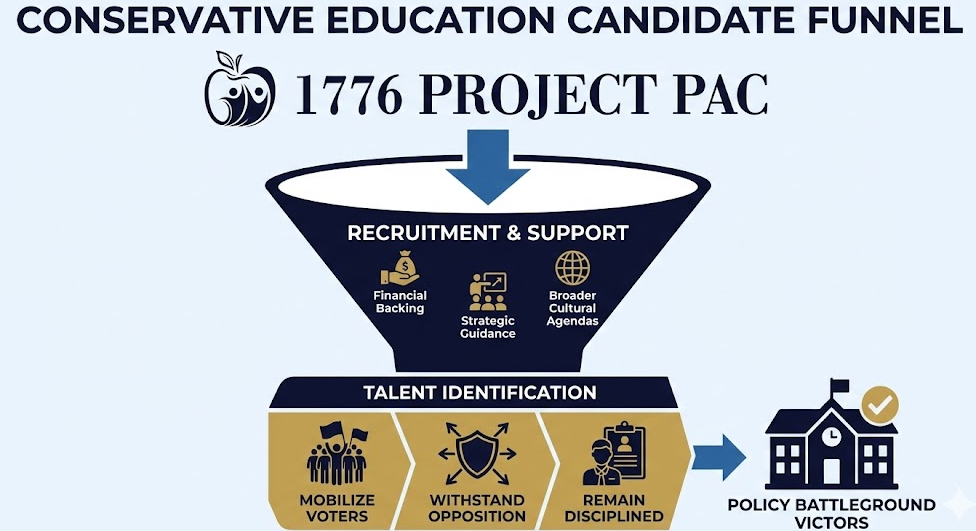
Conservative education-focused efforts have further narrowed this funnel. Groups such as 1776 Project PAC explicitly recruit and support school board candidates aligned with broader cultural agendas, providing financial backing and strategic guidance. These efforts treat education races as both policy battlegrounds and talent identification exercises, allowing campaigns to observe which candidates can mobilize voters, withstand opposition, and remain disciplined in hostile media environments.
The left has built a parallel ecosystem. Organizations like Run for Something and Arena actively encourage school board service as a first rung on the political ladder. These groups offer fellowships, campaign training, and mentorship networks that integrate local candidates into national donor and activist infrastructure early in their careers. Teachers’ unions and aligned advocacy groups also play a decisive role, providing endorsements, turnout operations, and policy support that can quickly elevate local board members into recognizable political figures.
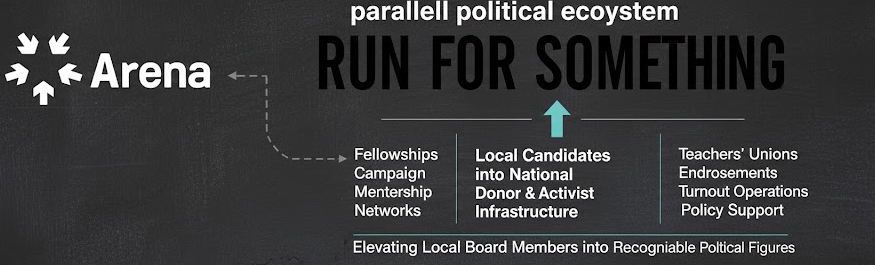
The result is a downstream shift in candidate development. Training, funding, and message discipline now begin earlier, at offices once viewed as apolitical or administrative. School boards are no longer just places where candidates learn governance on the fly. They are increasingly where campaigns are taught, tested, and professionalized long before a candidate ever files for higher office.
Education Fights as Political Sorting Mechanisms
School board races have taken on a new political function in places where competition actually materializes. In districts with contested races, debates over curriculum, parental involvement, gender policy, and public health operate as ideological signals, helping voters and outside groups quickly sort candidates into broader political camps.
On the right, organizations such as 1776 Project PAC and Moms for Liberty closely track these debates, using them to identify candidates aligned with their priorities and to mobilize donor and activist support early. On the left, teachers’ unions and aligned advocacy networks, including local affiliates of the National Education Association and American Federation of Teachers, play a similar role, signaling preferred candidates through endorsements, funding, and turnout operations.
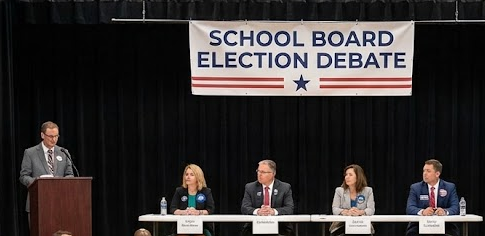
In this environment, even low-turnout school board races generate actionable political data, revealing which candidates can activate constituencies, withstand opposition, and fit cleanly into existing partisan ecosystems. Where contests do emerge, however, they function as unusually efficient vetting mechanisms. Even low-turnout races produce usable signals: vote margins, donor behavior, activist engagement, and opposition intensity.
By the time a board member from a contested district considers higher office, much of their political profile has already been stress-tested. The result is an uneven pipeline. School boards are not universally political battlegrounds, but where competition exists, they increasingly serve as early-stage sorting mechanisms that reduce uncertainty for parties scouting future candidates.
Partisan Spillover Is No Longer Subtle
School board races may still carry a nonpartisan label on the ballot, but in practice the influence of national politics is increasingly overt. Endorsements, direct mail, and digital messaging now closely resemble formal party infrastructure, importing national narratives into what were once narrowly local contests.
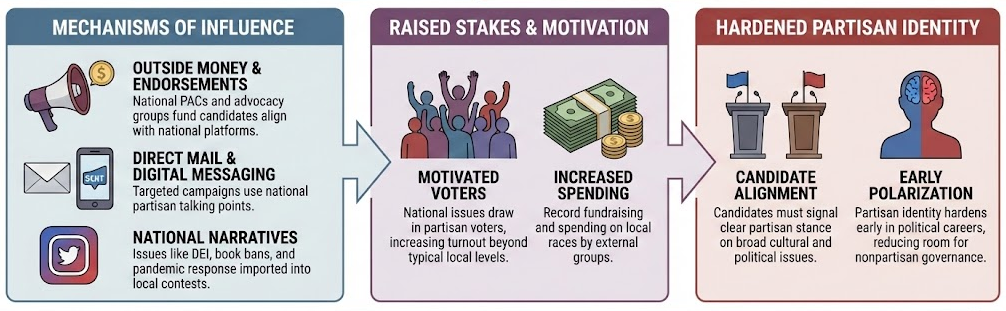
The effect is twofold: it raises the stakes of school board elections by drawing in motivated voters and outside money, and it hardens partisan identity earlier in a candidate’s political life. Even at the local level, candidates are now expected to signal alignment clearly, not just on education policy but on broader cultural and political issues.
Political parties strategically invest in early school board elections to cultivate loyalty, vet messages, and integrate candidates into established networks. This prepares candidates for higher office, as they are already skilled in party politics. Critics, however, argue this political involvement undermines the non-partisan nature of local governance.
Why School Boards Are Attractive Launchpads
School boards offer a rare combination of accessibility and credibility that few entry-level offices can match. Candidates can claim real governance experience while remaining visibly anchored to their local community, a balance that plays well with voters and party gatekeepers alike. Unlike purely symbolic or activist roles, school board members are responsible for approving budgets, overseeing senior leadership, negotiating labor agreements, and setting district policy. That record translates cleanly onto a legislative résumé and signals administrative competence rather than ideological posturing.
|
What a School Board Typically Consists Of School boards, usually composed of five to nine elected or appointed members serving staggered (often four-year) terms, are the district's primary governing authority. Members select a chair and sometimes a vice chair and treasurer. Their core duties include approving budgets and contracts, setting policy, adopting curriculum, and hiring/evaluating the superintendent. This governance experience and public accountability often serve as a political stepping stone. |
Wrap Up
School boards are no longer peripheral to electoral politics; they have become foundational training grounds for the next generation of candidates. As education debates intensify and local races absorb national political energy, these offices are producing contenders with real governing experience, defined political identities, and campaign skills already tested under pressure. The pipeline effect is increasingly visible, with school board alumni moving into state legislative races and emerging as credible congressional challengers backed by established donor and volunteer networks.
Looking toward 2026 and beyond, the strategic advantage will belong to parties that treat school boards as investments rather than afterthoughts. Early engagement at this level reduces uncertainty, builds durable candidate benches, and ensures future campaigns are staffed by individuals who have already navigated public scrutiny and voter mobilization. What unfolds in school board races today is no longer just about education policy; it is shaping who runs, who wins, and who governs in the next electoral cycle.
-Aug-22-2026-10-52-50-4969-AM.jpg)