

Southwest Washington’s incumbent must preserve crossover support while a seasoned Republican turns economic frustration into a competitive challenge.
What to Know
- Republican John Braun leads Democratic incumbent Marie Gluesenkamp Perez by 46% to 44% in a single district survey.
- Braun’s advantage narrows to 48% to 47% after undecided voters disclose which candidate they currently favor.
- Independent voters comprise 35% of the surveyed electorate and remain essential to both candidates’ competing coalitions.
- Every respondent considers the economy and living costs important, making affordability the race’s dominant shared concern.
- Outside Republican spending has narrowed the incumbent’s financial advantage and intensified an already competitive contest.
Southwest Washington remains one of the clearest tests of whether a Democrat can preserve an independent identity in territory that favors Republicans at the presidential level. Oregon Public Broadcasting’s district survey found Republican state Senator John Braun leading Representative Marie Gluesenkamp Perez by 46% to 44% among likely voters. Another 11% initially remained undecided.
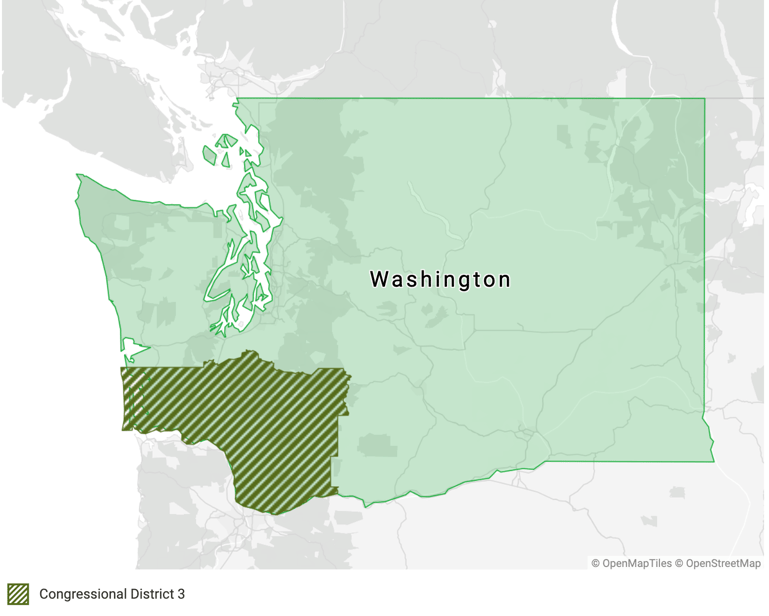
Location of Washington State Congressional District 3, via Oregon Public Broadcasting.
DHM Research surveyed 543 likely voters from September 17 through September 27, producing a margin of error of 4.2 percentage points. After pollsters pressed undecided respondents for their preference, Braun led 48% to 47%, with 5% still unsure. One survey cannot establish a durable trend, but its result confirms that neither candidate has secured the district’s political middle.
Split Ticket Voting Keeps Both Coalitions Fragile
Southwest Washington has repeatedly separated its presidential and congressional choices. Donald Trump carried the district by 50.3% to 47.0% in 2024, while Gluesenkamp Perez defeated Republican Joe Kent by 51.7% to 47.9%. Her congressional margin of almost 4 percentage points exceeded her narrower 2022 victory, even as the district again supported Trump.
Such results explain why Gluesenkamp Perez emphasizes trades, small businesses and local independence instead of relying entirely on a national Democratic message. Her coalition includes voters who support Republicans elsewhere but view her as attentive to the district’s working communities. Braun’s candidacy tests whether that crossover support depended partly on dissatisfaction with Kent rather than durable loyalty to the incumbent.
Braun offers Republicans a different profile from the nominee Gluesenkamp Perez defeated twice. His experience as Washington Senate minority leader, manufacturing executive and Navy veteran gives him a conventional governing résumé. Trump’s endorsement strengthens Braun with the Republican base, but the district survey shows that party consolidation alone has not settled the race.
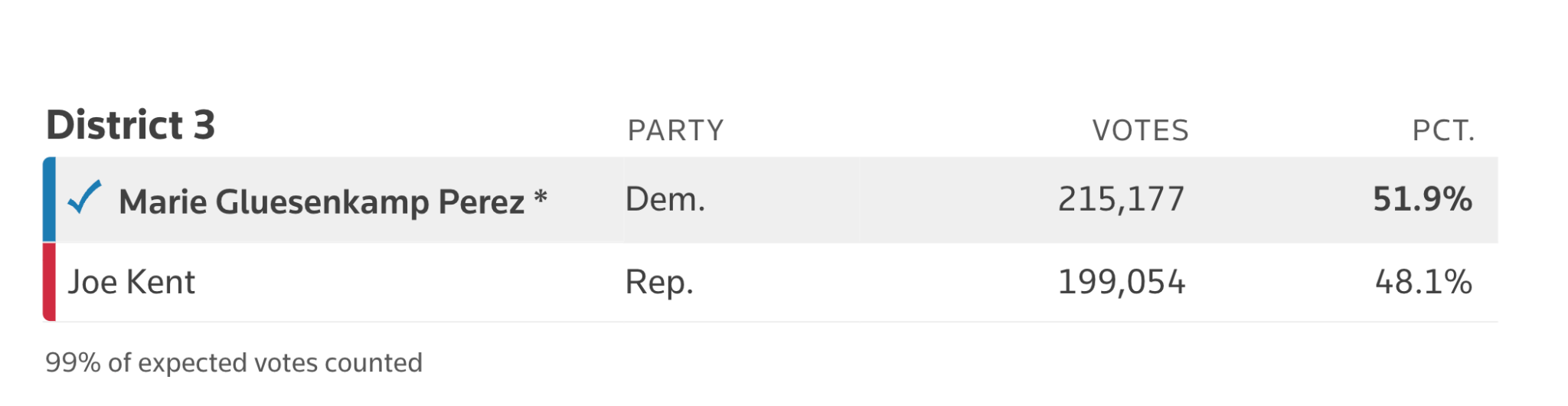
Perez won the district’s House race by 16,123 certified votes, via Reuters.
Primary results exposed vulnerabilities on both sides. Braun finished first with approximately 39.7%, while Gluesenkamp Perez received about 36.4% and progressive Democrat Brent Hennrich captured roughly 16.7%. Democratic candidates collectively received a larger share than Republicans, but Hennrich’s refusal to endorse the incumbent created uncertainty about whether every Democratic primary voter would return in November.
Braun must therefore consolidate Republicans while persuading independents that he represents more than a national party restoration. Gluesenkamp Perez must recover dissatisfied voters on her left without weakening the independent image that made her competitive. Each candidate needs voters who remain uncomfortable with part of the coalition required for victory.
Outside Spending Changes the Volume, Not the Fundamentals
Outside money has amplified the contest during its closing weeks. As of October 1, the Trump aligned No Going Back PAC had spent $1.7 million in the district, while outside Democratic groups had spent approximately $354,000, according to federal filings cited by Oregon Public Broadcasting. That disparity gave Republican messaging substantially more outside support at the moment the race tightened.
Candidate fundraising presents a different picture. Federal Election Commission data provides separate financial totals for Gluesenkamp Perez, Braun and the other candidates who entered the race. Earlier federal filings showed the incumbent with a sizeable fundraising advantage, demonstrating why candidate resources and independent expenditures must not be treated as the same measurement.

Campaign finances show why outside spending can alter message balance, via Federal Election Commission.
Heavy outside spending can increase message frequency, define an opponent and force a campaign to redirect money toward defense. It cannot, by itself, show that advertising caused a particular polling result. Gluesenkamp Perez’s campaign attributed the tightening race to Republican spending, but that remains a campaign interpretation rather than an independently established effect.
Allocation decisions nevertheless reveal how national organizations view the district. A party does not commit substantial late money to a race it considers settled. With the contest among the limited number rated as toss ups, every additional dollar reflects the broader struggle for House control.
Affordability Gives Local Independence a Concrete Test
Economic pressure dominates the district more completely than any partisan theme. Every likely voter surveyed described the economy and cost of living as either very or somewhat important. Housing produced similar concern, with 91% saying that finding an affordable place to live was difficult.
Confidence in government remains far weaker than concern about the issues. A combined 88% expressed little or no confidence that elected representatives in Congress would make progress on the matters important to them. Another 80% believed children growing up in Washington would eventually be worse off than adults are today.

Longview’s industrial economy makes local economic security an immediate concern, via The Guardian.
Those findings create a difficult environment for both candidates. Gluesenkamp Perez cannot rely on incumbency when most surveyed voters doubt Congress can deliver progress. Braun cannot convert dissatisfaction automatically when voters also distrust national politics and value candidate independence.
Local economic geography sharpens that challenge. Vancouver and its surrounding communities face housing and growth pressures associated with the Portland metropolitan area, while Longview and other rural communities depend more heavily on manufacturing, forestry, agriculture and transportation. A broad affordability message must therefore explain different experiences across the same district.
Gluesenkamp Perez connects those pressures to rural health care, small businesses and the trades. Braun emphasizes taxes, domestic energy production and protection for household paychecks. Closing arguments will succeed only if voters believe those priorities can produce a tangible local result rather than another national promise.
Wrap Up
Southwest Washington’s Third District remains competitive because neither party fully owns its electorate. Presidential voting favors Republicans, but Gluesenkamp Perez has twice assembled a congressional coalition extending beyond Democratic voters. Braun now presents that coalition with a more experienced Republican alternative.
Polling places Braun nominally ahead, but both reported margins remain inside the survey’s margin of error. Independent voters, dissatisfied Democrats and economically anxious ticket splitters retain enough weight to decide the outcome. Calling the district settled would mistake a narrow measurement for a forecast.
Affordability will shape the closing weeks, but candidate credibility will determine who benefits from it. Gluesenkamp Perez must prove that independence has delivered results worth preserving. Braun must show that change would improve local conditions rather than simply strengthen a national Republican majority.
-Sep-27-2026-01-50-05-4343-PM.jpg)
-1.png)