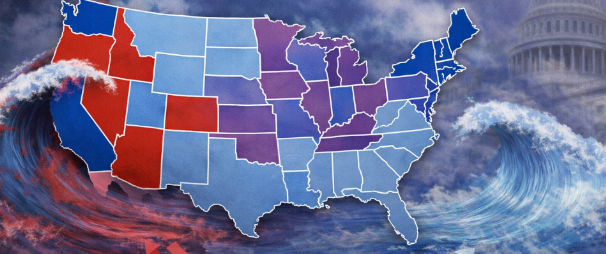

Democratic overperformance in early state legislative special elections provides a key indicator for the 2026 midterms.
What to Know
- Democrats are outperforming their 2024 presidential baseline by a median of 10.4 percentage points across 39 contested state legislative special elections.
- Democratic candidates have exceeded their expected performance in 34 of 39 races, suggesting broad-based grassroots enthusiasm.
- Democrats have flipped five Republican-held legislative seats while losing zero seats to Republicans so far in 2026.
- If the current swing persisted through November, projections suggest Democrats could gain roughly 683 state legislative seats, flip 12 chambers, and secure five new trifectas.
- Special elections often serve as early warning signs of broader electoral trends, though historical examples such as 2018 show that early swings can moderate before Election Day.
According to analysis from the University of Virginia Center for Politics' Crystal Ball and special election tracking from MultiState Elections, the early indicators of the 2026 midterm environment are pointing in the same direction. Historically, these localized, low-turnout contests act as highly sensitive barometers of grassroots mobilization and partisan enthusiasm.
Early results suggest Democrats are generating stronger voter engagement and electoral overperformance than would typically be expected, while broader forecasting models point to a political environment that has traditionally produced midterm losses for the president's party. Together, these indicators suggest that Republicans may face a more challenging electoral landscape in 2026 than national headlines alone would imply.
The Early 2026 Numbers Are in a Deep Blue Tint
According to MultiState Elections' Swing Analysis, Democrats have opened 2026 with a series of strong performances in state legislative special elections. Across 39 contested races, the data points to an environment that is favoring Democratic candidates well beyond their recent electoral baseline.
|
Key Metrics:
|
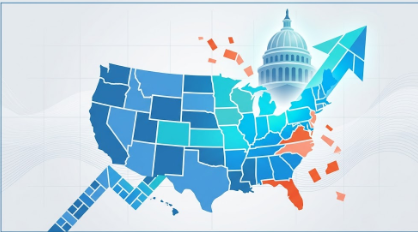
If a D+10.4 environment were sustained through the 2026 general election, MultiState Elections projects significant down-ballot consequences. Their modeling estimates Democrats could gain approximately 683 state legislative seats, flip 12 legislative chambers, and secure five new Democratic trifectas, including in key battleground states such as Michigan, Pennsylvania, Arizona, Wisconsin, and Minnesota.
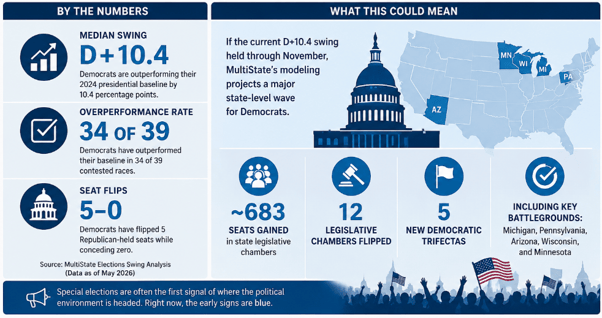
While special election results do not always translate directly to November outcomes, the consistency of Democratic overperformance across a relatively large sample of races suggests that the party is benefiting from a favorable political environment as the 2026 midterm cycle begins.
Potential Chambers at Risk
If the current trajectory holds, Democratic gains could put legislative control in play across several critical battleground states:
- Michigan
- Pennsylvania
- Arizona
- Wisconsin
- Minnesota
These states collectively sit at the epicenter of the nation's fights over election law, abortion, energy development, and congressional redistricting.
Caveats and the 2018 Reality Check
The early warning signs are already attracting attention from political observers and elected officials alike. Following a series of surprising special election results, some Democrats have argued that voter frustration may be surfacing earlier than expected. As Tampa Mayor Jane Castor observed after one such upset, "It's a real wake-up call across the state [of Florida]... and rightfully so. People are just so fed up with the chaos."

Mayor Jane Castor
That sentiment mirrors what special elections have historically revealed: they often serve as an early stress test of public mood before the broader electorate fully engages. However, history also shows that the intensity of these early swings can fade as campaigns become nationalized, turnout expands, and voters focus more closely on individual candidates and issues. Consider the 2018 midterm cycle, which featured a similar political dynamic under President Donald Trump:
|
Timeline / Metric |
2018 Special Election Median Swing |
2026 Special Election Median Swing |
|
January – April |
D+18.1 (22 races) |
D+10.4 (39 races) |
|
May – October |
D+2.0 (10 races) |
TBD |
|
Overall Pre-November |
D+14.5 (32 races) |
TBD |
|
Actual November Result |
Net +308 seats / 6 chambers flipped |
TBD |
In 2018, the initial explosion of Democratic enthusiasm chilled significantly by the summer and fall, though it was still strong enough to net major victories in November. The 2026 data shows a smaller initial "spike" than 2018 (D+10.4 vs D+18.1), but it stems from a larger, more consistent sample size of races (39 vs 22), indicating a deeply baked-in national environment.
Macro View: Mirroring the Federal Outlook
The grassroots energy found in state special elections directly mirrors what quantitative models are predicting on Capitol Hill. In their structural forecasting, Sabato’s Crystal Ball highlighted Alan Abramowitz’s Generic Ballot Model, which relies on just two fundamental variables: generic ballot polling and the "seat exposure" of the president's party.
The model heavily favors Democrats in the midterms for a clear structural reason: the party holding the White House historically faces severe mid-cycle corrections. Even with a tied generic ballot, structural exposure is estimated to cause Republicans to lose roughly 13 House and 5 Senate seats, which would be enough to hand control of both chambers back to the Democrats.
Wrap Up
Democrats have outperformed their 2024 baseline in 34 of 39 contested races, flipped five Republican-held seats, and posted a median overperformance of more than 10 percentage points. Taken together with broader structural models that predict midterm challenges for the president's party, these results suggest that Democratic enthusiasm is translating into measurable electoral gains.
Whether this develops into a 2018-style wave remains to be seen. But for Republicans, the early warning lights are flashing. For Democrats, the challenge will be sustaining this energy through November. And for political observers, the message is increasingly clear: some of the earliest clues about the 2026 midterms may already be appearing in state legislative special elections.