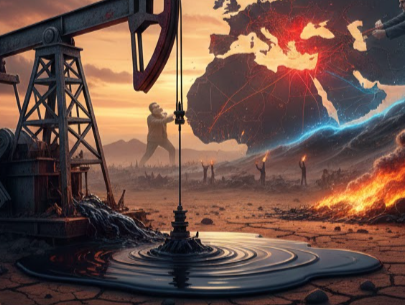

Underheading sentence: A potential collapse of the Iranian regime threatens an oil price shock that could upend the Republican Party's midterm strategy.
What to Know
- Iran is facing its most significant nationwide protests since the 1979 revolution, raising questions about the regime's survival.
- A government collapse could disrupt 3.3 million barrels of oil per day, with analysts putting the risk of a supply shock at 40 percent.
- Any disruption to the Strait of Hormuz, a key global oil artery, would amplify the economic impact.
- Historically, sharp increases in gas prices are linked to major electoral losses for the party in power.
- The GOP's handling of the crisis, from policy to messaging, will be critical to mitigating political fallout.
A confluence of events in Iran is creating a potential "black swan" with direct implications for the 2026 GOP midterm elections. Intensifying protests and regime fragility in Tehran have raised the likelihood of a major oil supply disruption. Such an outcome represents a material political risk for Republicans, as a sharp spike in gas prices could weaponize pocketbook pain for voters and create a narrative of strategic incompetence that Democrats could exploit.
The Tinderbox of Iranian Unrest
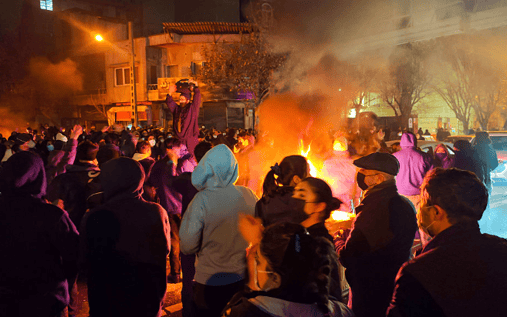
Since late last year, Iran has been engulfed in a nationwide uprising. What began as demonstrations over economic collapse have exploded into the most consequential challenge to the government since the 1979 revolution. The regime's response of mass arrests and lethal force has drawn sharp human-rights scrutiny and failed to suppress the movement.
As Matt Gertken of BCA Research noted, "The survival of Iran’s regime seems seriously at stake for the first time since it assumed power."
Analysts now debate the endgame, with scenarios ranging from a fragmentation of the security apparatus to an elite-driven transition. The reportedly failing health of Supreme Leader Ali Khamenei adds another layer of profound instability.
The Oil Shock Domino Effect
The immediate channel for political risk is the global energy market. Iran’s exports of roughly 3.3 million barrels per day are pivotal to market balances. A sudden halt to these exports would trigger a sharp price spike and sustained volatility. The risk is not trivial. A BCA Research analysis summarized in Barron's places the likelihood of a global oil supply shock at "around 40%" if the regime crumbles.
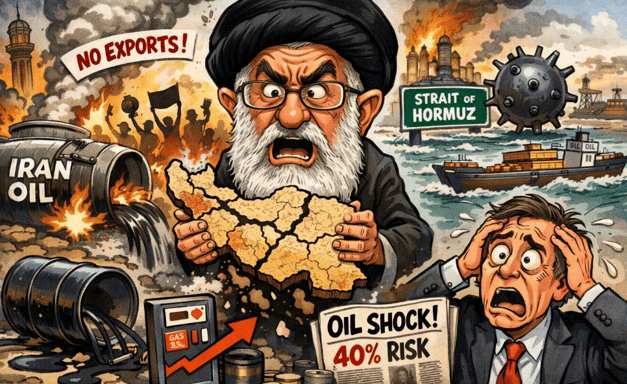
Any incident that constrains oil flows through the Strait of Hormuz, a critical artery for global crude, would amplify the effects significantly. Should prices double, the risk of a global recession would rise dramatically, with immediate consequences for American consumers.
Strategic Bind for Republican Leadership
The Iranian crisis places Republican leadership in a narrow strategic corridor with little margin for error. Aggressive posturing risks inflaming markets and accelerating price volatility, while restraint invites attacks from both Democrats and elements of the GOP base that equate caution with weakness. This tension limits policy flexibility at precisely the moment when clarity and discipline are most needed.
Complicating matters further, responsibility for outcomes will be assigned domestically regardless of causation. Even if price shocks originate overseas, the party in power bears the burden of explanation.Cohesive narratives from the White House, Congress, and media are vital; inconsistency threatens stability and undermines confidence.
For Republican candidates, this creates an asymmetric challenge. Defensive explanations consume airtime that would otherwise be devoted to favorable themes such as inflation moderation, border control, or crime. The longer the crisis dominates headlines, the harder it becomes to pivot back to controlled messaging. In close races, that displacement effect alone could prove decisive.
A Midterm Massacre for the GOP
For the party in power, a pronounced oil-price shock is a political catastrophe. History shows a clear correlation between rising energy costs and incumbent-party losses. With voters already sensitive to living costs, a gas-price spike would become a highly salient issue, shaping narratives around competence and international risk management.
The opposition's messaging would focus squarely on pocketbook pain and market instability. For Republicans, it is the kind of crisis that could transform a difficult election cycle into a rout, turning perceived strategic missteps into a clear and powerful campaign issue for Democrats.
Wrap Up
The unfolding crisis in Iran is more than a foreign policy challenge; it is a significant electoral risk for the GOP. The key for the incumbent party will be in its handling of the crisis across three fronts: policy calibration, energy buffers, and narrative framing. Avoiding any action that could trigger a disruption in the Strait of Hormuz is paramount, while strategic management of the SPR and coordination with allies could help cushion a price shock.
Ultimately, the political fallout will be determined by communication. The ability to project competence and clearly explain contingency plans will be decisive in shaping voter perceptions. Without a clear and authoritative message, the GOP risks being defined by the crisis. This would allow the opposition to frame the 2026 election around economic pain and global instability, a dynamic that could cost the Republican party dearly and reshape the political landscape for years to come.
.png)