
Trump’s approval rating is virtually unchanged by tariffs, economic volatility, or scandals, showing a presidency shielded by polarization and an unpersuadable electorate.
What to Know
- Presidential approval has remained stuck in a narrow low-40% range even through tariff fights, economic turbulence, foreign policy clashes, and nonstop political controversy.
- A durable political floor of roughly 40% to 44% support appears to be holding, making Trump unusually resistant to bad headlines or governing shocks.
- The pool of truly persuadable voters has shrunk dramatically, with many self-described independents acting more like partisan leaners than traditional swing voters.
- Campaign strategy has shifted accordingly, with base turnout and voter mobilization now mattering more than persuading a broad middle.
- The broader consequence is a weaker link between performance and public opinion, as presidential approval increasingly reflects polarization more than governance.
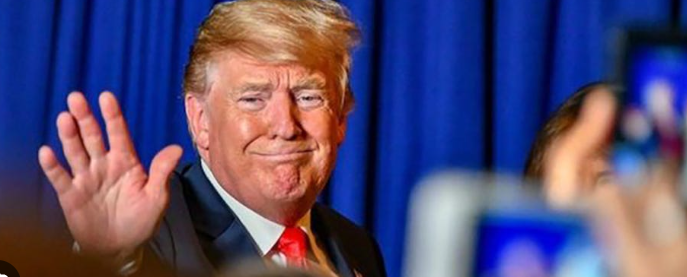
Presidential approval functioned like a volatile stock ticker. A successful military operation or a strong quarter of economic growth could lift a president’s numbers, while a major scandal or foreign policy failure could drag them down just as quickly. In the current political era, that ticker looks frozen. Months of tariff fights, foreign policy clashes, economic volatility, and nonstop political controversy have dominated the news cycle, yet President Donald Trump’s approval rating has barely moved.
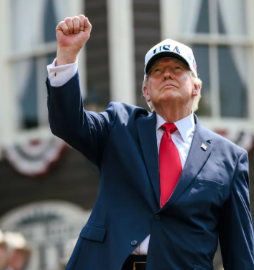
President Donald Trump; image via White House Gallery
The data from both major polling trackers points to the same conclusion. The New York Times presidential approval tracker had Trump at 39% approval and 58% disapproval on July 2, while CNN’s poll tracker shows a similar pattern, with most recent national surveys placing him in the high 30s to low 40s.
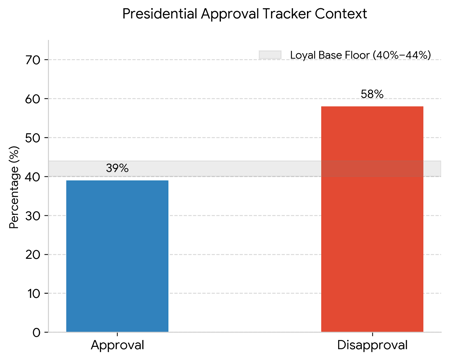
Image made with Gemini
Taken together, the numbers suggest Trump is operating behind a hard political floor of roughly 40% to 44% support, backed by a loyal base that has proven unusually resistant to bad headlines, governing shocks, or changing conditions. The bigger story may no longer be whether a president’s numbers rise or fall, but whether the modern electorate is still persuadable at all.
The Death of the Floating Voter
Aggregate polling suggests public opinion on Trump’s presidency is not moving in the way presidential approval once did. The New York Times average had Trump at 39% approval and 58% disapproval on July 2, while CNN’s tracker shows the same basic pattern across June polling, with Trump repeatedly landing between 34% and 39% approval in surveys from Reuters/Ipsos, AP-NORC, NPR/PBS/Marist, Fox News, Quinnipiac, and Strength in Numbers/Verasight.
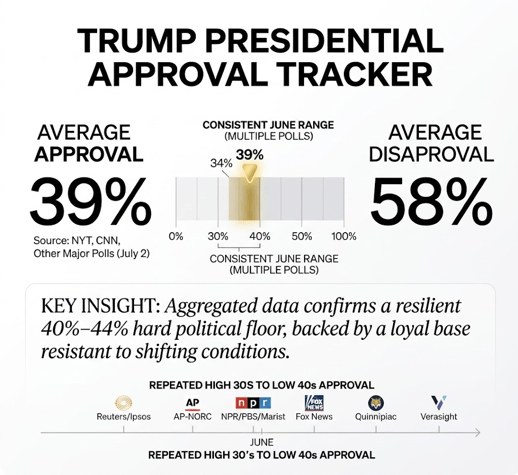
Even the higher-end June polls, including Fox News and RMG Research, only put him in the low 40s. In other words, months of tariff escalation, foreign policy conflict, economic volatility, and legislative fights have not produced a meaningful polling breakout in either direction. That stability reflects a deeper structural change in the electorate. In earlier eras, independent voters could push a president up during periods of calm or pull him down during periods of failure.
Trump has spent much of his second term trapped in the high 30s to low 40s, and according to The New York Times, no president in the last 17 years had spent more than a few days below 38% approval before this stretch. His numbers no longer rise or fall like a normal presidency. They hover like a fixed front in a political war, held in place by a loyal floor beneath him and a ceiling of hardened opposition above.
Where Scandal Goes to Die
Every major event now passes through a partisan filter before it ever reaches the voter. A new tariff round is not just an economic policy fight. For Trump’s base, it can be framed as a necessary sacrifice to protect American industry and punish foreign competitors. A damaging controversy is not simply damaging. It becomes proof that the president is under attack from the same political and media establishment his supporters already distrust.
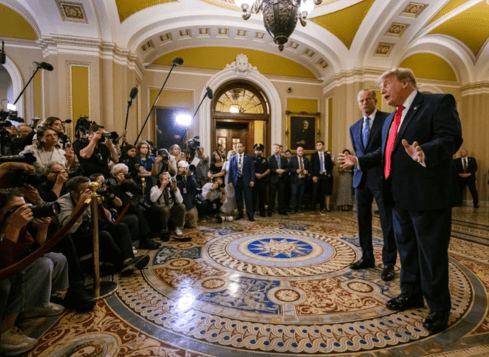
President Donald J. Trump meets with GOP leadership at the U.S. Capitol, June 24, 2026; image via White House Gallery
For his opponents, the exact same events tell the opposite story. Tariffs look like economic self-sabotage. Controversies look like further evidence of chaos, corruption, or institutional decay. The same presidency produces two completely different realities, and both are reinforced daily by the media ecosystems people already live inside.
That is why persuasion has become so weak. Good news does not win over critics who believe the system is still broken. Bad news does not shake supporters who have already decided the attacks are part of the war. The result is a presidency sealed inside hyper-partisanship, where scandal rarely collapses support, success rarely expands it, and almost every new event simply hardens the lines that were already there.
A Stress Test That Barely Moved the Numbers
Trump’s July 1 remarks were effectively a live demonstration of the modern approval ceiling. Standing at the White House after the Iran ceasefire announcement, he pitched the moment as a sweeping political win: Iran had been forced into an agreement, the Strait of Hormuz was open, oil was falling, and markets were surging. He explicitly tied the foreign policy outcome to economic confidence, arguing that without the deal the market would have plunged and the global economy could have taken a hit. In a more fluid political era, a president publicly claiming to have ended a military crisis while stabilizing oil and stocks would expect at least a modest polling bounce.
https://www.youtube.com/watch?v=QI19kSXP0Z4 [embed] video of Trump in the Situation Room.
Instead, the polling barely moved. The New York Times average still had Trump at 39% That is the strategic shift underneath Trump’s second term. The White House no longer has much incentive to moderate in search of broad approval if broad approval is structurally out of reach. Instead, the objective becomes turnout, intensity, and cultural solidarity.
Wrap Up
Trump’s approval floor is not just a polling curiosity. It is a warning about what happens when public opinion stops functioning as a meaningful check on power. If tariffs, military escalation, economic volatility, scandal, and legislative chaos can all come and go without moving the electorate very much, then the normal relationship between performance and accountability starts to erode. A president no longer has to expand support to survive. He only has to hold his side.
That changes the incentives of governing in ways that reach far beyond Trump. The less reward there is for persuasion, the less reason there is to build broad coalitions, make concessions, or govern toward the middle. Politics becomes a game of preservation rather than conversion, fought through turnout, grievance, media warfare, and cultural loyalty instead of persuasion or consensus. The danger in the 40% barrier is not simply that it protects one president. It is that it points toward a political future where leaders are judged less by what they do than by whether they can keep their tribe locked in place.
-May-16-2026-10-24-03-9739-PM.jpg)