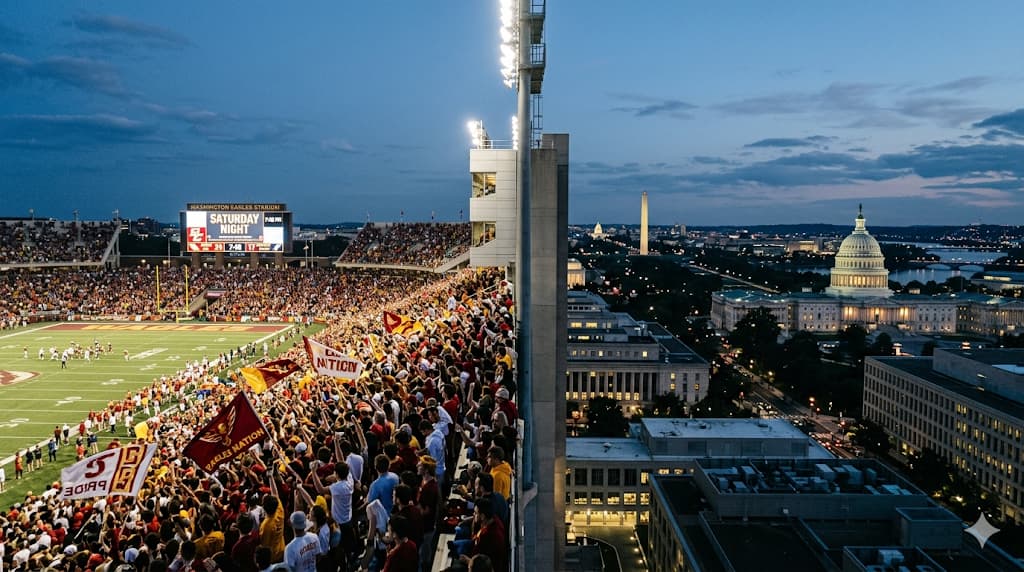

When Washington starts deciding who can get paid and who can transfer, sports-first voters stop changing the channel and start keeping score.
What to Know
- Trump's April 3, 2026 order "Urgent National Action to Save College Sports" ties NIL and eligibility compliance to federal funding, with noncompliant schools cut off after August 1, 2026.
- The order caps eligibility at five years, allows one immediate transfer, and bans above-market pay-for-play NIL deals.
- College sports fans lean heavily Republican in key regions, putting GOP-aligned sports-first voters directly in the path of a federal crackdown.
- Universities, collectives, brands, and investors now face heightened regulatory and funding risk under fast-shifting federal standards.
- For Republican campaigns, the order is an opportunity to champion fairness and tradition, but a risk if it ignores athletes who see NIL as a hard-earned economic chance.
College sports have always been political, but not like this. President Donald Trump just used the power of federal funding, procurement rules, and agency guidance to turn NIL compensation and transfer rules into questions that now involve the Department of Education, the Office of Management and Budget, and the Federal Trade Commission. The April 3 order is framed as a rescue mission for college sports, yet it lands directly on the wallets and mobility of the most visible young people in American culture at the exact moment they have learned how to monetize that visibility.
For campaigns, the timing is not an accident. The same administration that polled “save college sports” as a slogan now has an enforcement-driven framework tied to federal dollars that it can present to sports-first voters as proof of action. The question for Republican strategists is whether they treat this as a culture fight about saving tradition or as a kitchen-table story about how Washington rules can decide whether a star quarterback or volleyball captain can get paid without blowing up their eligibility and their school’s federal funding.
NIL Enforcement Is Now a Federal Lever
The Morgan Lewis LawFlash is blunt. The new executive order takes concepts that were aspirational in the July 24, 2025 “Saving College Sports” order and turns them into a national compliance baseline by tying athletic department behavior to federal funding eligibility. That means NIL deals, transfer policies, eligibility decisions, and revenue-sharing structures are no longer just conference debates or NCAA handbook issues, they are risk factors that can affect whether a university keeps its research grants and major federal contracts.
As one Morgan Lewis analysis puts it:
“The April 3, 2026 executive order Urgent National Action to Save College Sports marks a significant escalation in federal involvement in intercollegiate athletics, moving beyond prior policy guidance to an enforcement-driven framework that ties college athletics practices particularly NIL activity to federal funding eligibility.”
The order directs federal agencies that provide grants or contracts to universities to treat athletic department behavior as part of assessing institutional responsibility, and it tasks OMB and GSA with writing the guidance that will turn this political headline into binding funding rules. Noncompliance can trigger suspension or debarment from federal programs, which puts athletics decisions into the same risk category as accounting controls and research compliance for general counsels and boards of trustees.
-jpg-Apr-20-2026-12-20-06-1649-PM.jpeg?width=757&height=413&name=image%20(1)-jpg-Apr-20-2026-12-20-06-1649-PM.jpeg)
Campaign Now (Gemini), data from Morgan Lewis. College NIL decisions feeding into federal funding risk gauge
The order also embraces a national standard project under an interstate governing body, with federal encouragement to cap eligibility at five years, curb multi-stop transfer paths, and keep former professionals from returning to college rosters. On NIL, it operationalizes the House settlement by defining “improper financial activities” that include above-market deals tied to athletic performance, interference with existing athlete contracts, and any use of federal dollars for NIL or revenue-sharing payments, all backed by potential FTC enforcement and Department of Justice litigation.
Sports-First Voters Are Already Politicized
The sports-first voter the brief targets is not apolitical. He is partisan, younger, and more online than the average midterm voter, and he has already mapped his sports identity to his political identity in ways that matter for 2026. The Young Men Research Initiative finds that college sports fans, especially those who follow major college programs, lean significantly more conservative and Republican than fans of leagues like the NBA or global soccer. Commonwealth Times reporting adds that college football fans remain one of the most Republican-leaning major fan bases in American sports, particularly in the South and Midwest, where college allegiance mirrors partisan geography.
Young Men Research Initiative summarizes the partisan spread across fan bases this way:
“At the other end, MMA or UFC shows the lowest share of Democratic-identifying young men (27 percent), while golf fans are the most Republican (54 percent).”
Yahoo Sports and associated voter file analysis go further by matching fandom to political affiliation, showing that fans of certain college and pro teams are surrounded by neighbors and peer networks that lean heavily Republican. In other words, the college sports ecosystem is not just culturally aligned with the Republican Party, it is embedded in physical and social networks that already vote Republican at higher rates than the national average. For a party that has spent cycles trying to energize sporadic male voters and younger men, that is not a curiosity, it is a turnout and persuasion map.sports.
The Order Turns Programs Into Political Actors
Universities and athletic departments did not ask to be campaign props. The new order forces them into politics by making every NIL deal, every transfer waiver, and every roster decision part of a compliance picture that can affect federal science funding, student financial aid, and even defense research dollars. Baker Donelson’s analysis warns that institutions now have to treat NIL governance and transfer oversight as enterprise risk, reexamining relationships with collectives, reviewing Title IX implications of revenue-sharing models, and preparing for enhanced financial and roster reporting.
Baker Donelson’s team captures the shift this way:
“The order is designed to promote a more uniform national approach to core college-sports rules – especially athlete eligibility, transfers, revenue-sharing, and pay-for-play activity – by leveraging federal grants and contracts and by pressing the NCAA to update or clarify its rules before August 1, 2026.”
-jpg-4.jpeg?width=160&height=160&name=image%20(3)-jpg-4.jpeg)
Sarah E. Bouchard, Partner, Morgan Lewis
As the Baker Donelson team puts it, institutions are being pushed toward more centralized control over college sports economics, even as they navigate antitrust, state law, and player rights litigation that all lean in the opposite direction. That tension, a Washington push for uniform standards against a backdrop of decentralization and athlete empowerment, is exactly where political narratives can either help or hurt Republican campaigns. A framing that says “we are protecting women’s sports and Olympic sports from NIL chaos” is very different from one that sounds like “Washington is cutting off kids’ chances to earn.”
At the same time, ICS Lawyer’s breakdown of the order’s limits reminds us that agencies still have to write the rules and courts still have to weigh in. The order signals aggressive intent, but it does not instantly resolve litigation over athlete employment status, antitrust challenges to NCAA rules, or conflicts with existing state NIL laws, and the Attorney General’s preemption strategy will invite challenges that may narrow its reach over time. Campaigns need to understand that dual reality, strong messaging value now and legal uncertainty later, before they overpromise what the order will accomplish.
How Republicans Can Talk To Sports-First Voters Without Losing Athletes
For Republican campaigns, the executive order is an opening to speak into a voter’s most emotional weekly ritual, the moment when a sports-first voter sits in a packed college arena or stadium and feels like part of something bigger than politics.
-jpg-Apr-20-2026-12-20-35-6461-PM.jpeg?width=292&height=365&name=image%20(4)-jpg-Apr-20-2026-12-20-35-6461-PM.jpeg)
President Donald Trump, President of the United States
The White House is already framing the move in those emotional terms, pitching the action as “saving college sports” by stopping NIL abuses, protecting women’s sports, and preserving Olympic and nonrevenue programs. That is the top-of-ticket narrative, and it gives down-ballot Republicans permission to talk about the order as a defense of fairness and tradition for ordinary fans.
According to Politico, Republican recruiters are already leaning into the sports connection by backing more athletes and former coaches on the 2026 ballot, betting that shared sports identity can close the gap with voters who are sour on politics but loyal to their teams. That strategy intersects directly with the executive order, which gives those candidates a concrete Washington action they can point to when they say they are on the side of saving college sports. A Republican campaign that parrots the talking points without acknowledging how NIL and the transfer portal opened real economic opportunities for players, though, will lose credibility with younger sports-first voters who often identify with athletes more than administrators.
-jpg-Apr-20-2026-12-20-51-8181-PM.jpeg?width=561&height=306&name=image%20(2)-jpg-Apr-20-2026-12-20-51-8181-PM.jpeg)
Campaign Now (Gemini), data from Young Men Research Initiative. Young male college fans leaning Republican, distrusting both parties
The more effective message for Republicans is localized and concrete. It starts with acknowledging that NIL and the transfer portal created real opportunities for players, especially those from working and middle class families, then pivots to the practical question of whether those opportunities are being captured by a few big brands and powerful collectives or are being spread fairly across rosters and sports. It emphasizes protecting scholarships and women’s and Olympic sports opportunities in a way that makes sense to parents and high school coaches, while promising to keep Washington from micromanaging every NIL deal on campus.
Wrap Up
The federal NIL crackdown did not suddenly turn sports-first voters into political obsessives. It did something subtler and more powerful. It brought Washington into the one part of American life that many of those voters thought was still theirs alone.
For Republican campaigns, that is a rare opportunity. The sports-first voter who leans right and spends Saturdays in team colors is now paying attention to who is framing the future of college sports as something being done for him and for the athletes he loves, and who is framing it as something being done to them.
The campaigns that meet that voter where he actually lives, inside the tension between wanting fair, stable college sports and wanting athletes to have real economic chances, will own this issue in 2026. The ones that talk past him, treating NIL and transfer rules as just another culture fight, will learn the hard way that you cannot take a sports-first Republican for granted once politics walks into his locker room.