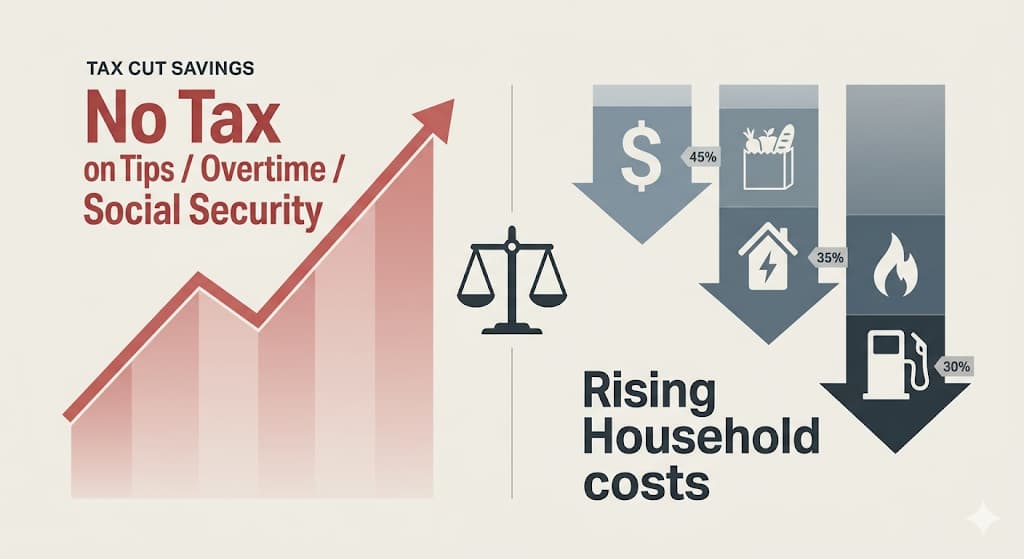

Rising costs from energy shocks and import levies are quietly swallowing the working-class savings Republicans promised voters.
What to Know
- Trump's "one big beautiful bill" cuts federal income tax on tips, overtime, and Social Security.
- Wages are up 30.8% since the pandemic, but household costs have risen even faster.
- Groceries are up 31%, utilities up 41%, auto insurance up 55% since 2020.
- Tariffs are costing the average household between $760 and $1,500 every year.
- Trump's inflation approval has collapsed to 34%, endangering Republican seats in 2026.
Republican campaign professionals know the pitch: no tax on tips, no tax on overtime, no tax on Social Security.What the One Big Beautiful Bill delivers on paper is genuine relief for working families.What it faces in practice is a war against pandemic-era inflation and a tariff structure passing costs straight to consumers Republicans need.
Wages have climbed 30.8% since the pandemic, according to Brookings Institution Senior Fellow William A. Galston, but core costs have outpaced that gain everywhere. Grocery bills are up 31%, utilities up 41%, and every dollar recovered on the tax line meets resistance at the wallet.
Working Families Feel the Pull in Both Directions
Republican messaging has centered these tax cuts as a working-class victory, and on paper that case holds. Eliminating federal income tax on tips puts real money in the pockets of bartenders, servers, and hospitality workers. Michael Whatley, the Republican Senate nominee in North Carolina, framed the stakes at a Rocky Mount rally around protecting "no tax on tips, no tax on overtime, no tax on Social Security."
%20copy-jpg.jpeg?width=168&height=299&name=image%20(1)%20copy-jpg.jpeg)
Michael Whatley, Republican Senate Nominee, North Carolina
Workers benefiting from tip relief are often absorbing the steepest cost increases elsewhere. Brookings data shows out-of-pocket health expenses climbed nearly one-third in five years, from $1,239 to $1,652 per person. For a service worker without employer coverage, no tax on tips does not bridge that gap.
-jpg-May-31-2026-12-45-42-6340-PM.jpeg?width=650&height=355&name=image%20(1)-jpg-May-31-2026-12-45-42-6340-PM.jpeg)
Campaign Now (Gemini), data from Brookings Institution, household cost increases since pandemic
Michael Whatley, speaking in Rocky Mount, made the Republican case:
"I don't know about you, but I sure trust you to spend your money better than a federal government in D.C."
Committed Trump voters hear that and agree. Persuadable working-class voters are weighing checkout sticker shock against a tax benefit that arrives once a year.
Tariffs Add a Second Layer of Pressure on Household Budgets
Tariffs have layered a direct cost on top of existing inflation. Yale Budget Lab's April 2026 analysis puts the average effective tariff rate at 11.8%, the highest since the early 1940s. Under the baseline scenario, households absorb losses of $760 to $940 annually. If Section 122 tariffs are made permanent, that range climbs to $1,200 to $1,500.
New car prices climbed from $38,000 to $50,000 since the pandemic, a 32% jump, while auto insurance premiums surged 55%. Families stretched by those numbers are absorbing tariff-driven increases on every subsequent purchase.
-jpg-May-31-2026-12-45-53-6193-PM.jpeg?width=672&height=367&name=image%20(2)-jpg-May-31-2026-12-45-53-6193-PM.jpeg)
Campaign Now (Gemini), data from Yale Budget Lab, tariff burden by income

William A. Galston, Senior Fellow, Brookings Institution
Brookings Institution Senior Fellow William A. Galston, writing in March 2026, stated the electoral risk:
"His dismal approval rating of 34% for his handling of inflation is endangering the survival of Republican House candidates in swing districts and is raising the odds that Democrats will take control of the Senate."
Yale Budget Lab found the burden is regressive. Households in the bottom income decile absorb a cost 3 times higher as a share of income than those at the top. Working-class voters at the coalition's core are bearing the heaviest load.
Affordability Has Become the Central Battleground of 2026
Housing has deepened the crisis. Median home prices have risen 28% since early 2020, from $317,000 to $405,000, while mortgage rates jumped from 3.45% to 6.11%. Qualifying now requires $120,000 in household income, against a national median of just $85,000. First-time buyers have been locked out, with the median purchase age rising to 40 years.
North Carolina Democratic candidate Roy Cooper built his Senate campaign around health care costs, housing prices, and tariff-driven grocery bills. PBS NewsHour reported that even some longtime Trump supporters are wavering under cumulative cost pressure.
-jpg-May-31-2026-12-46-43-9414-PM.jpeg?width=575&height=314&name=image%20(3)-jpg-May-31-2026-12-46-43-9414-PM.jpeg)
Campaign Now (Gemini), data from Brookings Institution, housing gap vs. income
%20copy-jpg.jpeg?width=437&height=291&name=image%20(2)%20copy-jpg.jpeg)
Vice President JD Vance, Vice President of the United States
Vice President JD Vance, rallying voters in Rocky Mount, delivered the Republican answer:
"He constantly is pressing on the gas. He wants us to do more."
Republican campaigns putting real dollar values on tip and overtime savings in front of working voters will be better positioned than those ceding the affordability debate to Democrats.
Wrap Up
Trump's tax cuts deliver real money back to working Americans. No tax on tips, no tax on overtime, and no tax on Social Security carry measurable dollar value for the families Republicans need in 2026. Campaigns making those savings tangible will hold ground generic messaging cannot.
Tariff costs and inflation are facts voters feel every week. Yale Budget Lab puts household tariff losses between $760 and $1,500 annually, and Brookings confirms core costs have outrun wages across every budget category. Republicans leading with the relief they have delivered carry the stronger argument into November.