
As digital platforms overtake traditional media in voter influence, campaigns must pivot from legacy TV-centric structures to agile operations focused on high-volume content production and real-time data analysis.
What to Know:
- Online political advertising spending surged to at least $1.9 billion in the 2024 cycle, but paid reach alone did not match the scale of organic attention in the platform era.
- Among registered voters who listen to podcasts, 50% said the medium influenced their vote in 2024; among listeners aged 18–34, the split favored Trump (54% vs. 43%).
- TikTok is now a primary political information channel for younger Americans, with 48% of users aged 18–29 saying they use the platform to keep up with politics or political issues.
- Legacy campaign operations are struggling to keep pace: only 42% of political professionals report they are satisfied with the tools they currently use, citing UX and integration gaps.
- Voter engagement has fundamentally shifted toward online video, with 64% of voters reporting they watched videos of or about candidates during the 2024 cycle.
This analysis draws on the Center for Campaign Innovation’s Creator-Candidate framework, backed by election-cycle benchmarks from the Brennan Center for Justice, Pew Research Center, and eMarketer.
The Acceleration of the Creator Candidate Era
The 2024 cycle was a tipping point for what the Center for Campaign Innovation describes as the Creator Candidate Era: political success increasingly rewards candidates who can win attention and trust through podcasts, short-form video, and direct-to-voter channels, not just through a late-cycle television “air war.” Even as digital ad dollars climbed, the dominant story of the cycle was how quickly organic content ecosystems shaped narratives and moved impressions at scale.
“The candidates who broke through were not simply those with the largest television budgets, but those who had mastered the influencer landscape of short-form video, podcasts, and direct-to-voter relationships.” — Center for Campaign Innovation
The shift is not abstract. Key blocs that decide close elections are consuming information across fragmented feeds, streaming environments, and long-form audio. Campaigns that still treat social as a sidecar to the TV plan are discovering that “reach” is no longer guaranteed by a media buy and that persuasion increasingly depends on consistency, responsiveness, and platform-native storytelling.
Why Legacy TV-First Structures Are Misaligned
Traditional campaign infrastructures still reflect a broadcast-era logic: build around TV, optimize GRPs, and surge spending late. That structure is increasingly misaligned with how voters actually experience politics today. The cycle time from message creation to voter consumption has collapsed. A narrative can form in hours, not weeks, and a campaign that only “goes loud” at the end often arrives after the story has already hardened.
This shift is quantifiable: in 2024, swing voters were significantly more likely to rely on social media (45%) for news than on local television (39%) or broadcast news (38%).
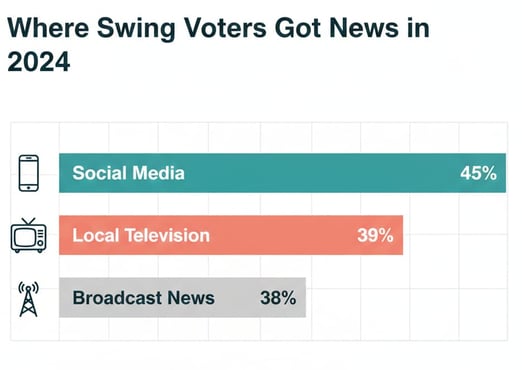
Swing voters prioritize social feeds over traditional broadcast. Created by Campaign Now with Gemini. Data from Navigator Research
“That logic is breaking down. In an environment dominated by TikTok clips, livestreams, and long-form conversations on Spotify, authenticity and speed matter more than thirty-second polish.” — Center for Campaign Innovation
This misalignment also shows up in incentives. TV-first teams tend to prioritize thirty-second polish, strict message control, and quarterly cadence. Platform environments reward speed, authenticity, and iterative testing. When persuasion happens in a feed, message discipline is less about a single perfect spot and more about whether a campaign can repeat its core frame in dozens of formats without losing coherence.
Core Capability 1: Content Production at Scale
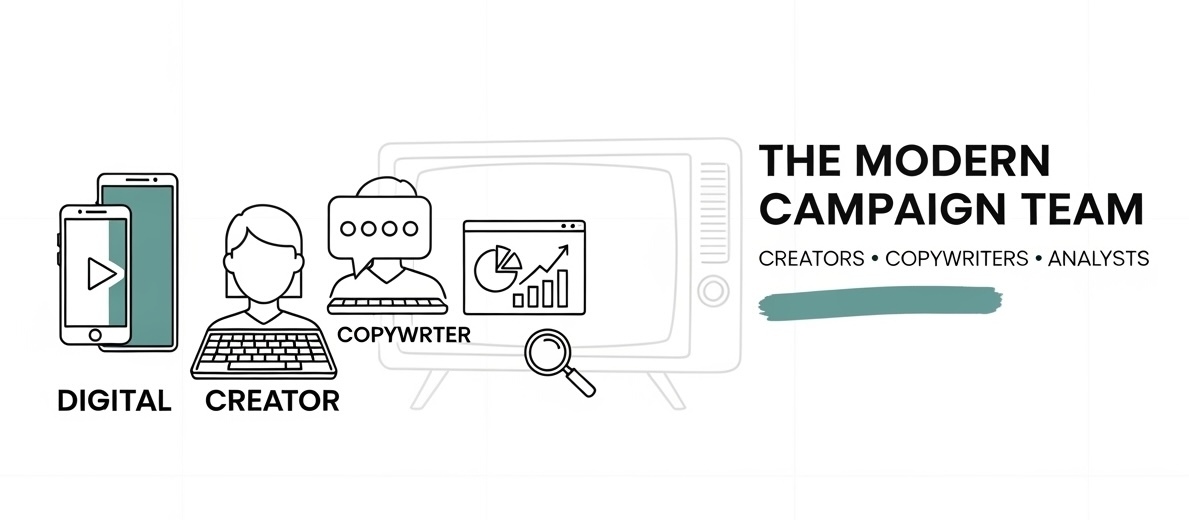
The first modern capability is operational, not ideological: campaigns need production capacity that matches the tempo of the internet. In the Creator Candidate model, the key role shifts from a generalist media consultant producing a handful of high-gloss spots to a producer function that can record, edit, clip, caption, schedule, and publish continuously.
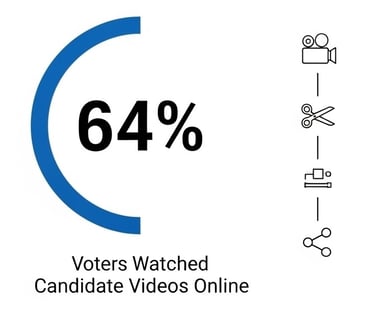
Online video drove majority of voter engagement. Created by Campaign Now with Gemini. Data from 2024 Post-Election National Survey | Center for Campaign Innovation
“Unlike the traditional media consultant who perfects a few television spots, this producer trims a podcast into a vertical teaser before lunch and schedules three follow-up clips before dinner.” — Center for Campaign Innovation
This is not just about volume for volume’s sake. Continuous production creates optionality. It lets campaigns test frames, respond to breaking moments, and repurpose long-form assets into a steady stream of short clips that carry the same message into multiple audiences. It also supports relational organizing, giving supporters shareable, platform-specific content that travels through trusted networks.
Core Capability 2: Platform-Native Copywriting
The second capability is platform-native writing. In practice, that means writing for hooks, retention, and clarity under extreme compression. Copywriters are no longer optimizing only for press hits and fundraising emails; they’re optimizing for on-screen text, captions, show notes, and short scripts that perform in silent autoplay and reward the algorithms that decide distribution.
“The key... is ‘authenticity.’ Democrats... often approach podcast appearances as an opportunity to ‘repeat the same talking point’ that they may have already made on CNN or MSNBC.” — Campaigns & Elections
This also changes tone. Platforms punish jargon and reward language that sounds like a human, not a committee. The job becomes translation: turning complex policy into digestible, conversational lines that can be repeated across formats without losing meaning. In the Creator Candidate Era, copy is not decoration. It is distribution.
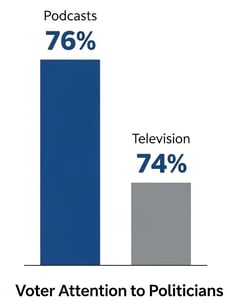
Voters pay more attention to podcasts than TV. Created by Campaign Now with Gemini.Data from Campaigns & Elections
Core Capability 3: Real-Time Analytics and Strategy
The third capability is the engine that ties the system together: real-time analytics that turn engagement data into decisions. Platform performance creates a flood of signals, including watch time, retention curves, shares, saves, and click-through. The strategic advantage comes from translating those signals into action quickly: what to make next, what to amplify, what to cut, and where to spend.
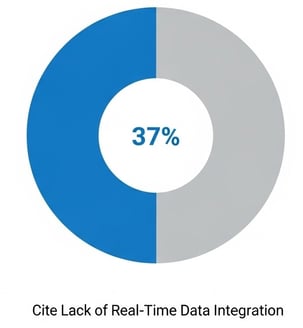
Real-time integration remains a top challenge for professionals. Created by Campaign Now with Gemini. Data from Center for Campaign Innovation
“The platform’s interactive features—such as duets, stitches, and comment sections—allow for direct engagement and real-time feedback.” — International Journal of Research and Innovation in Social Science
Campaigns that keep analytics siloed in paid media reporting are leaving persuasion value on the table. The modern loop is integrated. Organic performance informs creative priorities, audience focus, and paid boosts, often within the same day. In a feed-driven environment, strategy must be responsive, not static.
The Podcast Frontier: A Case Study in Adaptation
The “Podcast Election” dynamic of 2024 shows why production, copywriting, and analytics must operate as one system. Podcasts let candidates bypass traditional filters and build trust through long-form conversation. But capturing value from audio requires a full-stack approach. Producers must clip and distribute highlights into short-form ecosystems. Copywriters must tailor narratives to the culture of hosts and audiences. Analytics teams must work with imperfect attribution to understand which appearances and clips are driving reach, fundraising, and persuasion.
“Podcasts played a pivotal role in swinging key voting blocs toward President Donald Trump in the 2024 election and could hold the key for Democrats seeking to rebuild their splintered political coalition.” — Campaigns & Elections
The takeaway is not that podcasts replace everything else. It’s that podcasts illustrate the new standard: campaigns win when they treat modern channels as ecosystems that require specialized roles, rapid repurposing, and disciplined iteration.
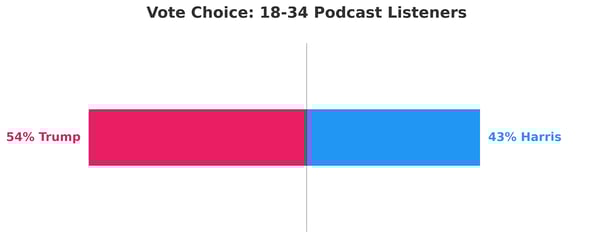
Young podcast listeners broke for Trump in 2024. Created by Campaign Now with Gemini. Data from Campaigns & Elections
Wrap Up
The 2024 cycle made the Creator Candidate Era impossible to ignore. Voters, especially persuadable and younger audiences, are consuming politics through fragmented feeds, streaming environments, and long-form audio, where authenticity and speed often outperform traditional polish.
That reality forces a staffing and workflow shift. Campaigns need production capacity that scales, writers who can build platform-native narratives, and analytics functions that turn engagement signals into strategic direction in real time.
Traditional media still matters, but it no longer sets the tempo. The campaigns that invest earlier in continuous content, modern creative roles, and integrated analytics will carry a durable advantage in fundraising, persuasion, and message discipline heading into the next cycle.
Source:
https://campaigninnovation.org/research/2024-post-election-political-professional-survey
https://campaigninnovation.org/research/2024-post-election-national-survey
https://campaignsandelections.com/industry-news/podcasts-played-pivotal-role-in-2024-election/
https://www.wired.com/story/visual-guide-to-influencers-shaping-2024-election/
https://navigatorresearch.org/wp-content/uploads/2024/11/Navigator-Update-12.02.2024.pdf