
Trump now motivates far more voters in opposition than support, intensifying Republican exposure across competitive House districts nationwide.
What to Know
- Voters describing their congressional choice as opposition to Trump outnumber his supporters by 44% to 19%.
- Trump factors into the congressional choice of 63% of registered voters, nationalizing races beyond his own ballot status.
- Democratic House candidate supporters lead Republicans in extreme voting motivation by 63% to 46%.
- Democratic candidates hold a 44% to 36% national House preference advantage in one individual survey.
- Only 49% of Trump voters who dislike the Republican Party currently support its House candidates.
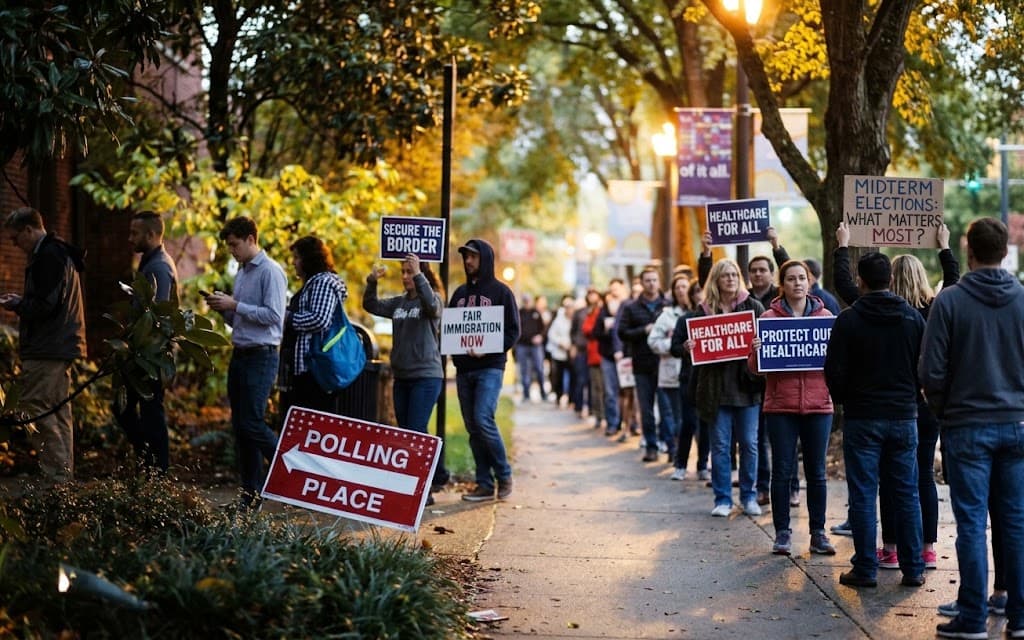
Donald Trump remains the central figure in American electoral politics even though his name does not appear on the 2026 ballot. A Pew Research Center survey found that nearly two thirds of registered voters consider him a factor in their congressional choice. Far more of those voters describe their ballot as opposition to Trump than support for him.

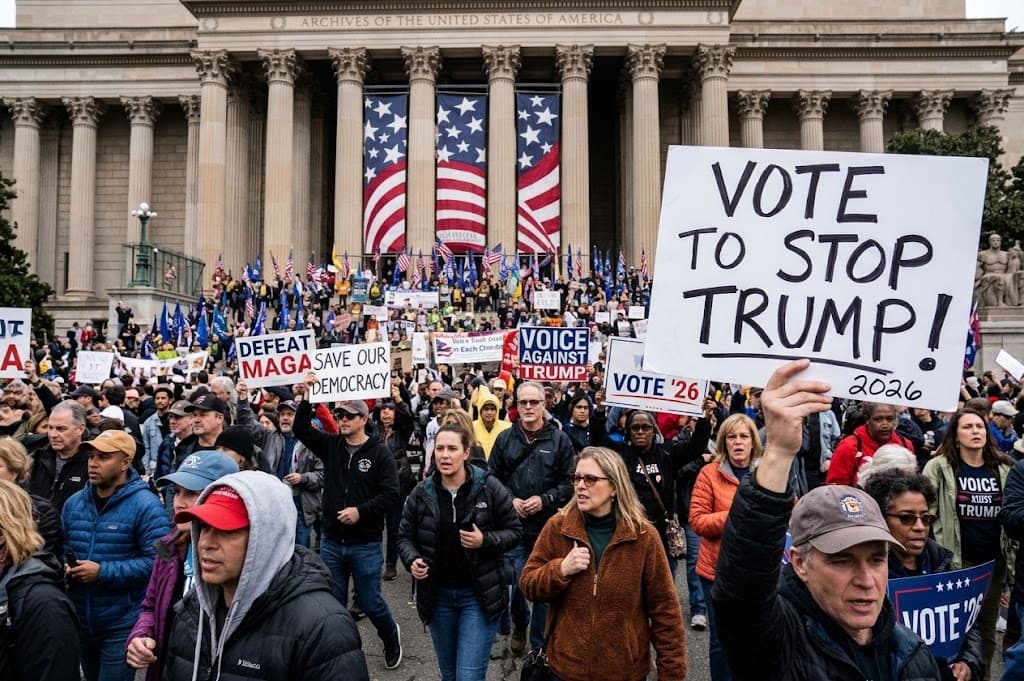
Donald Trump remains central to the midterm referendum, via Al Jazeera.
That imbalance turns the midterms into a negative referendum on the president while exposing Republican candidates to forces they cannot control locally. It does not prove that a Democratic wave will occur, because House control depends on individual districts and Senate control depends on separate statewide contests. It does show that opposition to Trump is supplying Democrats with a larger pool of motivation than support for him is supplying Republicans.
Opposition Turns Trump Into a Negative Referendum
Pew surveyed 5,062 American adults, including 3,917 registered voters, from September 28 through October 4, 2026. Among registered voters, 44% described their congressional choice as a vote against Trump, while 19% called it a vote for him. Another 36% said the president was not a factor, with no answer responses excluded from the published chart.
Those findings create a 25-percentage-point gap between opposition and support. Opposition is also more than twice as common as support, supporting the conclusion that Trump’s electoral presence currently mobilizes more resistance than loyalty. Still, this is one individual national poll measuring self-reported motivation, not a polling average, district forecast or prediction of congressional control.
Comparison with 2022 shows why the current imbalance matters. At that point, 36% of registered voters described their House vote as opposition to President Joe Biden, while 19% described it as support for him. Negative presidential motivation is normal in midterms, but Pew found it running 8 percentage points higher against Trump than it did against Biden four years earlier.
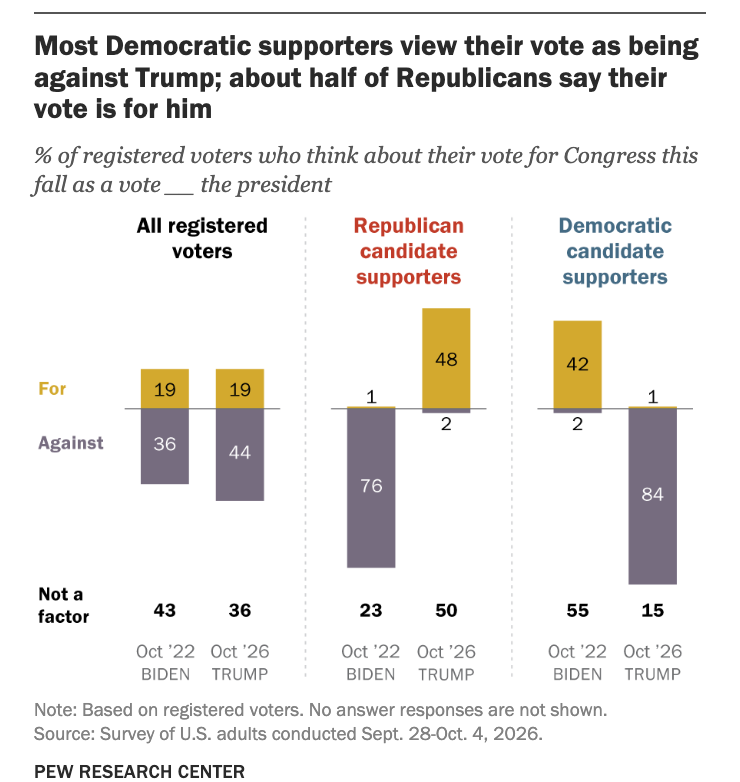
Opposition to Trump outweighs support in congressional vote motivation, via Pew Research Center.
Partisan responses reveal an even sharper divide. Among voters supporting Democratic House candidates, 84% described their choice as a vote against Trump and only 1% called it a vote for him. Among Republican candidate supporters, 48% viewed their choice as support for Trump, while 50% said he was not a factor.
Republican candidates therefore cannot assume that loyalty to Trump supplies the same intensity that opposition generates among Democrats. Trump remains valuable for consolidating part of the Republican base, but approximately half of Republican candidate supporters do not describe their congressional choice as a vote for him. Democratic candidates, by contrast, can draw on an unusually concentrated opposition motive.
Democratic Engagement Changes the Turnout Equation
Motivation matters because a preference recorded in a national survey does not become an election result unless voters participate. Pew found Democratic House candidate supporters ahead across three separate engagement measures. Each measure captures a different element of turnout readiness rather than guaranteeing that any respondent will cast a ballot.
Among Democratic candidate supporters, 78% said it really matters which party controls Congress, compared with 69% of Republican candidate supporters. Democrats also led by 50% to 36% among supporters who had given the election a lot of thought. Most consequentially, 63% of Democratic supporters described themselves as extremely motivated to vote, compared with 46% of Republican supporters.
That 17-point motivation gap reverses the pattern recorded before the 2022 midterms. During that cycle, Pew found Republican supporters slightly more motivated, with 58% describing themselves as extremely motivated compared with 56% of Democratic supporters. Current engagement therefore represents a change in partisan intensity, not simply the continuation of a familiar midterm pattern.
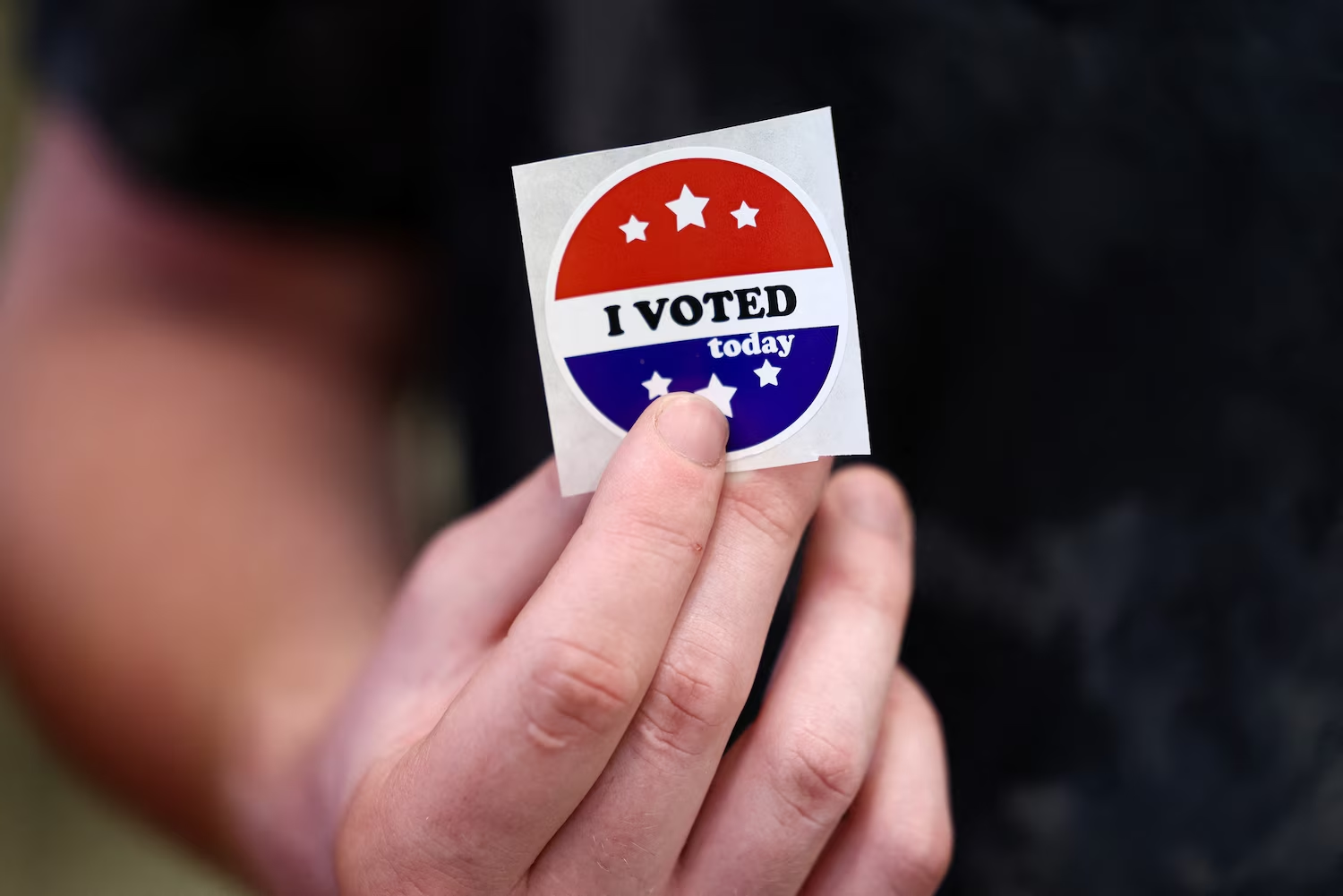
Early voting begins amid a widening partisan engagement gap, via ABC News.
Separate polling conducted later in October pointed in the same direction without producing identical percentages. An ABC News, Washington Post and Ipsos poll, fielded from October 9 through October 13, found 72% of Democratic voters and 65% of Republican voters absolutely certain to vote. Democratic voters also led Republicans by 44% to 31% in following the midterms extremely or very closely.
Those surveys should not be combined into an informal average because they used different questions, populations and field dates. Their agreement nevertheless strengthens the evidence that Democrats hold an engagement advantage. Republican candidates need more than nominal party support if a larger share of Democratic voters remains attentive and motivated through Election Day.
Pew’s national House preference result reflects that environment. Democratic candidates led Republican candidates by 44% to 36% among registered voters, while 5% preferred another candidate and 15% were unsure. That 8-point advantage describes one national individual poll and cannot account for district boundaries, candidate quality or local political conditions.
Republican Exposure Begins Inside Trump’s Coalition
Trump’s approval rating compounds the turnout problem. Pew found 30% of American adults approving of his job performance and 68% disapproving, his lowest approval rating of the second term at that point. Approval had fallen 4 points since July and stood near the level Pew recorded before he left office in January 2021.
Weakness also appeared among voters who supported Trump in 2024. Pew found 67% of validated Trump voters approving of his performance, compared with 95% near the beginning of his term. That represents a 28-percentage-point decline within the president’s own electoral coalition.
Disaffection with the Republican Party creates another problem for congressional candidates. One quarter of validated Trump voters held an unfavorable opinion of the Republican Party. Within that group, only 49% supported a Republican House candidate, while 12% backed a Democrat, 14% preferred another candidate and 25% were unsure.
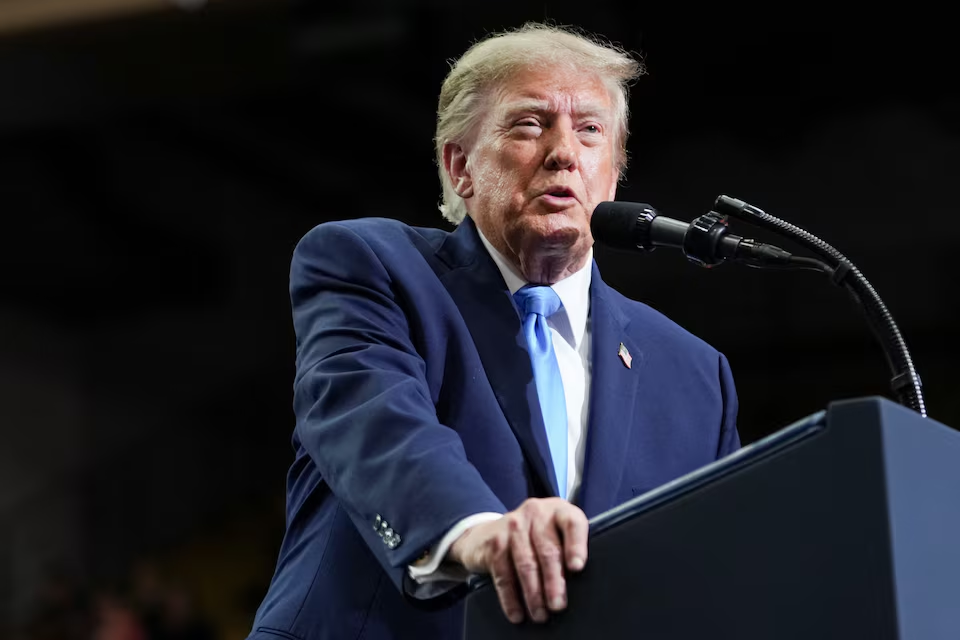
Republican candidates face a president with historically weak approval, via Reuters.
Democratic dissatisfaction does not produce the same degree of defection. Among validated Harris voters holding an unfavorable view of the Democratic Party, 73% still supported Democratic House candidates. Republican candidates therefore face a more fragile segment of their presidential coalition than Democrats do within theirs.
Later evidence showed that the pressure had not eased. A separate Reuters and Ipsos poll, conducted from October 16 through October 19, measured Trump’s approval at 31% among adults. Registered voters in that poll favored Democratic congressional candidates by 47% to 35%, a 12-point national advantage.
Reuters correctly cautioned that a generic congressional ballot cannot capture every state and district contest. Republican candidates may outperform the national environment through incumbency, local positioning or favorable district fundamentals. Low presidential approval and coalition disaffection nevertheless increase the amount of crossover support and turnout strength they must recover elsewhere.
Wrap Up
Trump remains powerful because voters continue organizing their political choices around him. Pew’s individual poll found 63% treating him as a factor in their congressional vote, but the direction of that influence is strongly negative. Opposition exceeded support by 25 percentage points.
Democratic candidates also benefit from an engagement advantage that appears across attention, motivation and national House preference. Those indicators do not guarantee control of Congress, and they should not be presented as a statistical forecast. They do identify the turnout conditions Republicans must overcome in competitive races.
Republican strategy now depends on reconnecting with voters who backed Trump in 2024 but have cooled toward his performance or the party. Distance from the president may help some candidates reach disaffected voters, while too much distance could weaken support among committed Republicans. Trump still defines the campaign, but defining the campaign is no longer the same as strengthening his party.