

Most surveys give Democrats a modest edge, but redistricting and district geography complicate the path to a majority.
What to Know
- Democrats lead all 20 of the newest tracker entries, while 19 remain within single digits and only one reaches double digits.
- The newest surveys range from D+2 to D+11, showing agreement on the leader but continued disagreement over the margin.
- The opposition party enters the midterms with a familiar historical advantage, although the current environment remains weaker than 2018.
- Republicans begin from a 220 to 215 election baseline, leaving Democrats needing a net gain of only three seats.
- New congressional maps favor Republicans in more districts, so a national Democratic lead will not convert evenly into House victories.
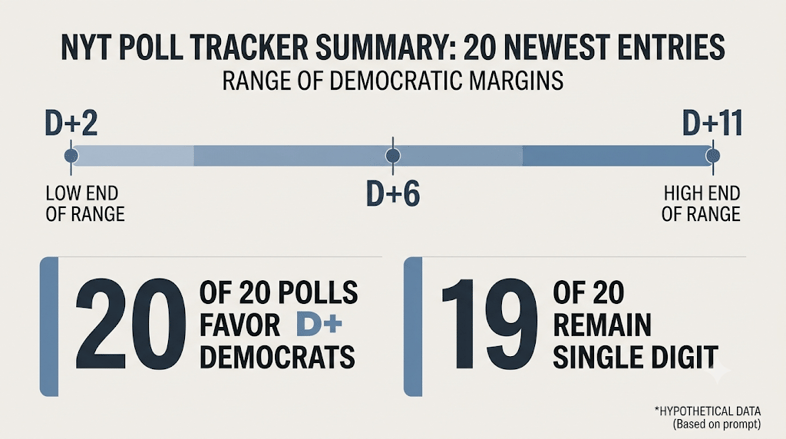
The New York Times 2026 congressional ballot tracker presents a clear early pattern. Democrats lead every one of the 20 newest entries listed through July 28, 2026, and 19 of those advantages remain in single digits. Only Emerson College reaches double digits with a D+11 result.
That consistency matters more than the highest or lowest individual finding. The newest surveys stretch from D+2 in Ipsos, McLaughlin and RMG Research to D+11 in Emerson College, but none places Republicans ahead. The national environment therefore favors Democrats even though the exact size of their advantage remains unsettled.
Twenty Recent Polls Point in the Same Direction
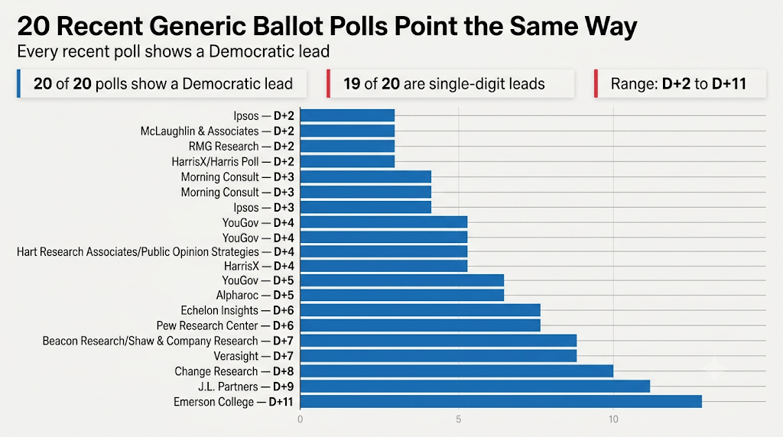
The Times tracker listed 553 polls when it was updated on July 28. Its newest entry came from YouGov, which found Democrats ahead 46% to 42%, or D+4, in interviews conducted from July 25 through 27. Morning Consult followed at 46% to 43%, or D+3, for the week ending July 26.
Several other recent polls produced smaller but still Democratic margins. Ipsos measured 40% to 38%, while McLaughlin reported 46% to 44%, placing both at D+2. RMG Research and the HarrisX-Harris Poll also found D+2, reinforcing the lower end of the current range.
Other firms placed the Democratic advantage closer to the middle or upper single digits. J.L. Partners reported D+9, Fox News polling showed D+7, Change Research measured D+8 and Verasight also found D+7. Echelon Insights and Pew Research Center each recorded D+6, while the CNBC-sponsored poll found D+4.
The table below reproduces all 20 newest entries in the tracker. It includes repeated pollsters when they released separate surveys covering different field periods. Every entry gives Democrats an advantage, but the reported margins vary considerably.
Campaign Now (Gemini), twenty recent polls show Democratic leads.
The table shows why the tracker’s broad direction is stronger than any single reading. Every poll gives Democrats the lead, yet the gap varies by nine points from the lowest to the highest result. A modest Democratic advantage is the common finding, while a double-digit lead remains the exception.
Campaign Now (Gemini), nineteen recent leads remain single digit
Emerson College is the only double-digit result among the 20 newest entries. Removing that poll leaves a range from D+2 to D+9, with every remaining result in single digits. That concentration supports the Times description of a modest advantage rather than a settled national wave.
Polling Methods Explain Part of the Spread
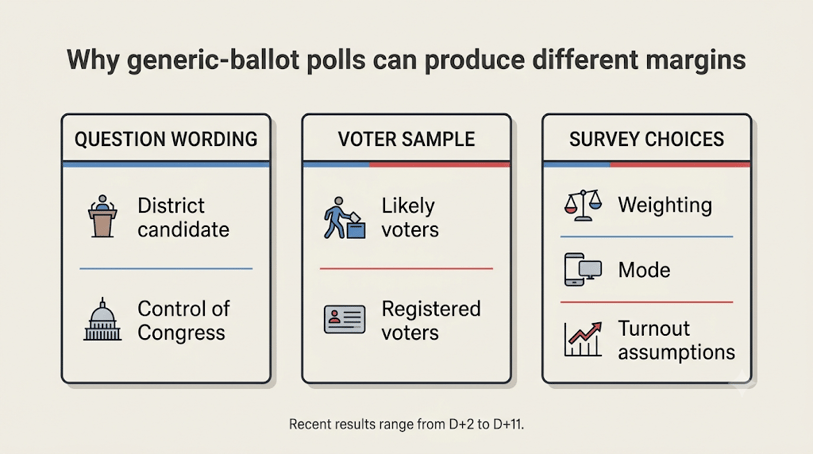
The tracker combines two related question types. Some surveys ask which party’s candidate respondents would support in their congressional district, while others ask which party voters want to control Congress after the election. Both questions measure the national political environment, but they do not measure it in precisely the same way.
Sample definitions create another source of variation. Likely-voter surveys try to identify people expected to participate, while registered-voter polls include everyone listed as registered regardless of their likelihood of voting. Differences in screening, weighting, survey mode and turnout assumptions can shift the result even when field dates overlap.
The latest range demonstrates that methodology does not move results in one predictable partisan direction. A likely-voter survey can show a narrow Democratic lead, while another likely-voter survey can reach double digits. Pollster-specific decisions therefore matter alongside the basic sample classification.
Silver Bulletin placed Democrats at D+6.1 on July 27, down from a cycle high of D+7.1 on June 1. The one-point decline indicates some narrowing without changing the broader direction of the national environment. Polling averages remain useful because they reduce dependence on one unusually high or low survey.
Campaign Now (Gemini), polling methods produce different Democratic margins
The historical comparison provides additional perspective. At a similar point in the 2018 cycle, Democrats held a stronger national advantage than they currently possess. The present environment favors the opposition party, but it has not yet reached the level associated with the last major Democratic House wave.
Midterm History Gives the Opposition Party an Opening
Midterm elections regularly create opportunities for the party outside the White House. The House historical record shows that changes in chamber control have frequently occurred during midterm years. Voters often use those elections to place a check on the administration in power.
The 2018 election demonstrates how a national advantage can translate into chamber control. Democrats gained 41 House seats and secured the majority after building a larger generic-ballot lead than they hold in the current cycle. That comparison does not guarantee the same result in 2026, but it explains why sustained single-digit advantages command attention.
Silver Bulletin’s series stood at R+3.3 in January 2025 and moved to D+5.3 by January 2026, producing an 8.6-point shift toward Democrats over twelve months. That movement from early 2025 through early 2026 established the foundation of the current midterm environment reflected in the July 2026 tracker update. The subsequent move to D+6.1 strengthened the opposition-party advantage as the election year progressed.
Recent narrowing has not erased that larger movement. Rasmussen shifted from D+6 in May to D+4 in July, while Silver Bulletin moved from D+7.1 to D+6.1. Republicans recovered some ground, but the newest New York Times tracker entries still show Democratic leads across every survey.
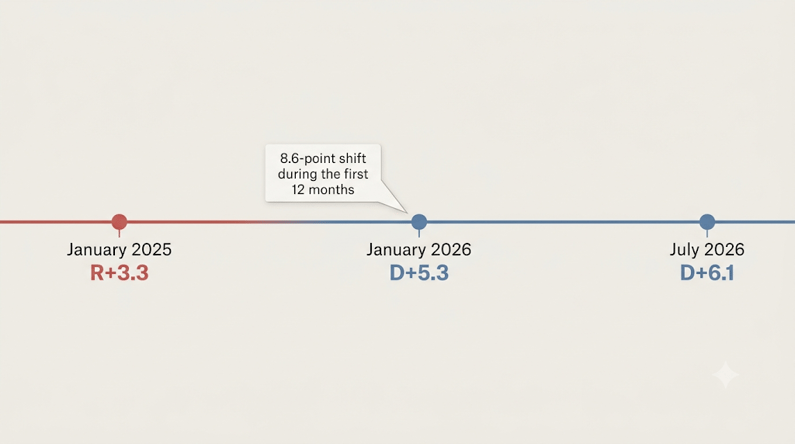
Campaign Now (Gemini), the national environment shifted toward Democrats
Historical patterns provide an opening rather than a guarantee. The opposition party must still recruit credible candidates, finance competitive races and turn national dissatisfaction into district-level support. A favorable generic ballot creates pressure on the majority, but campaigns determine where that pressure produces actual seat changes.
House Control Depends on More Than the National Vote
The election baseline remains extraordinarily narrow. Inside Elections lists a 220 to 215 Republican majority from the previous election, meaning Democrats need a net gain of three seats to take control. Its projection ranges from a Democratic gain of two to 10 seats.
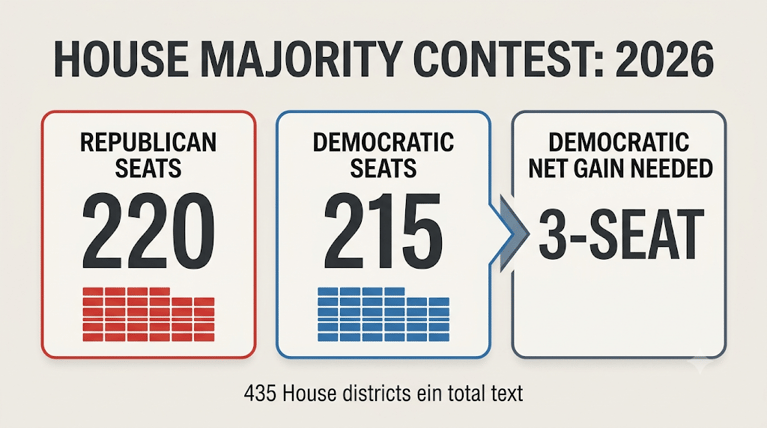
Campaign Now (Gemini), three seats could determine House control
A national lead improves Democratic chances without producing an automatic majority. Votes are distributed across 435 districts, and large margins in safe urban seats do not help win additional contests. Candidate quality, incumbency, fundraising and local conditions determine whether national movement reaches the districts that matter.
Decision Desk HQ gave Democrats a 62% chance of winning the House on July 15 and identified the generic ballot and presidential approval as important indicators. That forecast favors Democrats while preserving a substantial path for continued Republican control. A probability above 50% does not make the outcome settled.
Redistricting makes the translation from votes to seats more difficult. Inside Elections reports that new congressional maps have made the House battlefield more favorable to Republicans and reduced the number of competitive districts. Democrats may therefore need a larger national advantage than a uniform national swing would suggest.
Fewer naturally competitive seats raise the value of every remaining battleground. Democrats can win more votes nationally and still fall short if those votes are concentrated inefficiently, while Republicans can survive a modest popular-vote deficit if their coalition is distributed effectively. The Times tracker measures pressure on the majority rather than directly counting the seats likely to change hands.
Wrap Up
The New York Times tracker presents a consistent story with an uncertain margin. Democrats lead all 20 of its newest entries, and 19 of those advantages remain in single digits. Pollsters disagree over whether the environment is closer to D+2, D+6 or D+11, but they agree on which party currently holds the national edge.
Midterm history gives Democrats a genuine opening because the party outside the White House often gains ground. The current polling environment remains weaker than the comparable 2018 landscape, yet Democrats need only three seats from the previous election’s baseline. A modest national advantage can therefore matter even without becoming a wave.
House control will depend on whether national support reaches the right districts. New maps, fewer competitive seats and uneven vote geography give Republicans protection that the topline cannot show. Continued Democratic leads will keep the majority under pressure, but district-level movement will determine whether that pressure becomes control of Congress.
-May-16-2026-10-24-03-9739-PM.jpg)