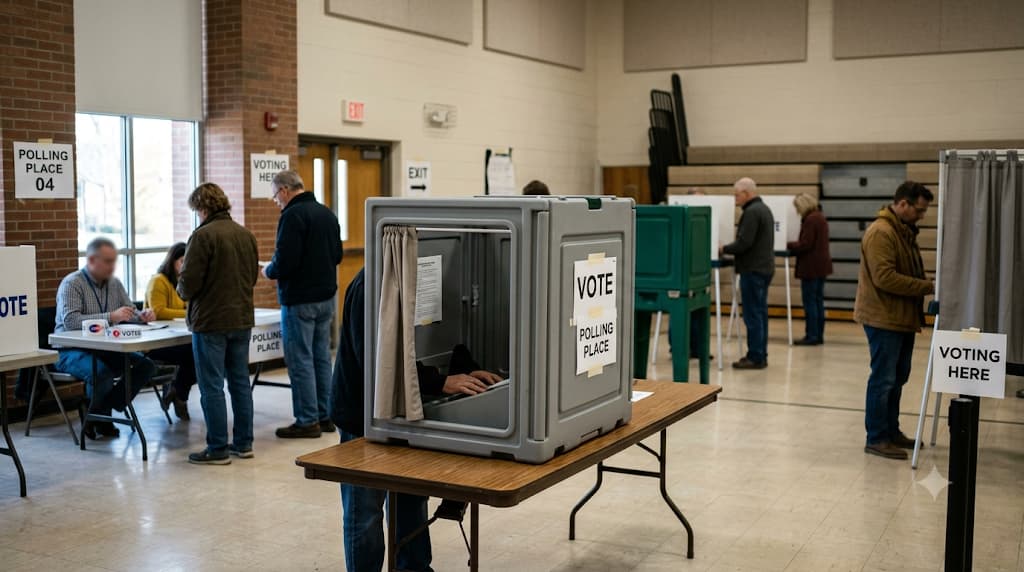


National strength can deliver a House majority while an unusually Republican Senate class keeps control beyond Democrats’ reach.
What to Know
- Democrats need a net gain of four seats to reach a 51 seat Senate majority.
- The median seat in the 2026 Class II map has an estimated R+10 Baseline.
- Democrats must defend three competitive seats in Georgia, Michigan and New Hampshire.
- Flipping Maine and North Carolina would produce only 49 Democratic aligned seats.
- Inside Elections estimates that approximately a D+9 national environment may be needed for control.
National political conditions can strongly favor one party without producing the same outcome in both chambers of Congress. The Silver Bulletin generic ballot average placed Democrats ahead by 6.6 points on August 28. Its likely voter adjustment expanded that advantage to 7.6 points, a margin that would normally support substantial House gains and place numerous Republican held districts in danger. That number measures the national mood, not a direct forecast of Senate seats. It captures a hypothetical congressional choice before campaigns, turnout patterns and state differences are fully resolved.
Senate control is a separate fight for survival against a map stacked with Republican leaning states. House control is determined across 435 districts, allowing a broad shift in public opinion to affect many contests at once. Senate control depends on the particular states voting in one of three rotating classes. In 2026, Democrats must turn a favorable national climate into victories across a small, unusually Republican group of states while protecting every vulnerable seat they already hold. A wave can move the country, but Democrats still have to win state by state. Every Senate candidate must build a coalition inside their own boundaries.
Four Seats, Not One National Wave
The starting arithmetic is unforgiving. Democrats need a net gain of four seats to reach the 51 seats required for control. A 50 to 50 Senate leaves the Republican vice president with the tie breaking vote, so a perfectly divided chamber does not transfer the majority.
Democrats must first protect Georgia, Michigan and New Hampshire. After that, they must flip four Republican held seats. Inside Elections’ examination of the battlefield identifies Maine and North Carolina as the two strongest pickup opportunities, but winning both moves Democrats only to 49 seats if every defensive race also holds.
Iowa, Alaska, Ohio or Texas would then have to supply the final two gains. Each state begins well to the right of the national electorate. Democrats cannot rely on a strong generic ballot to close those gaps. They must demand local candidate overperformance through persuasion, turnout and credible state specific appeals.
Every surprise changes the calculation, but no upset cancels out a defensive loss. A difficult pickup in Texas or Ohio cannot replace a loss in Georgia, Michigan or New Hampshire. Democrats must expand the map while holding their foundation.
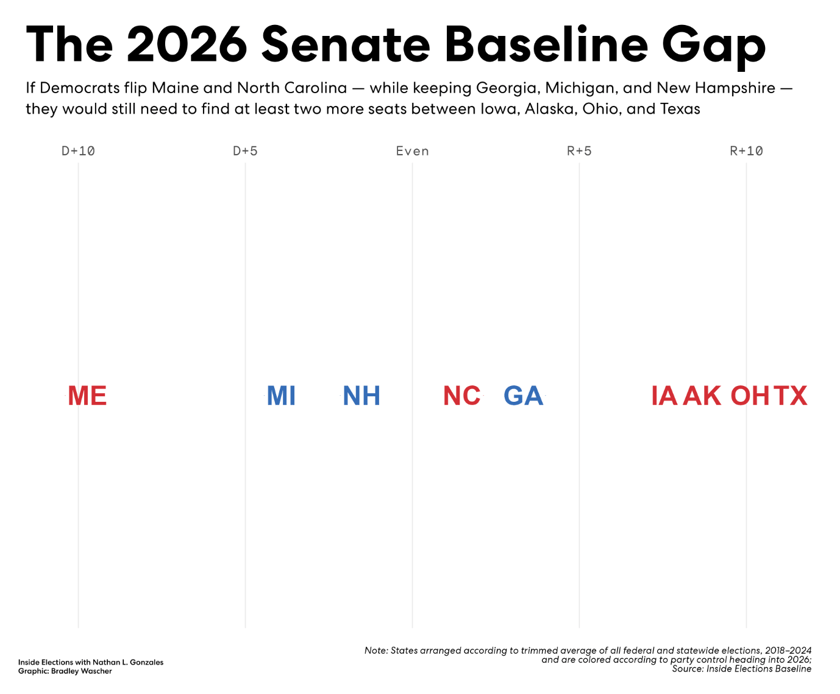
Maine and North Carolina alone would leave Democrats two seats short.
Opportunity and control are not the same thing. A favorable year can open several races, but Democrats need four conversions, not simply a strong national headline.
The Most Republican Leaning Senate Class
Senate seats are divided into three classes, with one class appearing on the regular ballot every two years. Class II creates the central 2026 survival test for Democrats. Its unusually Republican profile means national polling alone cannot secure Senate control.
Inside Elections calculates its Baseline from a trimmed average of federal and statewide election results across the previous four cycles. By that measure, the median Class II seat stands near R+10. The median is approximately D+2 in Class I and R+6 in Class III, making the current class substantially less favorable to Democrats than either alternative.
Class II has also moved rightward. Its median Baseline was about R+4 in 2014 and R+9 in 2020. That movement reflects declining Democratic strength in several smaller and more rural states that once supported senators from both parties.
A favorable environment lowers the amount of local overperformance Democrats need, but it does not erase that requirement. Candidates must close the gap with direct voter contact, turnout programs and messages that fit their own state. An R+10 median means Democrats cannot simply ride a national wave. They must beat the map repeatedly.
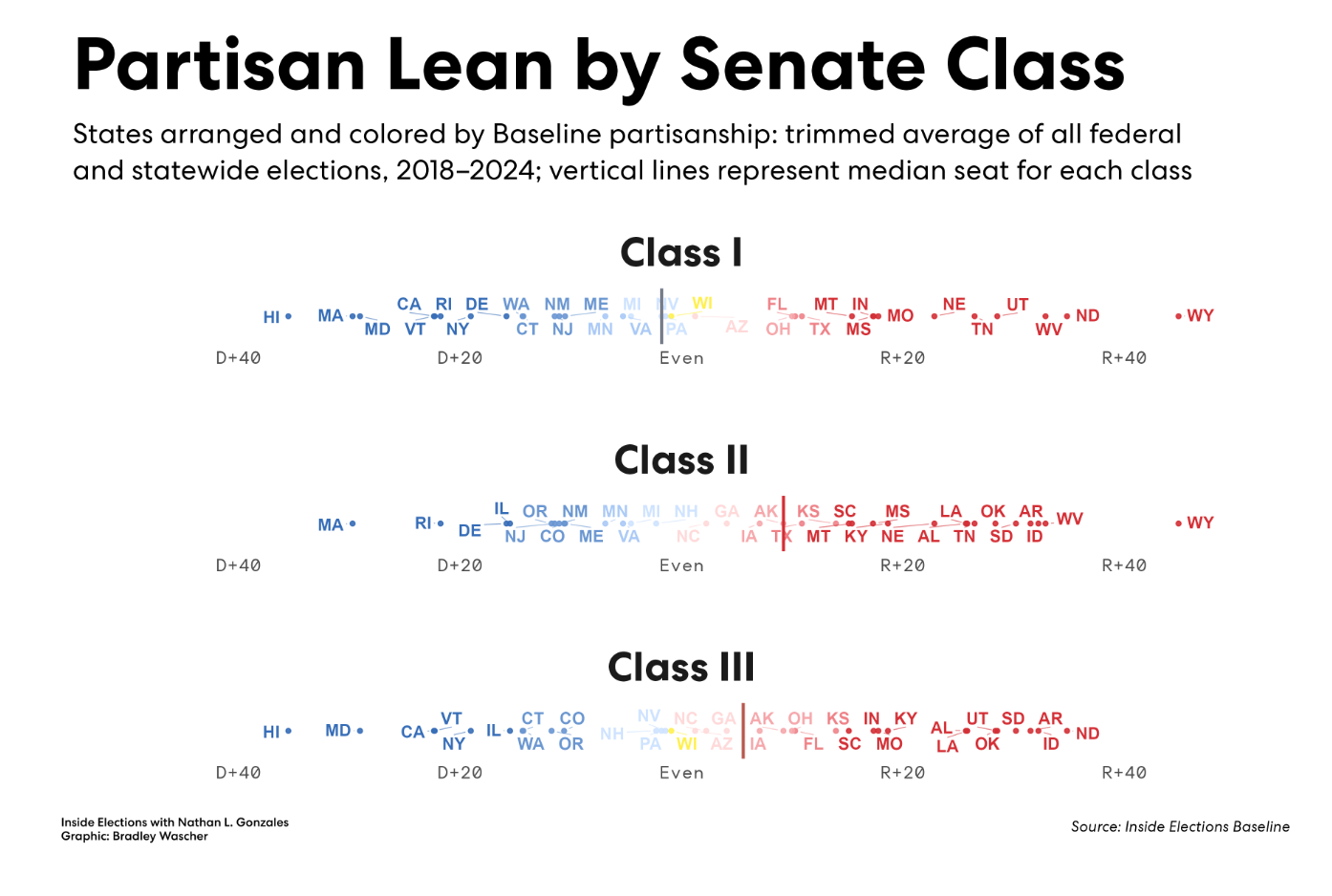
Class II sits markedly farther right than the other Senate classes.
The Baseline is a benchmark, not a prediction. It cannot anticipate every candidate advantage, campaign development or state specific issue. It does show why the same national margin can produce many House gains but fewer Senate victories.
Defense Comes Before Expansion
Field directors should make the resource order clear now: protect Georgia, Michigan and New Hampshire before investing heavily in long shot states. Inside Elections places all three Democratic held seats in competitive categories, either Toss Up or Tilt Democratic. Losing any one of them raises the pickup requirement from four seats to five.
Michigan and New Hampshire are open contests, removing the direct electoral advantage normally associated with an incumbent. Their Baselines are comparatively favorable to Democrats at approximately D+4.6 and D+2.3, but an open race creates uncertainty around turnout, organization and candidate performance. Georgia has a Democratic incumbent, yet its R+4 Baseline makes it the most structurally difficult defensive contest.
North Carolina and Maine form the first offensive tier. North Carolina stands near R+2.2, while Maine has a D+9.4 Baseline despite continuing to elect a Republican senator. Those figures explain why the two states are treated as the clearest pickup opportunities, but they also show how candidate history can complicate a simple partisan measurement.
That sequence should shape spending decisions throughout the fall. National committees must lock down Georgia, Michigan and New Hampshire, then fund Maine and North Carolina, before gambling core resources on Iowa, Alaska, Ohio or Texas. Money sent to emergency defense cannot also buy late opportunities in expensive pickup states.
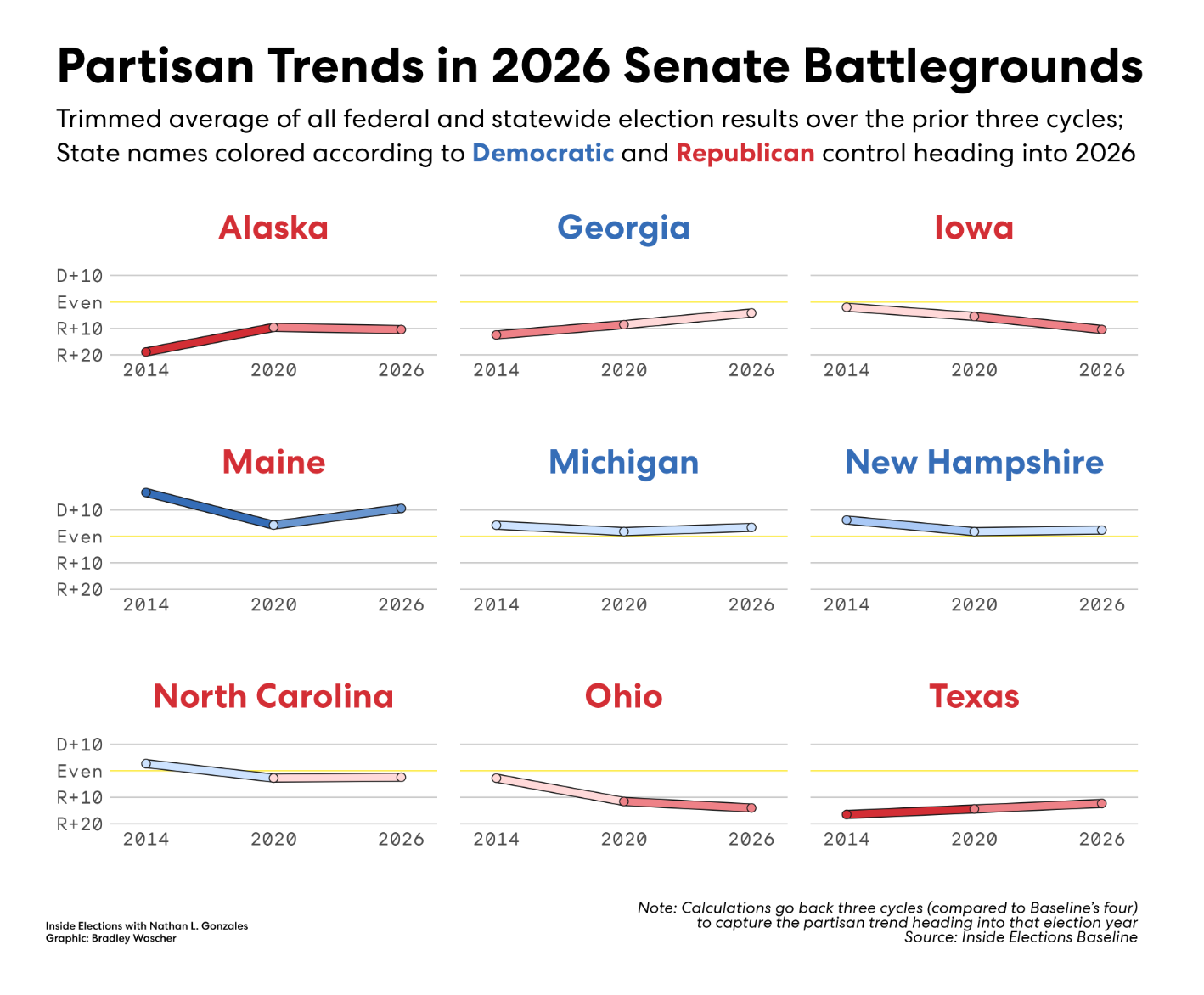
The battlegrounds begin from sharply different partisan foundations.
Democrats have little room for a defensive error. Resources spent stabilizing an existing seat cannot pursue a difficult pickup elsewhere. The map demands disciplined defense before ambitious expansion.
Texas Shows How Far the Path Must Reach
After Maine and North Carolina, the map becomes considerably steeper. Inside Elections places Iowa near R+7, Alaska at R+9.4, Ohio at R+10 and Texas at R+11. Democrats probably need at least two victories from that group if their three competitive seats remain secure.
Texas demonstrates how candidate strength can bend the map without erasing it. The Silver Bulletin polling average supplied for this project shows a close contest between the two major party nominees. That matchup shows how a candidate can create competitiveness beyond a state’s usual partisan position.

From left: James Talarico and Ken Paxton.
The August 30 average placed Talarico at 47.3 percent and Paxton at 45.2 percent, giving the Democrat a lead of roughly two points. That is notable in a state with an R+11 Baseline, but the average still leaves neither candidate above 50 percent and does not guarantee how undecided voters will break.
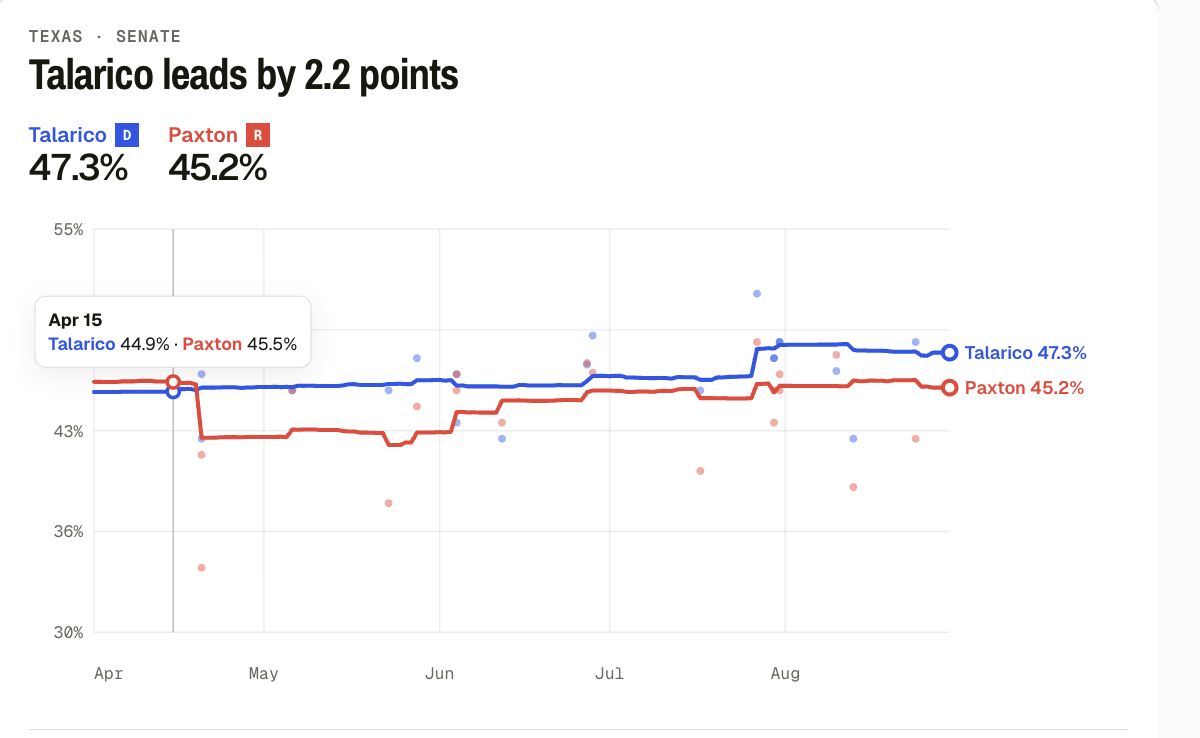
Silver Bulletin places Talarico narrowly ahead in Republican-leaning Texas.
Texas can expand the Democratic path, but it cannot replace the defensive assignment. One exceptional campaign can create one plausible upset. Senate control requires comparable success in several difficult states alongside flawless defense in Georgia, Michigan and New Hampshire.
Why House and Senate Results Can Split
House races respond more directly to a national swing because every seat is contested simultaneously. A shift of several points can move suburban, metropolitan and traditionally competitive districts across numerous states. The same voters may support a national wave while producing a much smaller collection of viable Senate opportunities.
Senate geography concentrates the contest. Extra Democratic votes in strongly Democratic states can enlarge the national popular vote margin without helping the party in Iowa, Alaska, Ohio or Texas. Individual Senate races also give incumbency, candidate quality and state political culture more influence than a national average can capture.
The 2018 midterms provide the clearest recent example. Democrats won the House popular vote by nearly 9 points and gained 41 House seats, taking the majority. Republicans nevertheless gained a net two Senate seats, defeating four Democratic incumbents while Democrats flipped only two Republican held seats.
|
|
|
|
|
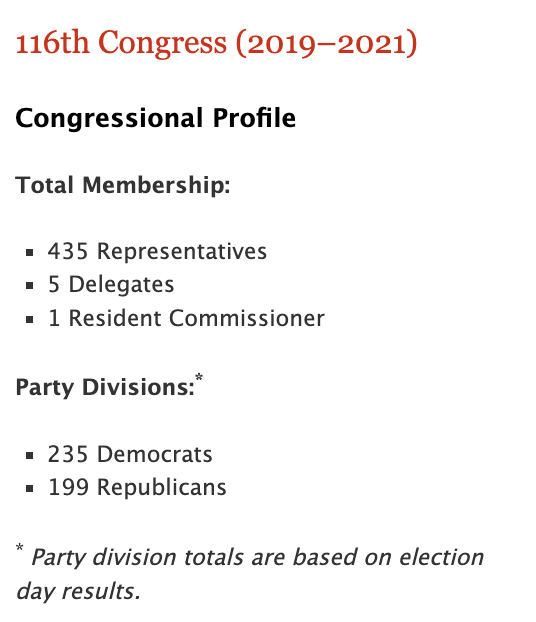
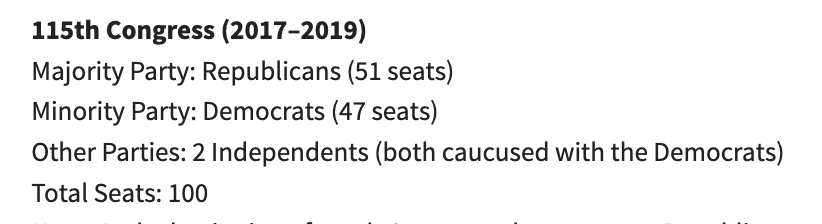
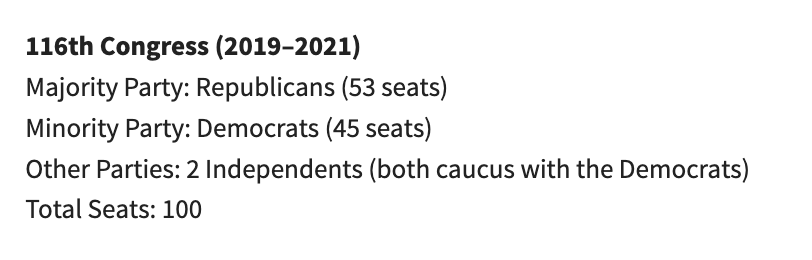
Official House and Senate records document the 2018 split
Silver Bulletin models House and Senate elections jointly because common national forces affect both chambers. Its framework also permits divided outcomes, including a Democratic House and Republican Senate. That result would reflect the rules and geography of the two institutions, not conflicting voter behavior.
Wrap Up
Democrats could have an excellent 2026 midterm and still fall short of Senate control. A national advantage near the current polling range could generate substantial House gains while leaving the party one or two Senate victories below the required 51 seats.
The route is narrow and sequential. Protect Georgia, Michigan and New Hampshire first. Capture Maine and North Carolina next. Then demand local candidate overperformance in at least two states on substantially more Republican terrain. Any defensive loss makes that offensive assignment harder.
Field directors and national committees should not let a strong generic ballot create false confidence. Fund the three defensive states, secure the two most credible pickups and reserve long shot investment for campaigns that can prove a real local path. A national wave may change the House. Only disciplined state level execution can break through the Senate map.