
Existing boundaries govern November, but pending lawsuits could reshape Wisconsin’s congressional recruitment, incumbency plans, and spending next cycle.
What to Know
- Wisconsin will conduct its 2026 congressional elections under the existing district boundaries.
- Republicans hold 6 of Wisconsin’s 8 House seats under the current map.
- Separate lawsuits challenge partisan advantage and the suppression of electoral competition.
- Justices are reviewing two dismissals rather than selecting replacement districts.
- Any eventual redraw would reshape recruitment and spending decisions before 2028.
Wisconsin’s congressional map is back before the state Supreme Court, but the immediate election will not change with it. Justices heard arguments on September 16 and September 17, 2026, in two appeals challenging district boundaries that currently produce a 6–2 Republican advantage in the state’s House delegation. Wisconsin Public Radio reported that both challenges seek to revive lawsuits dismissed by separate three judge panels earlier in the year.

Wisconsin’s congressional boundaries return to court, via Wisconsin Public Radio.
November’s candidates will continue campaigning under the existing districts. Any decision reviving the cases would begin another stage of litigation rather than produce an immediate replacement map. Political consequences therefore fall mainly after 2026, when both parties may have to reconsider which incumbents need protection, where credible challengers can run, and which media markets deserve early investment.
Two Lawsuits Challenge Different Forms of Political Protection
Both appeals question whether Wisconsin’s congressional boundaries protect political power at voters’ expense, but they reach that question through different legal theories. Bothfeld v. Wisconsin Elections Commission argues that the map unlawfully favors Republicans and dilutes Democratic voting strength. Wisconsin Business Leaders for Democracy challenges the same boundaries as intentionally resistant to competition, regardless of which party benefits.
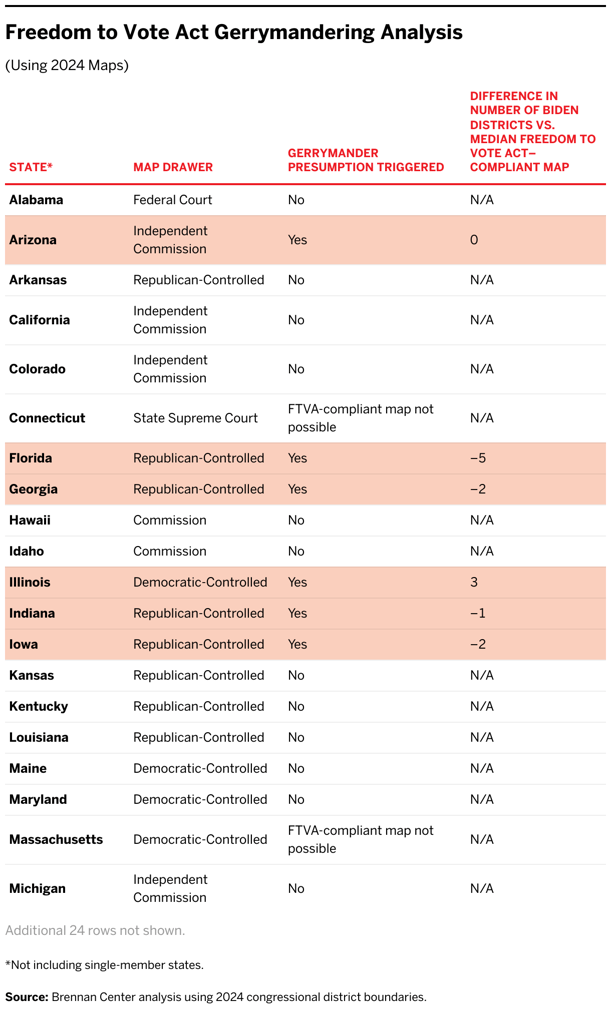
Wisconsin’s current map produced 2 Democratic seats, compared with 3 under the median map meeting the study’s partisan-fairness standard, via Brennan Center for Justice. Brennan Center for Justice
History complicates both claims. Republican lawmakers drew the 2011 congressional districts while their party controlled Wisconsin’s state government. After the 2020 census, a deadlock between the Legislature and Democratic Governor Tony Evers placed responsibility for new boundaries with the Wisconsin Supreme Court.
Wisconsin’s former conservative court majority adopted Evers’ proposed congressional map in 2022 under a least change approach. That map made limited adjustments to the earlier boundaries and preserved much of the framework established in 2011. Describing the current map as solely Republican drawn ignores Evers’ role, but describing it as entirely new ignores how closely it followed the previous lines.
Plaintiffs in Bothfeld argue that preserving those boundaries also preserved their partisan effect. Their case asks whether Wisconsin’s constitutional protections permit a map whose alleged predominant purpose and practical result favor one political party. Opponents argue that prior Wisconsin Supreme Court decisions do not recognize partisan fairness as a judicially enforceable right and that lower courts cannot disregard those decisions.
Wisconsin Business Leaders for Democracy advances a more novel argument. Its lawsuit alleges that state officials designed the map to suppress meaningful competition and protect incumbents from both parties. That theory focuses on predetermined outcomes and reduced voter influence rather than on guaranteeing an advantage to Democrats or Republicans.
Opponents respond that competition cannot override every other redistricting consideration. District designers may also consider representation, geographic continuity, communities of interest, county boundaries, and the disruption caused by placing incumbents together. Justices must first determine whether the state constitution recognizes either claim before a court can evaluate evidence about the map itself.
Chief Justice Jill Karofsky questioned whether the current boundaries can be separated from the disputed map that preceded them.

Jill Karofsky, Wisconsin Supreme Court chief justice, via Wisconsin Court System.
Chief Justice Jill Karofsky said:
“Many people felt their votes were diluted, that they weren’t representative of the people.”
Her question signaled concern about the map’s history, but it did not establish how she or the court will rule. A 4–3 liberal majority controls the court, yet ideological labels cannot substitute for a decision on standing, precedent, judicial authority, and the legal standards required to measure either partisan favoritism or competition.
Existing Boundaries Control the 2026 Election
Wisconsin’s congressional campaigns do not face an immediate boundary change. Both appeals reached the Supreme Court after lower judicial panels dismissed the underlying complaints in spring 2026. Plaintiffs are asking the justices to reverse those dismissals and permit further proceedings, not to install a completed replacement map for November.
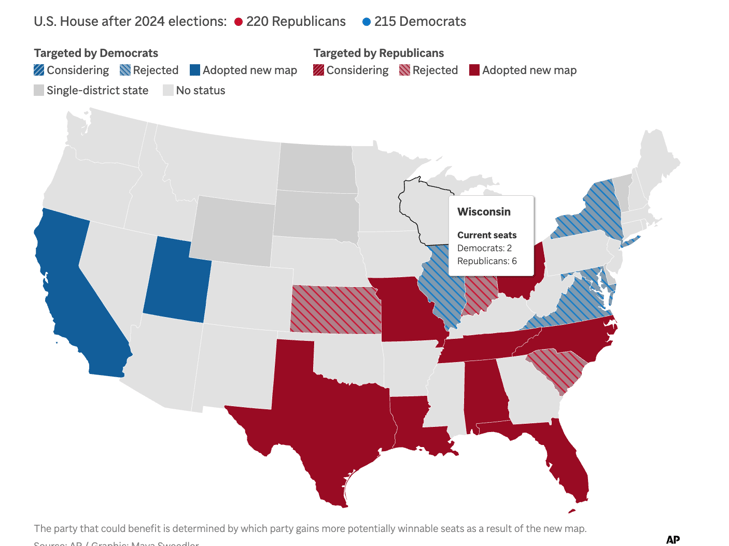
Wisconsin entered the 2026 election with a 6–2 Republican map, no approved replacement, and a June 1 candidate deadline, via Associated Press.
A favorable decision for the plaintiffs would not end the dispute. Justices could send one or both cases back for discovery, development of an evidentiary record, and decisions on the merits. Losing parties could then appeal again, and any finding that the map is unconstitutional would require a separate process to create and review a remedy.
That sequence explains why the existing map governs 2026 more accurately than the draft’s claim that ballot distribution alone settled the matter. Candidate recruitment, filing, fundraising, and election administration have already proceeded under the current districts. More importantly, neither case has completed the trial and remedial stages necessary to replace those boundaries.
Candidates in the First and Third Districts must therefore campaign for the voters currently assigned to them. Field plans, media purchases, direct mail, and voter targeting cannot anticipate boundaries that do not exist. Campaigns may monitor the litigation, but shifting current resources toward hypothetical 2028 districts would sacrifice the election directly in front of them.
National committees face a different timeline. Recruitment for a congressional election often begins well before the election year, particularly when a party needs candidates with local recognition and fundraising capacity. A decision reviving these cases could make Wisconsin’s 2027 recruiting calendar more tentative even before any new map receives approval.
Incumbents face the same uncertainty from the opposite direction. A representative who now holds a comfortable seat could inherit unfamiliar communities, lose favorable territory, or face another incumbent under a replacement plan. Building visibility outside current political strongholds may therefore become useful, but no campaign can know where that effort belongs until a proposed map exists.
First and Third Districts Mark the Initial Political Pressure Points
Wisconsin’s existing map does not make all 8 districts equally competitive. Madison anchors the heavily Democratic Second District, while Milwaukee anchors the heavily Democratic Fourth. Most Republican held districts have also produced comfortable margins, leaving the First District in southeastern Wisconsin and the Third District in western Wisconsin as the clearest present targets.
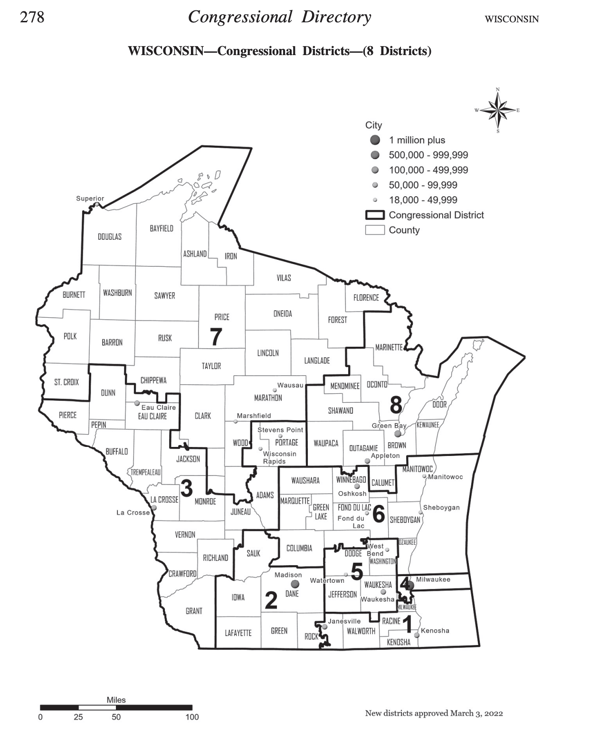
Current district boundaries define Wisconsin’s political battlefield, via GovInfo.
Recent results demonstrate the difference between potential and proven competitiveness. Republican Derrick Van Orden won the Third District by approximately 2.7 percentage points in 2024, while Republican Bryan Steil carried the First by approximately 10.2 points. Steil nevertheless represented a district where presidential and statewide results were closer than his own congressional margin, showing the value of personal incumbency strength.
Those results make western Wisconsin the most immediate Democratic recruitment opportunity under the current map. Southeastern Wisconsin remains strategically important because its underlying electorate is less Republican than Steil’s personal margin suggests. Neither observation establishes what a court ordered map would look like.
Boundary changes around Madison, Milwaukee, western Wisconsin, or the southeastern counties could alter several districts simultaneously. Adding Democratic voters to one Republican held seat would require removing them from somewhere else, while preserving equal population and coherent geography. A change intended to increase competition in the First or Third could therefore affect the Second, Fourth, Fifth, Sixth, or Seventh District as well.
No replacement map, district performance table, or remedial standard is currently before the justices. Predicting a 4–4 delegation would therefore present a partisan possibility as a legal or geographic result. Even a map designed without partisan favoritism would not guarantee proportional representation because candidate quality, incumbency, turnout, and political conditions still determine election outcomes.
Both parties should treat 2028 as a planning scenario rather than a settled realignment. Democrats gain a reason to cultivate credible candidates beyond the two districts they already contest most aggressively. Republicans gain a reason to strengthen incumbents whose present margins depend partly on boundaries that may not survive the litigation.
Resource allocation may change before candidate decisions do. State parties and national committees can preserve research, fundraising, and legal capacity without committing to speculative races. Flexible preparation will matter more than prematurely declaring which seats a future map would place in play.
Wrap Up
Wisconsin’s congressional map litigation will not change the 2026 ballot. Candidates must win under the districts already in place, and campaign organizations should not divert current resources toward imaginary boundaries. November’s results will still provide evidence about where each party possesses durable strength.
Legal consequences begin with the court’s treatment of the two dismissals. Reviving either lawsuit would create additional litigation, factual development, and possibly a remedial process before 2028. Dismissal would preserve the existing map unless another legal or legislative route emerged.
Political uncertainty is the immediate result. Wisconsin’s First and Third Districts remain the clearest current targets, but a future redraw could change the value of incumbency, recruitment, and spending across the state. Parties that preserve flexibility will be better positioned once the court defines what happens next.