

After 2024, Democrats face a hard truth: youth enthusiasm no longer reliably converts into youth turnout, creating a growing structural vulnerability heading into 2026.
What to Know
- Gen Z turnout declined in 2024 despite record digital engagement and issue awareness.
- Progressive campaigns are reaching young voters but failing to mobilize them.
- Messaging saturation and issue fatigue are weakening traditional turnout tactics.
- Organizational infrastructure for youth voters has eroded since 2020.
- The problem threatens the durability of progressive coalitions in midterm cycles.
For years, Democrats talked about young voters as if their support were automatic. The assumption was cultural alignment equals political loyalty. Gen Z leaned left on social issues, spoke the language of activism, and lived online. From that, party strategists concluded turnout was just a matter of exposure. Put the right content in the right feeds and the votes would show up.
2024 broke that illusion. The election was saturated with issues that were supposed to animate young voters. Climate. Abortion. Gaza. Student debt. None of it translated into the level of participation Democrats expected. Not because young voters were unaware or indifferent, but because many no longer see elections as meaningful. They watch politics the way people watch reality TV. Loud, emotional, and ultimately disconnected from their own lives.
What the Turnout Data Is Showing
What Axios found after the election should worry Democrats far more than any single policy miss. Gen Z is not tuning out because Republicans persuaded them. They are tuning out because the system feels hollow. Many pay attention, hold strong opinions, and still choose not to vote. That is not a messaging problem. It is a legitimacy problem. And unless Democrats confront that reality instead of blaming algorithms or apathy, 2026 will bring the same surprise, only this time it will be harder to explain away.
Post-election data reinforces that warning. Gen Z participation fell from 2020 levels, with the steepest drop showing up in non-presidential and down-ballot races. Young voters still leaned Democratic, but the margins shrank and turnout missed projections in several states that were supposed to be safe assumptions.
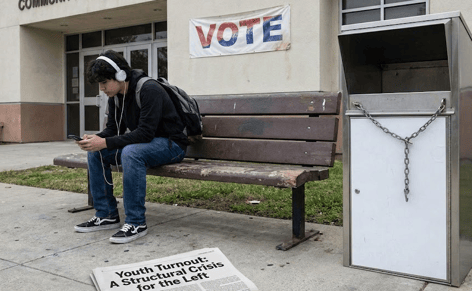
The decline was not evenly distributed. In states where campus organizing, peer-to-peer outreach, and year-round voter infrastructure were still intact, youth turnout held up. Where those systems had been scaled back, outsourced, or treated as optional, participation collapsed. The difference was not enthusiasm. It was presence.
That distinction matters heading into 2026. This is not evidence of an ideological shift to the right. It is evidence of operational neglect. Campaigns bet that alignment on issues would substitute for sustained ground work. It did not. Midterms always magnify these weaknesses. If youth turnout cracked during a presidential cycle, the warning for 2026 is obvious. Without rebuilding the machinery that turns attention into action, Democrats are setting themselves up to be surprised again, and this time they will not be able to claim they did not see it coming.
Digital Saturation Without Conversion
Young voters are not starved for political information. They are drowning in it. Research from Tufts shows that nearly four in five young people rely on social media or YouTube as a primary source of political information. Platforms like TikTok, Instagram, and YouTube are not peripheral. They are central. For many young Americans, especially Black and Latino youth and those without college experience, these platforms are the political information ecosystem.

Democrats have interpreted that reality as a green light to flood the zone. The result is constant exposure but weak outcomes. Awareness is high, yet turnout is uneven. The reason is not persuasion. It is friction. Young voters who rely most heavily on social media are less likely to vote than those who get information from news websites or more traditional sources.
The same research shows that youth who voted were more likely to check sources, verify claims, and understand where information came from. Media literacy, not ideology, tracked most closely with participation.
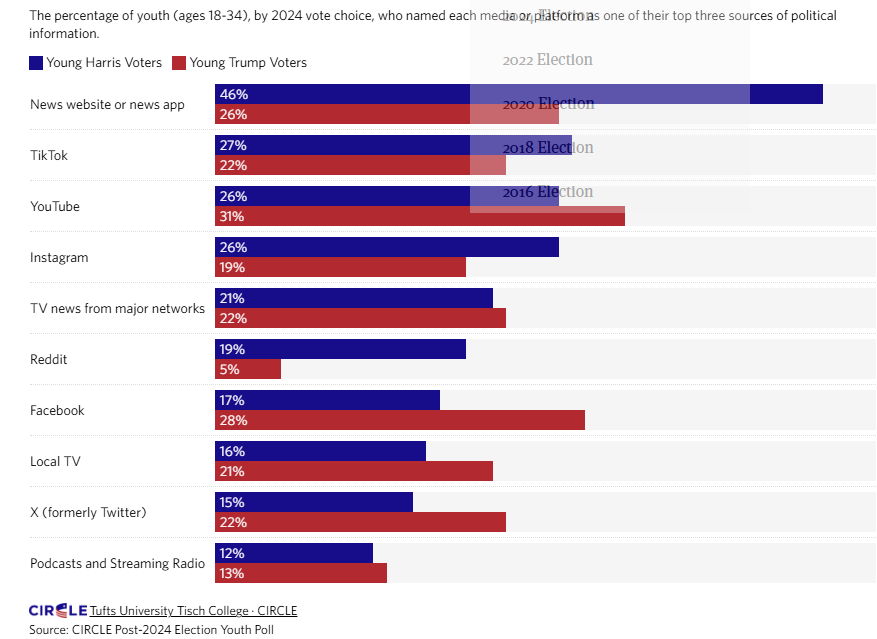 Screenshot via CIRCLE
Digital-first strategies assume information equals empowerment. The data says otherwise. Research from CIRCLE at Tufts University consistently shows that while young people consume and engage with political content at extremely high rates online, that engagement does not reliably translate into voting.
Social platforms excel at emotion and identity, not instruction. Young people watch clips, argue in comments, and even create political content, but many are never given a clear, practical path from content to ballot. As a result, voting becomes optional, abstract, and easily postponed. It competes with other forms of expression instead of anchoring them.
This is where campaigns keep missing the point. The problem is not that Gen Z lacks passion. It is that the information environment rewards reaction over resolution. Without trusted sources, verification habits, and direct guidance on how participation works, political engagement stays online. Until campaigns treat media literacy and real-world access as turnout infrastructure rather than side issues, digital saturation will continue to produce noise instead of votes.
Issue Fatigue Is Real
Gen Z voters are not disengaged from politics. They are saturated by it. Over the past several years, they have encountered a continuous stream of high-stakes issues, each framed as urgent, existential, and unresolved. Climate change, gun violence, abortion, foreign conflict, student debt, housing affordability, healthcare, and democratic stability have all competed for sustained attention, often without clear signals of progress or resolution.
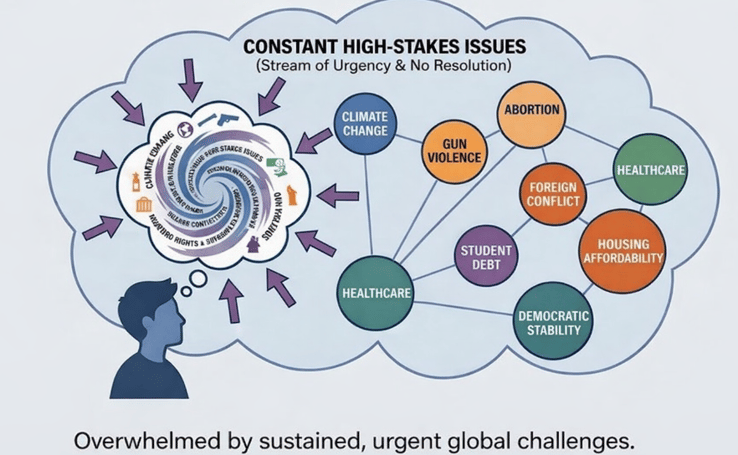
Campaigns frequently respond by aggregating these concerns rather than prioritizing among them. While this approach is intended to convey moral seriousness, it often produces the opposite effect. When every issue is presented as equally critical, voters struggle to identify achievable goals or pathways to impact. Research cited by the American Psychological Association on political burnout suggests that prolonged exposure to crisis-oriented messaging increases stress and disengagement, particularly when individuals perceive limited agency over outcomes.
This fatigue does not result in political indifference. Many young voters remain informed, expressive, and active in non-electoral forms of participation, including protest, online advocacy, and community organizing. However, belief in electoral efficacy erodes when participation appears disconnected from tangible results. Voting becomes one option among many, rather than the primary mechanism for change.
Organizational Gaps After 2020
The Democratic turnout model that powered 2020 was built on extraordinary and largely temporary conditions. Youth organizing surged through campus groups, mutual aid networks, and digital volunteer programs during a moment of overlapping crisis and urgency. That infrastructure delivered results, but it was not institutionalized. As the cycle ended, funding declined, staff moved on, and many programs reverted to campaign only operations. What remained was a thinner, fragmented system that activates episodically rather than maintaining a continuous civic presence.

This erosion matters because turnout is not primarily a messaging problem. It is a habit problem. Republicans benefit from durable, embedded networks such as churches, local civic groups, and community institutions that maintain consistent voter contact outside election cycles. Democratic strategists frequently respond by refining language. They pursue more culturally fluent content, more relatable messengers, and more precise targeting.
Wrap Up
Youth turnout is no longer a messaging challenge for the left. It is a structural vulnerability with cascading consequences across the progressive coalition. Young voters are not disengaging ideologically, but their declining reliability weakens margins in swing districts, reduces volunteer capacity, and reshapes primaries toward older and more risk averse electorates. That shift advantages institutionally backed candidates over grassroots challengers and forces Democrats in general elections to overperform with older voters simply to remain competitive.
Looking forward into 2026, the strategic choice is unavoidable. Campaigns can continue prioritizing digital visibility and episodic enthusiasm, or they can rebuild the durable organizing infrastructure that turns political engagement into habitual participation. Gen Z remains progressive, informed, and attentive, but attention alone does not translate into power. Until campaigns restore the connective tissue that carries voters from interest to action, youth engagement will remain high, and youth turnout will continue to lag.