

A broad Democratic advantage has narrowed, but still pressures a fragile Republican House majority.
What to Know
- The RealClearPolitics average places Democrats at 48.4% and Republicans at 42.4%, producing a verified D+6.0 advantage through July 29.
- All 12 polls in the average favor Democrats, with margins ranging from D+2 to D+11.
- The Democratic lead peaked at D+8.1 on May 28, narrowed to D+4.8 in June and recovered by late July.
- Likely-voter and registered-voter polls both show Democratic advantages, although their reported margins vary widely across firms.
- Democrats need a net gain of three House seats, but national support must reach a smaller set of competitive districts.
The RealClearPolitics (RCP) generic congressional ballot average gave Democrats a 48.4% to 42.4% lead through July 29, 2026. That is a D+6.0 advantage, not D+5.9, based on the values displayed in the July snapshot. The corrected figure still shows a clear Democratic edge at the national level entering the final midterm stretch.
The average matters because it reduces dependence on any single poll. Its 12 contributing surveys all place Democrats ahead, yet their margins range from two points to 11 points. Agreement on the leader is broad, while uncertainty over the margin remains central to the House outlook.
Every Contributing Poll Favors Democrats
Two polls define the upper end of the RCP range. Big Data Poll reports Democrats ahead 50% to 39% among 2,617 likely voters, while Emerson records a 53% to 42% advantage among 1,100 likely voters. Both produce D+11, but the matching margins come from different vote shares and separate field periods.
Several polls cluster in the middle of the range. Daily Mail reports D+9, CNN shows D+8, Quinnipiac and Fox News each show D+7 and Echelon Insights records D+6. Those results suggest a Democratic advantage without establishing a uniform wave.
Other surveys show a more modest Democratic advantage. Economist and YouGov reports D+4, Morning Consult shows D+3 and Reuters and Ipsos, RMG Research and Harvard-Harris each report D+2. Even the lowest-margin polls point in the same direction.
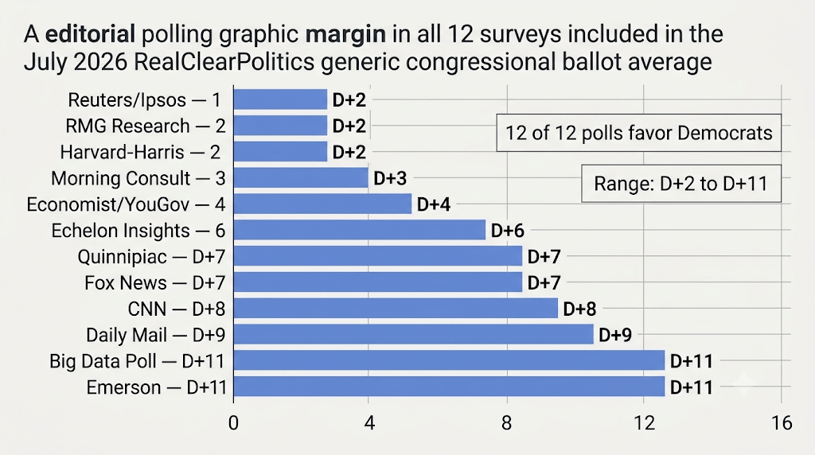
Campaign Now (Gemini), all twelve polls favor Democrats.
The poll mix also contains both likely-voter and registered-voter samples. Five contributing surveys use likely voters, while seven use registered voters, and both groups include relatively large and relatively small Democratic margins. Sample type alone therefore does not explain why one poll finds D+2 and another finds D+11.
The RCP figure is a center of gravity, not a promise. It shows where a selected group of recent national polls collectively places the race, while preserving visible disagreement among firms. Its strongest signal is that every included survey gives Democrats an advantage.
The Trend Line Shows Narrowing and Recovery
The late-July average sits below the Democratic high point of the cycle. RCP reported a D+8.1 lead on May 28, then described a contraction to D+4.8 by June 22. Republicans gained support during that period while Democratic support remained comparatively steady.
The July snapshot shows that the narrowing did not continue in a straight line. Democrats stand at 48.4%, Republicans at 42.4% and the margin has returned to D+6.0. That recovery leaves Democrats below their May peak but above the June level highlighted by RCP.
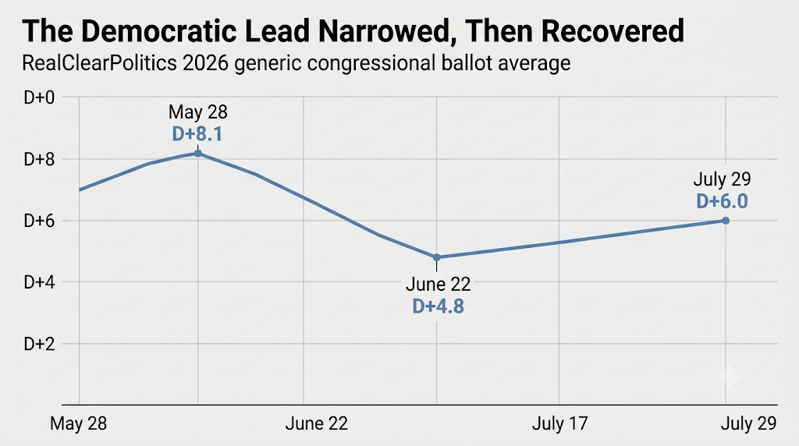
Campaign Now (Gemini), the Democratic lead narrowed then recovered.
Republican improvement since May still matters. Closing a gap from 8.1 points to six points reduces the number of voters the party must recover before Election Day. It also shows why campaign conditions should not be described as fixed several months before ballots are counted.
Democratic stability matters just as much. The party remained ahead when the margin narrowed, and every survey in the July average still favors its congressional candidate or control preference. Republicans have improved their position without yet breaking the opposition party’s consistent national lead.
The trend line therefore carries two messages at once. Democrats retain the stronger midterm position, while Republicans have demonstrated that the deficit can move. Future averages will show whether late July represents a stable six-point environment, another temporary rebound or the beginning of a wider shift as the election year advances.
Aggregates Clarify the Race Without Predicting It
A polling average is more useful than choosing the most favorable survey for either party. Big Data Poll and Emerson suggest a double-digit Democratic environment, while Reuters and Ipsos, RMG Research and Harvard-Harris suggest a much closer contest. The aggregate places those competing readings inside one broader national measure.
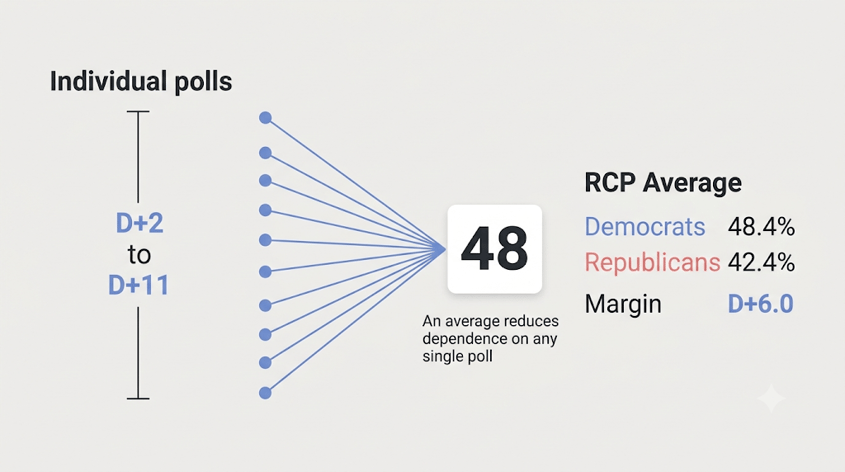
Campaign Now (Gemini), one average combines a wide polling range.
That does not make every contributing poll methodologically identical. Question wording can ask about a congressional candidate in the respondent’s district or which party should control Congress. Screening, weighting, survey mode and assumptions about turnout can also change each firm’s estimate.
The aggregate also measures national sentiment rather than individual House races. Voters may express dissatisfaction with the governing party nationally while supporting a familiar incumbent locally. Strong Democratic margins in safe districts can increase the popular vote without creating another seat.
Generic ballot polling still remains one of the clearest measures of the national congressional environment. RCP describes it as a major tool for tracking how voters feel about the two parties between elections. Its value comes from identifying pressure on the majority, not from assigning winners in 435 separate contests.
The current D+6.0 reading therefore represents meaningful Democratic momentum with limits. It supports the view that Republicans face a difficult national climate, but it does not reveal where the decisive votes are located. District ratings, fundraising, candidate quality and local issues remain necessary companions to the average.
A Six-Point Lead Raises the Stakes for House Control
Republicans hold a 220 to 215 House majority, according to Inside Elections. Democrats need a net gain of only three seats to take control, and the current projection ranges from a Democratic gain of two to 10 seats. That narrow baseline makes even modest national movement politically important.
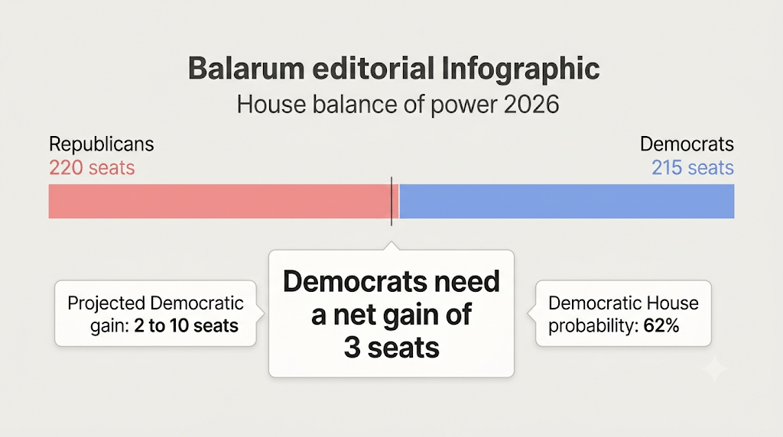
Campaign Now (Gemini), three seats could determine House control.
Midterm history gives the opposition party another advantage. Since 2002, the president’s party has lost House seats in every midterm and has not preserved a House majority it carried into those elections. Historical patterns create pressure, though they do not determine how the current cycle will finish.
The Decision Desk HQ forecast gave Democrats a 62% chance of winning the House on July 15. Its model identified the generic ballot and presidential approval as leading indicators of the environment. A probability above 50% favors Democrats without removing a substantial Republican path.
Redistricting complicates the translation from national votes to seats. New maps have reduced the number of naturally competitive districts and improved Republican positioning in parts of the battlefield. Democrats may therefore need to sustain a larger national advantage than a simple uniform swing would imply.
The practical question is whether the D+6.0 environment reaches Republican-held districts that are actually contestable. Democrats do not benefit equally from adding votes in already safe seats, while Republicans can withstand a national deficit if their coalition is distributed efficiently. The House fight will turn on where the advantage appears, not merely whether it exists.
For both parties, the RCP average sets the strategic backdrop. Democrats can argue that national opinion supports a change in House control, while Republicans can point to the decline from the May peak as evidence that recovery is possible. Competitive campaigns must now connect those national narratives to district-specific concerns.
Wrap Up
The verified July snapshot shows Democrats at 48.4%, Republicans at 42.4% and the RCP average at D+6.0. All 12 contributing polls favor Democrats, creating a consistent national signal despite a wide D+2 to D+11 range. The opposition party enters the late summer with the stronger position.
The trend is favorable without being static. Democrats remain below their D+8.1 May peak, Republicans recovered ground in June and the margin returned to six points by late July. That sequence shows a durable Democratic advantage alongside genuine room for movement.
House control will depend on whether the national lead reaches the few districts capable of changing the majority. Democrats need only three seats, but redistricting and vote concentration limit what a national average can guarantee. RCP’s aggregate is a warning for Republicans, not a completed forecast of November.

-Aug-01-2026-11-56-55-1279-AM.jpg)
-4.jpg)