

Economic frustration is widening Democrats’ national advantage, but district geography and turnout will decide whether it becomes control.
What to Know
- The RealClearPolling average gives Democrats an 8.3 percentage point generic ballot lead, 50.6% to 42.3%.
- Ballotpedia’s polling index places Democratic support at 50% and Republican support at 43%.
- An Emerson College national survey found Democrats ahead by 11 points, 53% to 42%.
- Democrats need a net gain of 3 House seats from their 2024 result to reach the 218 seat majority threshold.
- National polls favor Democrats, but competitive-district polling shows a narrower and more strategically important advantage.
National polling has moved beyond a temporary Democratic advantage and developed into a consistent warning for House Republicans. The RealClearPolling generic congressional vote average places Democrats at 50.6% and Republicans at 42.3%, producing an 8.3 point margin with approximately one month remaining before Election Day.
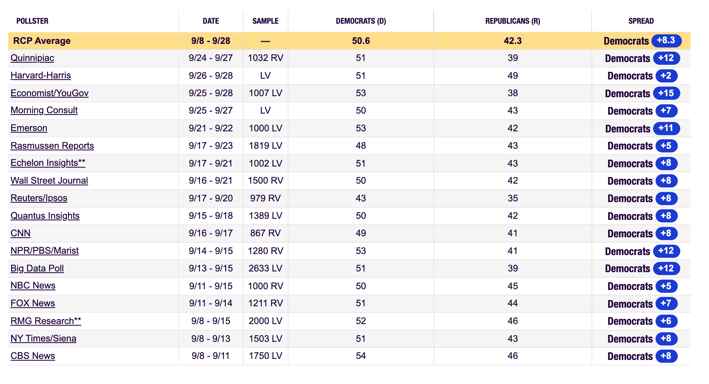
Democrats hold a widening national congressional advantage, via RealClearPolling.
That lead does not guarantee a Democratic House majority or establish a universal wave threshold. Generic ballot surveys measure national party preference without naming the candidates voters will see in their districts. The result still expands the number of races Republicans must defend and forces both parties to reconsider where their final advertising, field, and turnout investments can change the outcome.
National Polls Now Point in the Same Direction
Multiple polling measures show Democrats reaching or exceeding 50%, while Republican support remains in the low 40s. Ballotpedia’s Polling Index places Democrats at 50% and Republicans at 43%. Ballotpedia calculates its index from polls conducted during the preceding 30 days, giving campaigns a broader measure than any individual survey.
An Emerson College national survey produced a larger Democratic advantage. The survey found likely voters supporting the Democratic congressional candidate over the Republican by 53% to 42%, with 5% undecided. Emerson also found independents supporting Democrats by 60% to 31%, identifying the voters most responsible for turning a partisan advantage into a potentially larger electoral shift.
These measures use different polling selections, time periods, and methodologies. Their precise margins should not be treated as interchangeable. Their shared direction nevertheless gives Republican campaigns less room to dismiss the Democratic lead as a result produced by one unusual survey.
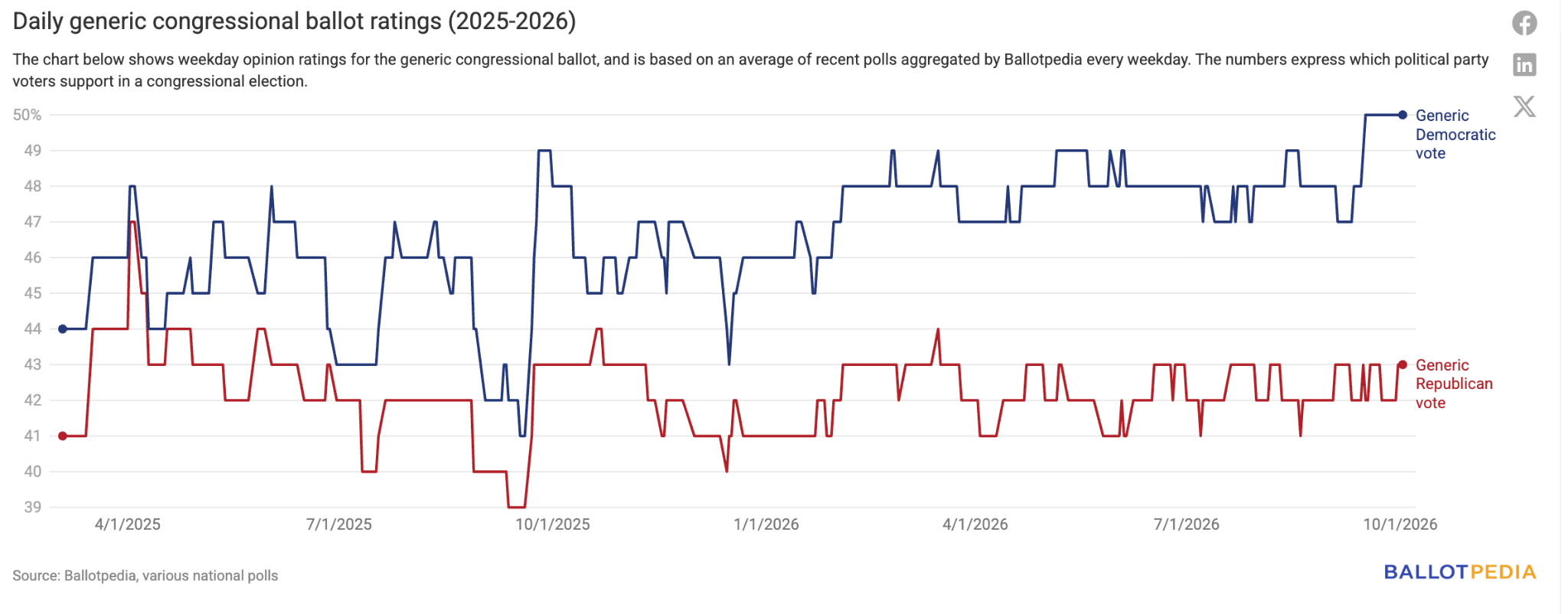
Polling averages show Democrats consistently leading congressional preference, via Ballotpedia.
Historical comparisons require more care than the original draft provided. A national margin above 5 points has sometimes accompanied major House gains, but no fixed threshold automatically produces a wave. Democrats won the 2018 national House vote by approximately 8.6 points and gained 41 seats, yet the current district map, candidate field, incumbency structure, and concentration of each party’s voters differ from that cycle.
Campaigns should therefore measure the direction and durability of the movement rather than attaching a predetermined seat total to the national margin. A persistent lead near 8 points expands the battlefield because Republican candidates in districts that previously appeared secure must now spend money defending themselves. That expansion can also strain Democratic resources if national optimism encourages investments in too many marginal opportunities.
Economic Dissatisfaction Gives the Lead Political Force
Cost-of-living pressure supplies the clearest explanation for the Republican decline. Emerson found that 60% of likely voters believed President Donald Trump’s economic policies were making the economy worse. Only 28% said those policies were improving it, while the remainder saw no effect or believed it was too early to judge.
A later Reuters and Ipsos survey measured Trump’s overall approval at 32% and found only 17% approving of his handling of cost-of-living issues. The same poll gave Democrats an 8 point advantage among registered voters on the congressional ballot. Differences between the Reuters and Ipsos result and other approval averages reflect survey timing, samples, and methodology, so the article should not combine them into a single approval range.
Public frustration has also moved beyond a general judgment about the economy. High gasoline prices, expensive groceries, housing costs, and uncertainty about employment conditions give Democratic candidates concrete ways to connect national Republican control with household expenses. Republican candidates must answer those attacks without relying entirely on national economic indicators that may not match voters’ personal experience.
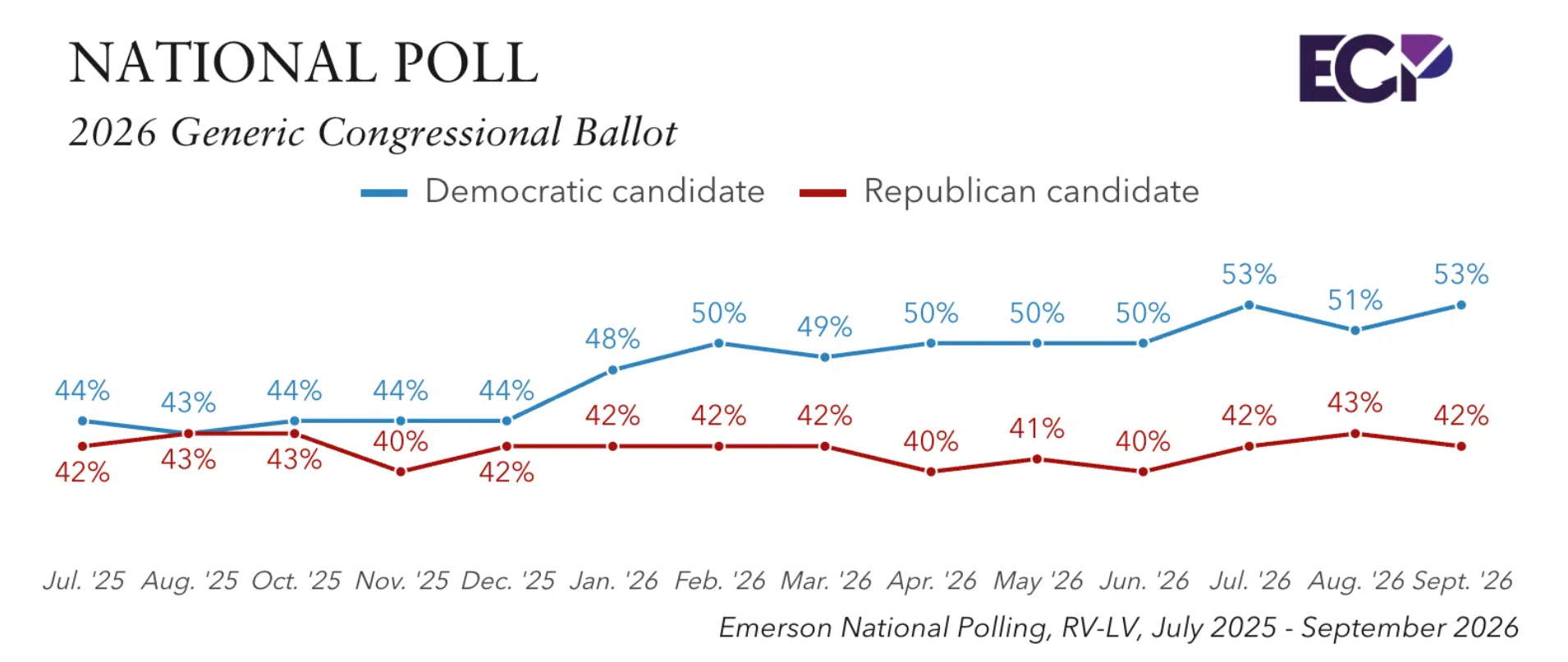
Economic dissatisfaction accompanies an 11 point Democratic advantage, via Emerson College Polling.
Economic concern does not automatically create Democratic enthusiasm. Voters can disapprove of Republican performance without developing confidence in Democratic candidates. Emerson nevertheless found 78% of Democrats very excited to vote, compared with 66% of Republicans, creating a potential turnout advantage if campaigns convert that enthusiasm into early votes and completed ballots.
Messages should remain specific to local economic consequences. Candidates need to show how federal choices affect gasoline, food, housing, utilities, health care, or employment in their district. Broad attacks on the national economy may reinforce existing opinion, but locally grounded contrasts are more likely to persuade voters who have not completed their choice.
Three Seats Make District Geography More Important Than the National Margin
Democrats do not need a national wave on the scale of 2018 to win control. They won 215 House seats in 2024 and need 218 for a majority, leaving a net gain requirement of 3 seats. That narrow target makes a modest number of district-level movements potentially decisive.
Competitive-district evidence gives the national advantage more practical meaning. A Cook Political Report survey of 1,052 likely voters across 37 competitive districts placed Democrats ahead by 49% to 47%. Donald Trump carried those districts by an average of approximately 5 points in 2024, indicating a substantial shift toward Democratic congressional candidates within the seats most likely to determine control.
The same survey also found Democrats holding advantages on the economy, inflation, gasoline prices, international trade, and tariffs. Those results challenge the assumption that Republicans retain an automatic advantage whenever campaigns focus on household finances. They also identify the specific issues Democratic campaigns can use to connect the national political environment with district-level persuasion.
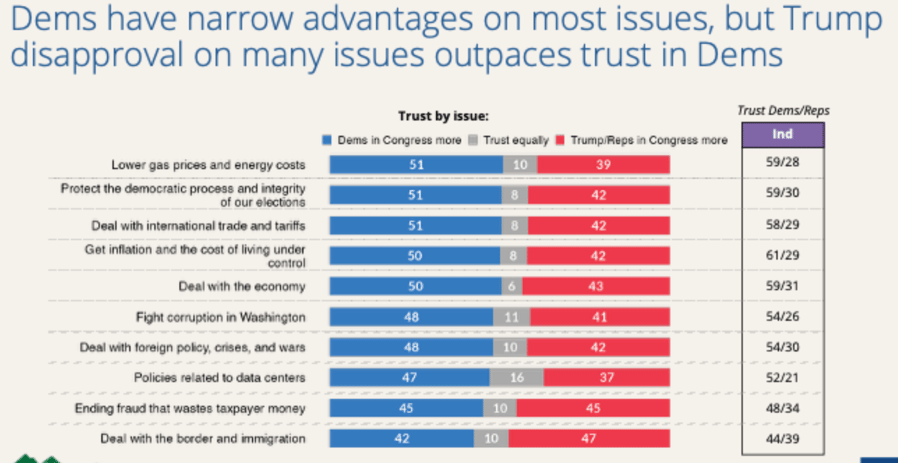
Battleground voters give Democrats advantages on major economic concerns, via The Cook Political Report.
Geography still limits how efficiently national votes translate into seats. Cook noted that 86% of Republican House members represent districts Trump carried by more than 10 points in 2024. A Democratic national lead can therefore produce a commanding popular vote result while leaving many Republican districts outside realistic reach.
Resource allocation must reflect that limitation. Priority districts should receive protected advertising reservations, field staff, direct mail, and turnout funding before campaigns expand into more speculative territory. Expansion districts should receive additional investment only when local polling, fundraising, voter registration, or early voting data confirm that the national movement has reached them.
National committees must also protect vulnerable Democratic seats. Winning 3 Republican districts will not produce a majority if Democrats lose incumbents elsewhere. The relevant calculation is net change, which means offensive and defensive spending decisions must be evaluated together rather than through separate national narratives.
Wrap Up
Generic ballot polling now gives Democrats a clear national advantage. RealClearPolling, Ballotpedia, Emerson College, Reuters and Ipsos all show the opposition party leading congressional preference, even though their exact margins and methodologies differ. Economic dissatisfaction gives that movement a durable campaign issue rather than leaving it dependent on temporary political news.
That advantage creates opportunity without eliminating uncertainty. Generic ballot surveys do not name local candidates, measure every district equally, or account completely for incumbency and voter geography. Competitive-district polling provides stronger evidence that the movement is reaching the House battlefield, but even those results remain snapshots rather than final outcomes.
Campaigns should respond by protecting priority markets, testing economic messages locally, monitoring turnout intensity, and expanding only where district evidence supports additional investment. Democrats need only 3 net seats, but converting a national lead into those gains requires disciplined spending and local execution. Republicans cannot erase the national environment, but strong candidates can still survive it if they separate themselves from the economic judgments weakening their party.