-Oct-08-2026-08-37-48-9565-PM.jpg)

Democrats hold a national advantage, but district geography and turnout will determine whether it becomes a governing majority.
What to Know
- A leading polling average placed Democrats ahead by approximately 8 percentage points on the national congressional ballot.
- Separate September surveys measured Democratic advantages ranging from 7 to 16 percentage points across different voter populations.
- Independent voters favored Democratic congressional candidates by margins exceeding 20 percentage points in multiple national surveys.
- Democrats led Republicans by 11 percentage points on handling living costs, but confidence in both parties remained weak.
- One prediction market’s separately defined blue wave contract briefly reached 87% before easing by 1 percentage point.
National polling has moved beyond an isolated favorable result for Democrats. Emerson College Polling, Marist, Reuters and Ipsos, and the Economist and YouGov all measured Democratic congressional advantages during September 2026. Those surveys used different populations and methods, but they pointed in the same direction.

National polling now raises the stakes for control of Congress, via U.S. House of Representatives.
Aggregation strengthens that signal without turning it into a seat forecast. FiftyPlusOne’s generic ballot average placed Democrats at 51.2% and Republicans at 43.4% on October 7, producing an advantage of approximately 8 percentage points after rounding. Ballotpedia’s polling indexes provide another framework for tracking national political opinion, but neither index can determine how support will distribute itself across individual House districts.
Polling Agreement Matters More Than Any One Margin
National surveys currently disagree about the size of the Democratic advantage more than its existence. A Reuters and Ipsos survey placed Democrats ahead by 44% to 37% among registered voters. That 7 point margin cannot be compared directly with likely voter polling because registered voters include people who may not register or participate.
Emerson College Polling measured a larger advantage among likely voters. Its survey conducted on September 21 and September 22 placed Democrats ahead by 53% to 42%, an 11 point margin. The poll included 1,000 likely voters and reported a credibility interval of approximately 3 percentage points.
Marist surveyed registered voters rather than likely voters. Its September 14 and September 15 poll placed Democrats ahead by 53% to 41%, producing a 12 point advantage. Population differences matter because registered voter and likely voter screens can produce different estimates even when surveys are fielded during the same period.
Economist and YouGov polling illustrates that distinction particularly clearly. Democrats led by 16 percentage points among its defined likely voters but only 6 percentage points among registered voters in the same late September survey. That divergence is evidence of differing turnout assumptions, not proof that one topline must be correct and the other wrong.
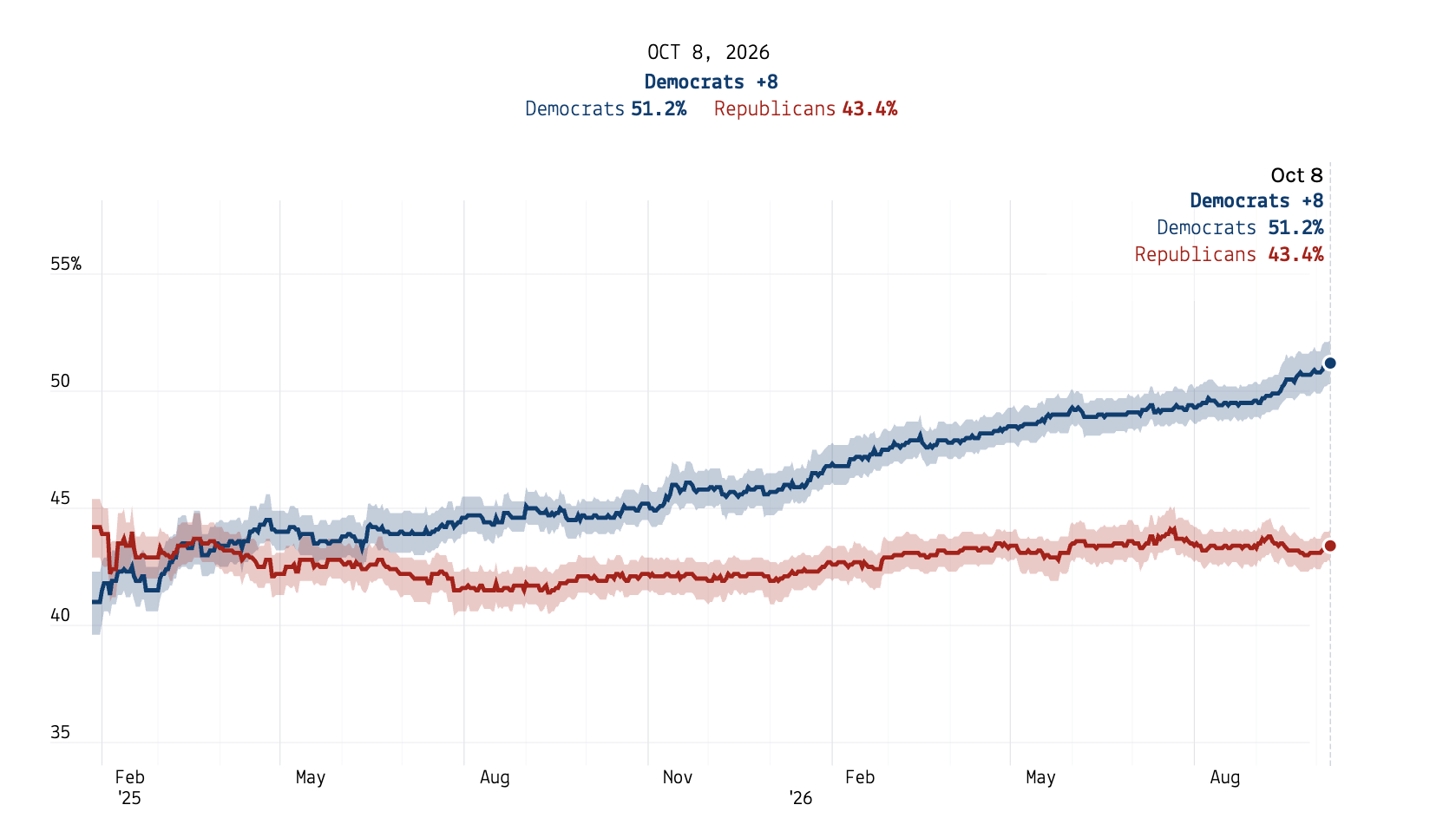
Polling averages smooth individual surveys into a clearer national direction, via FiftyPlusOne.
Consistency across polls creates a difficult national environment for Republicans, but the range remains strategically important. A Democratic advantage near 8 points would place more Republican held suburban districts under pressure than a margin closer to 5 points. Larger margins could also force Republican committees to defend seats that received limited early investment.
Independent Voters Are Expanding the Persuasion Map
Independent voters account for much of the Democratic advantage in several surveys. Marist found independents supporting the Democratic congressional candidate by 57% to 32%, a 25 point margin. A majority of those independents, 54%, also described their congressional choice primarily as a vote against President Donald Trump.
Economist and YouGov recorded an even larger difference within its likely voter definition. Independent likely voters supported Democrats by 59% to 27%, creating a 32 point margin. That subgroup estimate carries more uncertainty than the full poll because it relies on a smaller sample, but its direction matches the separate Marist result.
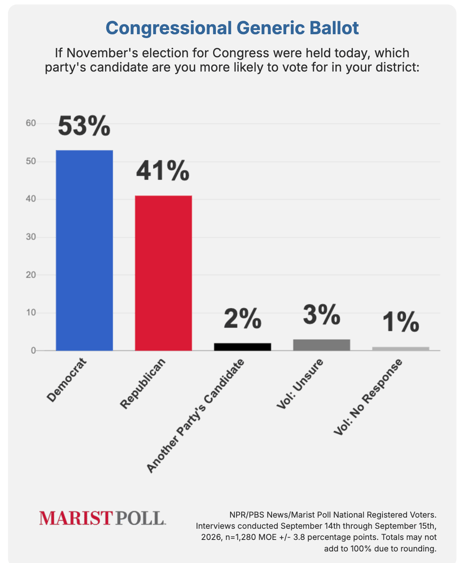
Independent voters create the widest Democratic margin in key surveys, via Marist Poll.
Independent movement changes where campaigns must compete. Republican incumbents in suburban districts cannot depend exclusively on conservative base turnout if unaffiliated voters view their congressional choice as a check on the administration. Democratic candidates gain an opening, but they still need locally credible messages capable of surviving candidate scrutiny.
Subgroup margins should not be interpreted as a national bloc moving uniformly. Independents differ across metropolitan suburbs, smaller industrial cities and rural communities. Campaigns therefore need district evidence showing whether national dissatisfaction is changing persuasion, enthusiasm or both.
Affordability Creates an Advantage Without Restoring Trust
Economic dissatisfaction appears to be reinforcing the generic ballot movement. Emerson found 41% of voters identifying the economy as their leading concern, while 60% said Trump’s economic policies were making conditions worse. Voters prioritizing the economy supported the Democratic congressional candidate by 55% to 41%.
Associated Press and NORC polling reached a related conclusion about living costs. Registered voters preferred Democrats over Republicans on handling the cost of living by 38% to 27%, giving Democrats an 11 point advantage. Earlier measurements had shown the parties much closer on the issue.
Public dissatisfaction does not amount to broad confidence in Democrats. Only about 2 in 10 registered voters said either party could solve important problems or remained focused on people like them. Voters may be moving away from Republicans without embracing a durable Democratic governing mandate.
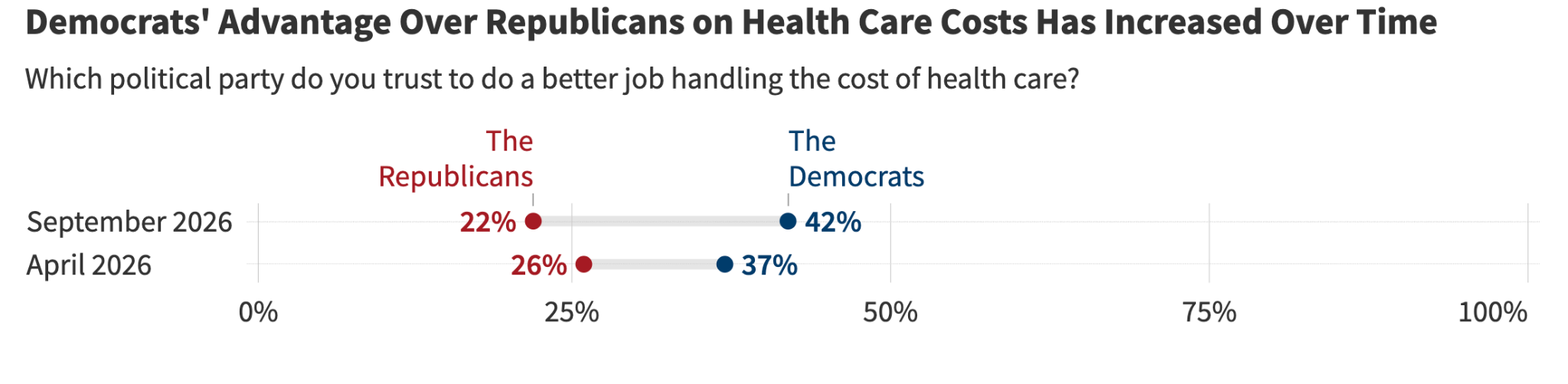
Democrats lead Republicans on cost of living by 14 points, via KFF.
That distinction changes the closing argument. Democratic candidates can benefit from frustration over prices, fuel costs and household finances, but a message built entirely around national opposition may leave skeptical voters unconvinced about what would change. Republican candidates must address affordability without asking voters to disregard their assessments of the administration’s economic record.
Prediction Markets Reflect Momentum, Not Voter Intent
Prediction markets have responded to the same political environment, but their prices measure trader expectations rather than public opinion. Kalshi’s blue wave contract briefly reached 87% on September 29 before easing to 86%. That movement represented what market participants were willing to pay under the contract’s rules at that moment.
Kalshi defines its blue wave outcome as Democrats holding at least 218 House seats and at least 49 Senate seats. That is a platform specific contract definition, not a conventional election rating or a direct probability that Democrats will control both chambers. Senate control can depend on the final seat division and the vice president’s tie breaking authority.
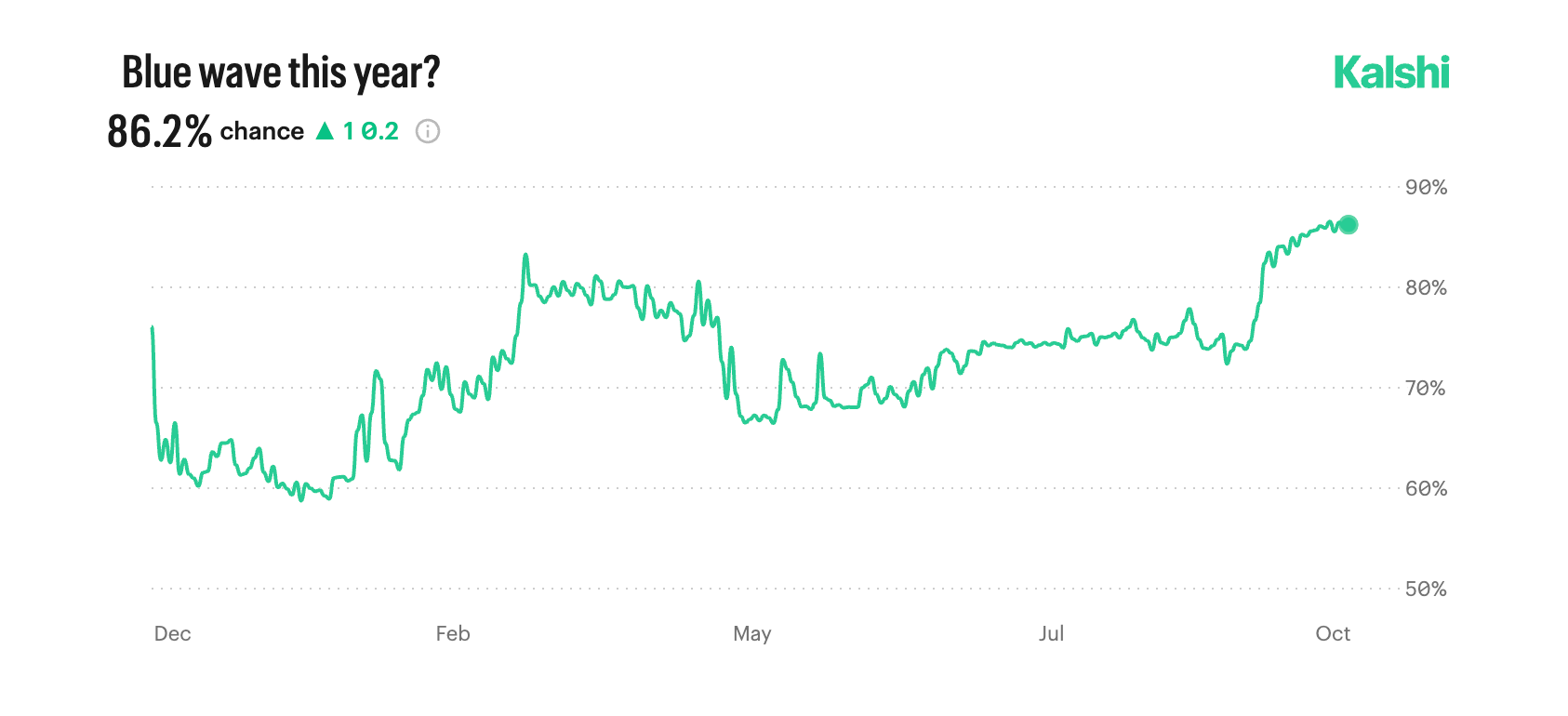
Market prices reflected trader expectations, not measured voter preferences nationwide, via Kalshi.
Market pricing can move rapidly after polling releases, campaign developments or changes in trading volume. Unlike a statistical election model, a contract price does not necessarily incorporate district level fundamentals through a consistent published methodology. It should be treated as a measure of market sentiment, not independent confirmation of every polling conclusion.
Campaigns should take the direction seriously without treating the percentage as destiny. Rising market expectations can influence media coverage, donor attention and perceptions of momentum. Votes, however, will be counted district by district rather than through a single national contract.
Wrap Up
Democrats have established a meaningful national generic ballot advantage across individual polls and polling averages. Agreement among different survey organizations makes the direction more significant than any one unusually large result. Exact margins still depend on methodology, voter population and turnout assumptions.
Republican vulnerability is greatest where national dissatisfaction intersects with competitive district fundamentals. Suburban incumbents, candidates tied closely to Trump and campaigns without a persuasive affordability response face the greatest pressure. Strong local candidates can still outperform a difficult national environment, but more of them may now require financial protection.
Democrats cannot convert national polling into House control automatically. District boundaries, candidate quality, turnout and late spending will determine how efficiently their vote translates into seats. Current numbers have expanded the battlefield, but only local execution can turn that expansion into a majority.