


The 2026 map reveals a political reality that generic ballot numbers alone cannot explain.
What to Know
- Democrats lead the generic ballot by about 7.5 points, but that advantage does not translate evenly across the Senate map.
- Republicans enter 2026 with most of their Senate seats protected by deep-red state geography.
- Democrats need a net gain of four seats while defending multiple states Trump won in 2024.
- The 2026 Senate battlefield is concentrated in fewer than ten truly competitive states.
- House control may be determined by national momentum; Senate control will be determined by political geography.
The 2026 congressional landscape presents a fascinating structural paradox: a "divergent majorities" dynamic where national generic sentiment heavily favors Democrats, yet the specific geography of the Senate map fiercely protects the Republican majority.
While generic ballot modeling (such as insights from Sabato's Crystal Ball) suggests a high-probability environment for Democrats to recapture the House of Representatives, translating that national momentum into a Senate majority is a much steeper uphill battle. This is due to a stark mismatch between high Democratic exposure and the geographic insulation of safe Republican seats.
The Analytical Paradox: House vs. Senate
To understand the 2026 cycle, analysts must reconcile two competing electoral realities:
|
Electoral Metric |
The House Landscape (Generic Model) |
The Senate Landscape (Exposure Model) |
|
Structural Baseline |
Highly responsive to national generic shifts and suburban realignment. |
Highly rigid, dictated by state boundaries and historical partisan baselines. |
|
Democratic Outlook |
Strong. Generic polling and historical midterm/cycle trends give Democrats a clear path to a majority. |
Defensive. Democrats must defend highly exposed seats in hostile or marginal territory. |
|
Republican Insulation |
Lower. Dozens of vulnerable incumbents sit in Biden/Harris-won or highly competitive swing districts. |
High. The vast majority of class 2 Republican seats are safely locked behind deep-red geographic moats. |
Understanding the Senate Exposure Model
According to Sabato's Crystal Ball, national generic ballot polling currently suggests an environment that would normally favor Democrats in the fight for control of Congress. However, the Senate operates under a different set of political realities than the House. While all House districts are contested every two years, only one-third of Senate seats are on the ballot during any election cycle, making the specific map far more important than national trends.
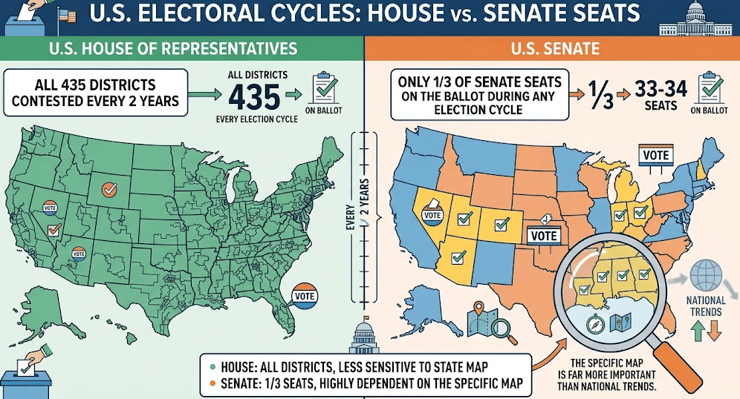
This is where the concept of Senate exposure becomes important. Exposure refers to how many seats a party must defend in states that are competitive or lean toward the opposing party. Although Democrats benefit from favorable national polling, the 2026 Senate map forces Democrats to defend several seats in politically challenging states while Republicans largely defend seats in states that strongly favor their party.

That favorable map is one reason Republicans remain confident about their prospects despite a difficult national environment. As National Republican Senatorial Committee Chairman Sen. Tim Scott recently told Fox News Digital, "There's no doubt the climate has gotten more and more difficult by the day," but he emphasized that he remains "incredibly optimistic" about Republicans not only holding but potentially expanding their current 53-47 Senate majority.
The challenge creates what can be described as a "mid-ticket squeeze." In states that are closely divided or lean slightly Republican, Democratic candidates cannot simply rely on a favorable national environment. They must outperform the broader political climate within their own states to remain competitive. Meanwhile, many Republican incumbents are insulated by state-level partisan advantages that make them less vulnerable to national swings.
The Geographic Insulation of Safe Republican Seats
Conversely, the Republican path to maintaining the Senate majority is heavily protected by American political geography. A significant portion of the Republican-held seats up in 2026 are located in deeply conservative states (e.g., Idaho, Wyoming, Arkansas, Mississippi). No matter how favorable the national generic ballot is for Democrats, these seats are structurally insulated from national waves.

Because the Republican base is geographically consolidated in these unassailable states, the GOP requires far less effort and capital to retain its baseline majorities, allowing them to hyper-focus resources on a select few swing-state battlegrounds.
States That Will Decide Senate Control
Several races are already emerging as pivotal. In North Carolina, Democrats view the open seat race as one of their best pickup opportunities. In Maine, longtime Republican Sen. Susan Collins faces another potentially competitive reelection campaign. Democrats must also protect vulnerable positions in states such as Georgia and Michigan, where close statewide contests have become the norm. Meanwhile, Republicans are defending seats in states like Texas and Alaska that have occasionally shown signs of competitiveness but still lean toward the GOP.
Taken together, these contests illustrate why the Senate remains so difficult for Democrats despite favorable national polling. Control of the chamber is unlikely to be determined by a national wave alone. Instead, it will come down to a handful of races where candidate quality, fundraising, turnout operations, and state-specific issues outweigh broader national trends. In many ways, the battle for the Senate is less a national election than a collection of individual state-level campaigns occurring simultaneously.
Wrap Up
The 2026 Senate map serves as a reminder that American elections are not fought on a single national battlefield. While Democrats may benefit from a favorable generic ballot environment and growing dissatisfaction with the White House, Senate races remain tethered to state-level realities. Political geography, candidate quality, fundraising, and local issues often matter more than national momentum. As a result, a Democratic wave large enough to flip the House may still fall short of delivering Senate control.
For Republicans, the path to maintaining their majority runs through the structural advantages built into the map itself. Many of the seats they are defending sit behind deep-red geographic strongholds that remain resistant to national political swings. For Democrats, the challenge is far steeper: defend vulnerable incumbents, capitalize on a handful of pickup opportunities, and recruit candidates capable of outperforming their party's baseline in competitive states.

-4.jpg)