
A new analysis shows Republicans are no longer just playing offense in 2026 but are now forced to defend critical seats in states with very different political dynamics.
What to Know
- Ohio carries a 10-point Republican baseline advantage, with Trump winning by 11% in 2024
- Senator Jon Husted faces former Senator Sherrod Brown in a high-profile comeback attempt
- Alaska becomes a top-tier race with Mary Peltola entering against incumbent Dan Sullivan
- Alaska’s ranked-choice voting system creates unpredictable coalition outcomes
- Control of the Senate may hinge on a small number of competitive states like these
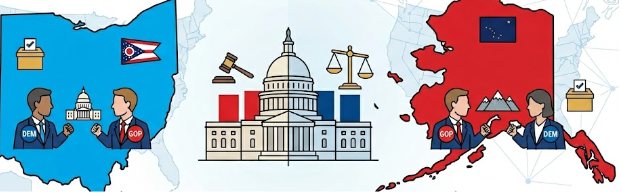
The 2026 Senate map is beginning to narrow into a handful of high-stakes contests that will determine chamber control. A new breakdown from Inside Elections identifies Ohio and Alaska as two races where Republicans are no longer expanding the map but actively defending it. Both states lean Republican on paper, but each presents structural challenges that could disrupt expectations and force both parties to recalibrate strategy.
Ohio: A Red State With a Familiar Democratic Threat
Ohio has completed its shift from battleground to reliably Republican territory. With a 10-point GOP baseline advantage and a consistent statewide winning streak since 2018, the structural environment clearly favors Republicans. That advantage is reinforced by Donald Trump’s 11% margin in 2024, signaling that partisan realignment is not temporary but embedded.

The matchup, however, introduces a controlled variable into an otherwise stable equation. Jon Husted enters as an appointed incumbent following JD Vance’s move to the vice presidency. While he brings statewide experience, he does not yet benefit from the institutional weight or voter familiarity that typically anchors Senate incumbents. His advantage is structural, not personal.


Lieutenant Governor of Ohio, John Husted; Vice President JD Vance
Sherrod Brown represents the opposite profile. He is one of the few remaining Democrats with a proven ability to outperform the state’s partisan lean, particularly among working-class voters. But that coalition has eroded, and the conditions that once enabled crossover support are materially weaker.

This race ultimately resolves into a hierarchy of forces. Structure leads. Candidate quality can only narrow the margin. For Republicans, the objective is discipline. Consolidate the baseline, define Husted early, and nationalize Brown as misaligned with a state that has already moved on. Any deviation introduces unnecessary risk into a race that fundamentals already favor.
For Democrats, the path is not expansion but survival. Brown must rebuild a coalition that is no longer naturally available, relying on residual brand strength and turnout efficiency rather than persuasion at scale. Ultimately, Ohio is not a toss-up but a defensive stronghold for Republicans. It remains competitive only if GOP execution falters or if Democrats can successfully leverage Brown's unique brand strength.
Alaska: Coalition Politics in a Ranked-Choice Environment
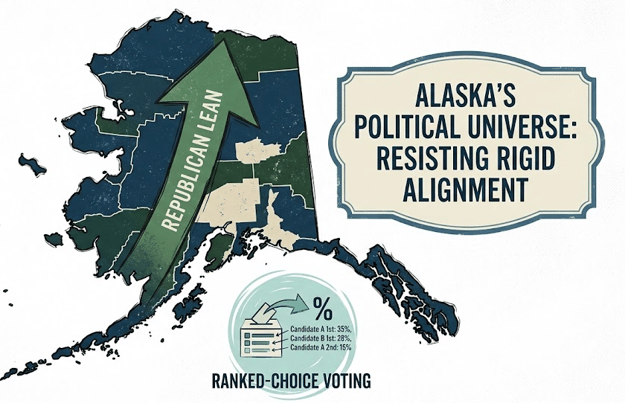
Alaska operates under a different set of rules, and those rules matter as much as the candidates themselves. While the state maintains a Republican lean at the federal level, its political culture consistently resists rigid partisan alignment. That tension is magnified by ranked-choice voting, which restructures how campaigns win rather than simply who wins.
Mary Peltola enters the race as a proven coalition builder. As the first Alaska Native elected to Congress, she has already demonstrated the ability to consolidate Democratic support while remaining broadly acceptable to independents and moderate Republicans. Her “Alaska First” positioning is not branding. It is a functional strategy aligned with how voters in the state make decisions.


Rep. Mary Peltola, Senator Dan Sullivan
Dan Sullivan brings a different advantage set. As an incumbent, he benefits from established name recognition, a consistent conservative record, and the underlying Republican baseline. In a traditional election system, those factors would likely be sufficient to anchor the race. But Alaska is not operating under a traditional system.
Ranked-choice voting introduces a structural constraint on purely partisan strategies. Winning requires not only leading in first-choice votes but also avoiding consolidation among opposition voters in later rounds. That shifts the campaign focus from base maximization to coalition prevention.
|
Ranked-Choice Voting (RCV): A voting system in which voters rank candidates in order of preference (1st, 2nd, 3rd, etc.) rather than selecting just one. If no candidate receives a majority of first-choice votes, the candidate with the fewest votes is eliminated, and those ballots are redistributed to the voters’ next choices. This process continues until one candidate achieves a majority. |
Peltola’s pathway is additive. She must lock down Democratic voters, secure strong independent support, and remain a viable second-choice option for a segment of Republican voters. Her ceiling is defined by breadth. Sullivan’s pathway is defensive. He must dominate first-choice votes while fragmenting the opposition field enough to prevent a unified transfer of second-choice support. His margin depends on preventing consolidation rather than simply expanding turnout.
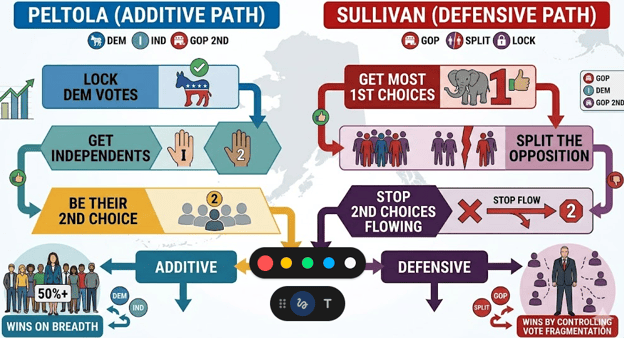
The implication is clear. Alaska is not a standard red state defense. It is a structural vulnerability embedded within a favorable map. This race will not be decided by who has more support at the outset. It will be decided by how that support transfers.
Wrap Up
The 2026 Senate battlefield reflects a structural shift from expansion to containment. Republicans are defending ground that, on paper, should be secure, but in practice demands precision. Ohio and Alaska illustrate how different variables can disrupt even favorable conditions. In Ohio, candidate identity tests the limits of partisan realignment. In Alaska, the voting system itself reshapes the path to victory. These are not edge cases. They are indicators of a map where fewer races matter more, and where each contest operates under its own set of rules.
For both parties, the operational takeaway is clear. National narratives will have limited impact in a compressed map defined by state-specific dynamics. Democrats must identify and maximize narrow openings through candidate strength and structural leverage. Republicans must execute cleanly in environments where advantage exists but is not self-sustaining. Control of the Senate will be decided in a small number of races where margins are thin, coalition management is critical, and mistakes cannot be absorbed.