

In Iowa’s most competitive district, the fight is not about policy first. It is about who defines reality before voters even start paying attention.
What to Know
- IA-03 is a true battleground (R+2 PVI), with recent results showing tight GOP control: Trump +0.4 (2020) → Trump +4 (2024) and Zach Nunn winning with 51.8%
- Fundraising is competitive but asymmetrical: Sarah Trone Garriott raised $1.7M (Q1 2026) vs Nunn’s $1.3M, yet Nunn holds a larger war chest (~$3.04M vs ~$2.19M cash on hand)
- GOP messaging is built on early definition, using past remarks like references to “white, masculine power” and a Satanist wedding story to frame her as culturally out-of-step
- Nunn’s positioning is data-backed: ranked #10 on the Bipartisan Index, with 110+ bipartisan bills and a top 3% cooperation score to reinforce a moderate profile
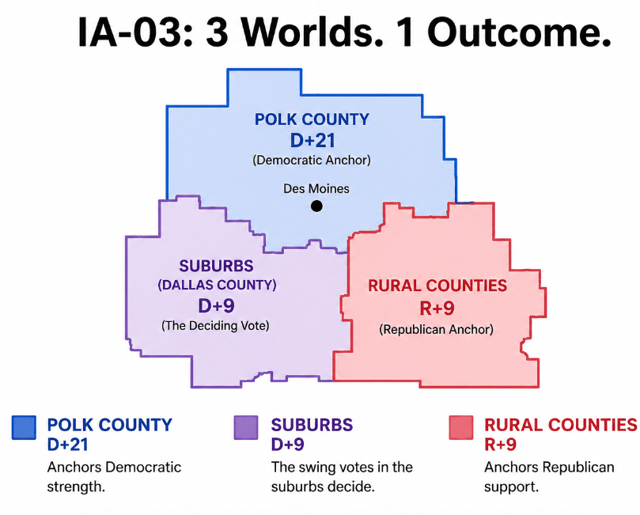
- The electorate is split and math-driven: Polk County D+21 (57–36), Dallas County D+9 (53–44), rural areas R+9 (41–50), making suburban margins the decisive battleground
Cook Political Report, FEC filings, and recent district polling IA-03 is an R+2 district where Zach Nunn won with just 51.8%. The challenger is outraising him $1.7M to $1.3M, yet he still holds a larger war chest at ~$3.04M vs ~$2.19M. The map is brutally split: D+21 in Polk, D+9 in Dallas, R+9 rural. That is the margin for control of the House.

Iowa’s 3rd is not waiting for the national environment to settle. It is already moving. This race sits inside the narrow band of districts that will determine control, and that pressure has forced both parties into a different strategy.
 .
.
The goal is no longer to build a long, persuasive case over time. It is to establish a fast, durable impression that voters can process instantly. That shift is clearest in how Republicans are approaching Sarah Trone Garriott. They are not starting with policy. They are defining who she is before voters ever get that far.
The Attack Is the Strategy
Republican operatives are not treating opposition research as a supporting tactic. They are treating it as the campaign itself. The focus is deliberate: pull from Sarah Trone Garriott’s past sermons, isolate phrases like “white, masculine power,” and elevate them into a repeatable narrative that frames her as culturally misaligned with IA-03 voters.
Video: Sarah Trone Garriott Sermon at Plymouth Church DSM (July 17, 2022)
The timing is the point. A pastor enters with built-in trust. That signals service, stability, and community alignment and makes it easier to connect with undecided voters. The strategy is to disrupt that advantage. By reframing her image as ideological, Republicans introduce distance before that trust fully forms.
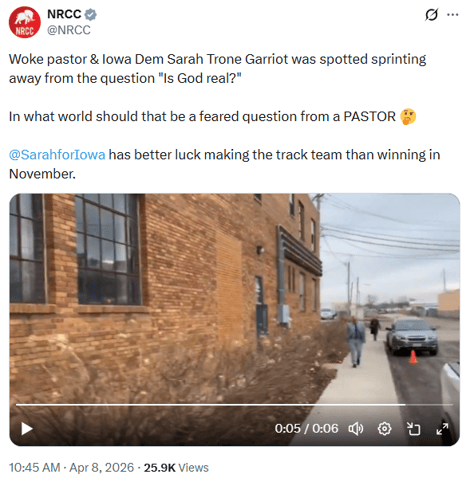
Screenshot from NRCC X
Once that first impression lands, it tends to stick. Voters process everything that follows through that lens. In a race like IA-03, defining first is often enough to shape the outcome.
Why This Matters More Than Policy
Democrats want this race centered on affordability, healthcare, and cost-of-living pressures. That is a standard midterm play. But IA-03 is structurally tight. It is an R+2 district where margins have consistently been narrow, with presidential results within a point and the seat itself held by a slim majority, according to Ballotpedia’s Iowa’s 3rd Congressional District page.
The Republican strategy is built to act before those policy arguments fully land. By defining Sarah Trone Garriott early, they introduce hesitation at the moment voters are forming first impressions. In a district this evenly balanced, that hesitation limits how much voters engage with economic messaging at all. This is less about winning a policy debate and more about controlling whether voters ever reach it.
A Structural Shift in How Campaigns Win
What is happening in IA-03 reflects a broader shift in how campaigns operate, and the map makes that clear. Iowa’s 3rd is not a uniform district. It is a mix of dense urban Des Moines in Polk County, fast-growing suburbs in Dallas County, and a wide stretch of rural counties surrounding them. That geographic split creates competing political identities inside a single district, as shown in the official Iowa Congressional District 3 map.
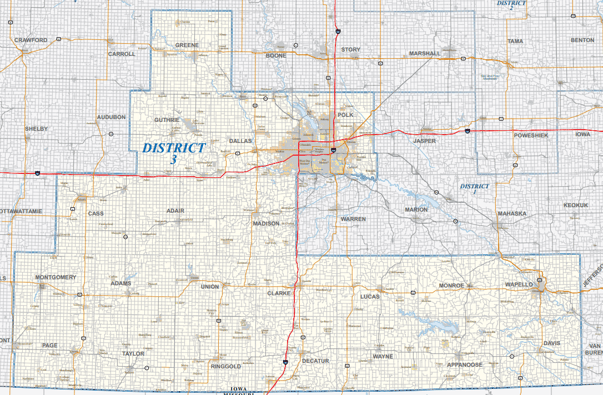
Iowa Congressional District 3 map
In an environment like this, persuasion takes time, and time is limited. Campaigns are not trying to slowly move voters across those different regions. They are trying to define candidates quickly enough that voters in each part of the map process information through a fixed lens. Urban voters, suburban voters, and rural voters may respond to different issues, but they all respond to clear identity signals.
The Risk for Democrats
Directly engaging the attacks carries risk. Repeating or explaining past remarks can keep the focus on identity, where Republicans are already invested. Ignoring them entirely carries a different risk. In a race where early definition is central, silence can allow that framing to settle, especially among undecided suburban voters who ultimately decide the outcome.
That leaves a constrained strategy. The campaign has to shift attention toward tangible alignment with voters’ daily concerns while maintaining its suburban edge. In a district where she raised $1.7M but still trails in total cash, message efficiency matters as much as message content. The campaign cannot afford to spend time reinforcing a frame it did not create.
Why IA-03 Is a Bellwether
IA-03 matters because it compresses multiple political environments into one map. Polk County (D+21) anchors Democratic strength, rural counties (R+9) anchor Republican support, and the suburbs determine the outcome. That structure forces campaigns to operate with precision rather than broad messaging.
What is happening here reflects a broader shift. Campaigns are not waiting to build issue-based persuasion. They are moving early to define identity, knowing that voters often process policy through that initial lens. This dynamic is not isolated. Similar patterns are emerging in other competitive districts where early narrative control and rapid message repetition are shaping the field before policy debates fully develop. IA-03 is simply showing it more clearly and earlier than most.
Wrap Up
The fight for the House is narrowing to a small number of districts where margins are thin and timing carries outsized weight. IA-03 sits at the center of that map, and the structure of the race is already defined by how quickly each side can shape voter perception.
Republicans are moving early to define the race on identity rather than policy, setting the frame before voters fully engage with the details. That approach is already influencing how the campaign is being interpreted across the district, especially in the suburban areas that will decide the outcome.
Democrats still have a path, but it is constrained and requires discipline. It depends on holding suburban ground, sharpening economic messaging, and presenting a competing identity that connects quickly with voters before the current frame hardens. The outcome will not be determined by the depth of policy arguments. It will come down to who establishes the first lasting impression and whether that impression can be shifted once it takes hold.
-4.jpg)