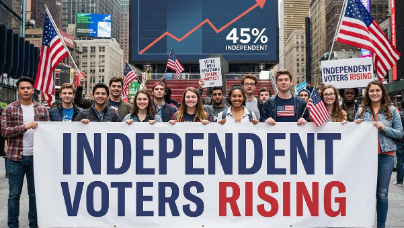

Increasing volatility and unpredictability mark the American political landscape as more Americans, particularly young voters, reject traditional party labels.
What to Know
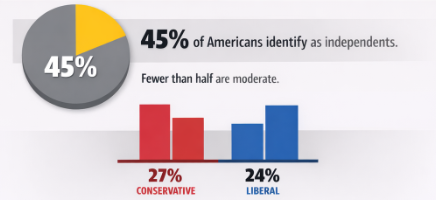
- A record-high 45% of U.S. adults identified as political independents in 2025, according to a recent Gallup poll.
- This surge is largely driven by younger voters, with 56% of Gen Z and 54% of Millennials now identifying as independents.
- Both the Democratic and Republican parties have seen their share of identifiers shrink, each claiming just 27% of the adult population.
- While many independents "lean" toward one party, a significant and growing number are truly unaffiliated, creating a powerful swing voting bloc.
- This trend of disaffiliation is more pronounced among today's youth than in previous generations at the same age.
The two-party system is showing its age. A new Gallup poll reveals a startling shift in the American electorate: a record 45% of U.S. adults now identify as political independents. This is not a sudden development but the culmination of a decade-long trend of increasing disaffection with both the Democratic and Republican parties.
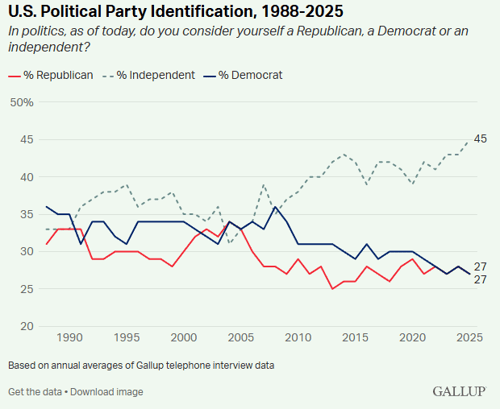
Screenshot of U.S. Political Party Identification, 1988-2025 chart from GALLUP poll.
The movement away from party labels is not uniform across all demographics. The most dramatic shift is occurring among younger voters. A stunning 56% of Gen Z adults (those born after 1996) and 54% of Millennials (born 1981-1996) now call themselves independents.
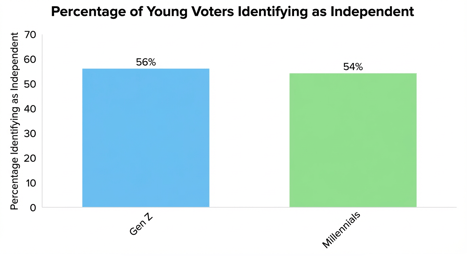
Data from GALLUP poll
This is a generational rejection of the political establishment that is more pronounced than in any previous cohort of young people. As these generations become a larger share of the electorate, their preference for independence will fundamentally alter the dynamics of American politics.
A Plague on Both Their Houses
Elections are increasingly influenced by voters who reject party labels, but that does not mean they are moderates. A record 45% of Americans now identify as independents, according to Gallup. Yet fewer than half describe themselves as moderate. 27% identify as conservative or very conservative, and 24% identify as liberal or very liberal. As Kristen Soltis Anderson wrote in The New York Times:
“These days, it does not necessarily signify moderation or centrism.”
Many independents are not centrists in the middle. They are dissatisfied partisans who lean clearly in one direction when they vote. In 2024, Republican-leaning independents overwhelmingly backed Donald Trump, while Democratic-leaning independents did the same for Kamala Harris. Only a small share, roughly 9% in Anderson’s research, insist they do not favor one party more than the other.
That reality reshapes campaign strategy. Independents do not vote as a single bloc, but a meaningful portion remain persuadable, especially in tight races. At the same time, they are more skeptical of political institutions and less likely to see party affiliation as part of their identity. The rise in independent identification signals distrust and frustration, not a national shift toward moderation. In competitive elections, understanding that distinction can determine who wins and who loses.
The Youth Revolution
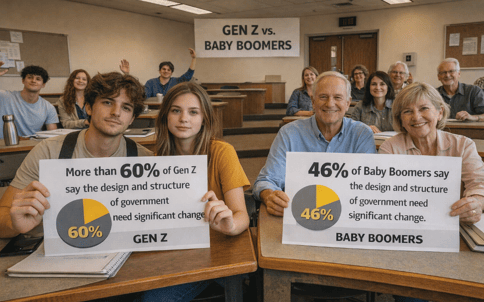
This shift is not a passing phase of youthful rebellion. It reflects a structural break in how younger Americans view democratic institutions and political parties. A nationally representative mid-2025 survey of 4,500 Americans conducted by the SNF Agora Institute at Johns Hopkins University found that more than 60% of Gen Z respondents believe the design and structure of government need significant change regardless of who is elected. Among Baby Boomers, that number falls to 46%, underscoring a measurable generational confidence gap.
The erosion of trust extends directly to party institutions. More than half of Gen Z respondents say their own political party is not moving in the right direction, while nearly two-thirds of Baby Boomers say the opposite. Younger voters report weaker attachment to party leadership and lower confidence that elected officials reflect their priorities.
This dissatisfaction persists across party lines, suggesting broad detachment rather than isolated ideological frustration. The Harvard Youth Poll in late 2025 reinforced the depth of the disillusionment. Only 13% of young Americans believe the country is headed in the right direction, a striking indicator of economic anxiety and institutional distrust.
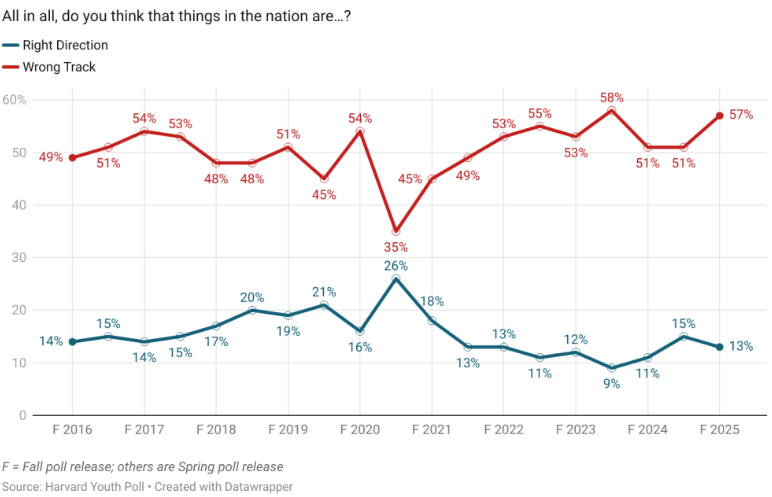
Screenshot of Harvard Youth Poll chart from Harvard Kennedy School, Institute for Politics
Younger respondents are less likely to feel represented by political leaders and more likely to question whether the system is delivering for them. At the same time, they are less inclined than older voters to describe political opponents in moralistic terms, signaling skepticism rather than hardened polarization.
This environment is reshaping political behavior. Younger voters are more open to independents, more willing to split tickets, and less motivated by party loyalty as an identity marker. When more than 60% of a generation believes the system requires significant change, traditional partisan appeals lose their force. The youth electorate is not disengaging from politics altogether, but recalibrating how and where it invests its trust.
Wrap Up
The rise of the independent voter is a seismic event in American politics. It is a clear and unmistakable signal that the old ways of doing things are no longer working. The two major parties are losing their grip on the electorate, and a new generation of voters is demanding a different kind of politics. This trend will have a profound impact on the 2026 midterm elections and beyond. Campaigns that can successfully appeal to this growing bloc of independent voters will be the ones that succeed in the new political landscape.
Looking ahead, the rise of the independent could lead to a number of different outcomes. It could pave the way for the emergence of a viable third party, or it could force the two major parties to moderate their positions and become more responsive to the needs of the American people. Whatever the outcome, one thing is clear: the era of the two-party system as we have known it is coming to an end. The future of American politics will be shaped by the choices and preferences of the independent voter.