
Michigan and Texas show how voters can distinguish candidates for Senate and governor even as statewide voting grows more partisan.
What to Know
- Michigan polling gives Jocelyn Benson a larger lead for governor than Abdul El-Sayed holds for Senate.
- Texas polling places James Talarico ahead for Senate while Governor Greg Abbott leads his reelection contest.
- Historical Senate and governor margins have generally moved closer together within the same states.
- A polling gap between two races does not establish that voters will split their ballots.
- Candidate appeal can shape a contest without overcoming the broader force of party loyalty.
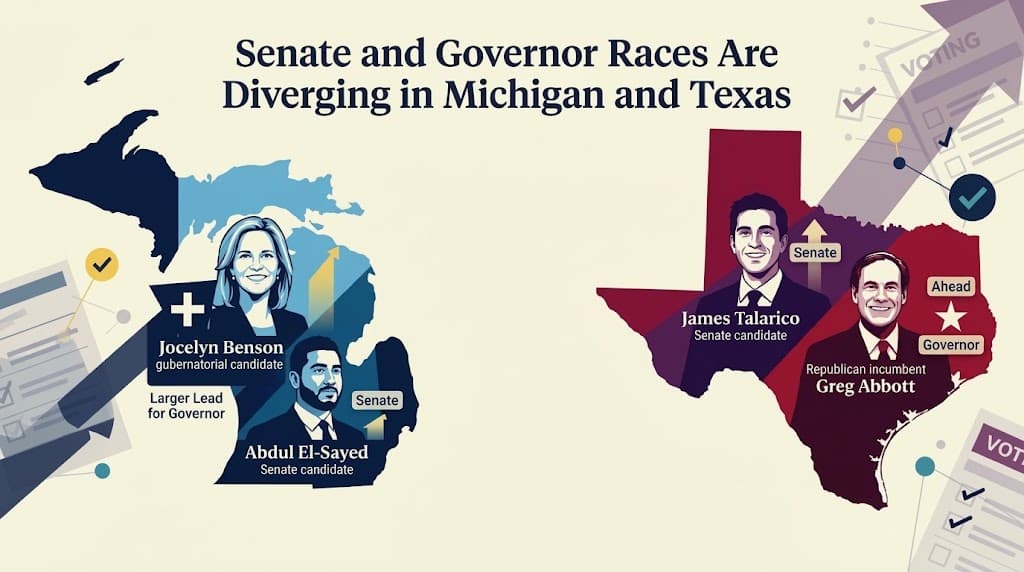
Two statewide races on one ballot can produce different political stories. In Michigan, Democrats lead the contests for governor and Senate, but Jocelyn Benson has generally polled better than Abdul El-Sayed. In Texas, Democrat James Talarico has led some Senate measurements while Republican Governor Greg Abbott remains ahead of Gina Hinojosa in the governor’s race.
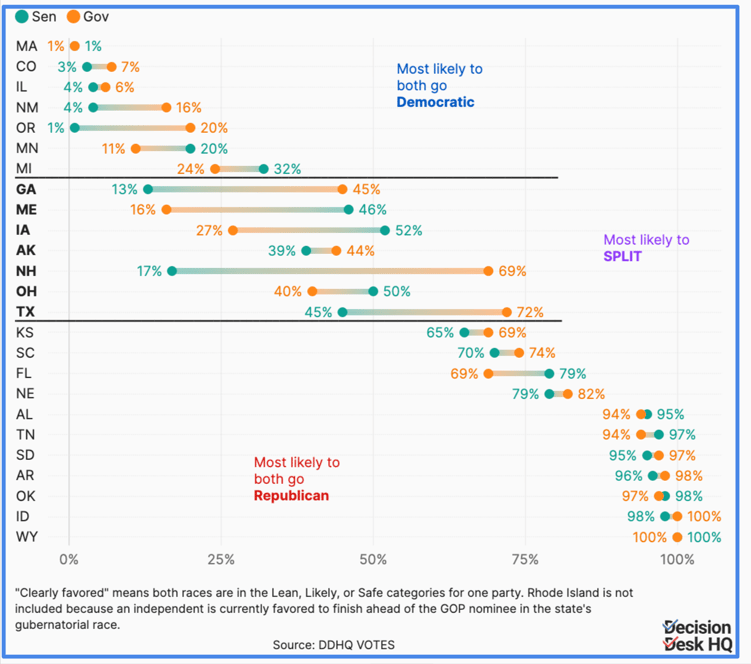
Statewide races have grown more alike despite consequential local exceptions, via Decision Desk HQ.
Those differences stand out because statewide elections have become more alike over time. Silver Bulletin’s analysis places Benson’s gubernatorial polling lead about 4.2 percentage points above El-Sayed’s Senate lead. Its contemporaneous polling averages put Talarico 2.4 points ahead of Ken Paxton and Hinojosa 2.7 points behind Abbott. Those are dated averages, not individual poll results or election forecasts. They describe a Texas gap of 5.1 points between the Democratic margins in the two contests.
Michigan’s Candidates Face Different Tests
Benson’s stronger position does not require Michigan voters to abandon their party preferences. Voters can favor Democrats in both races while remaining less certain about which Democrat they want to elect. For a party trying to hold a Senate seat and win the governorship, the size of that difference matters.
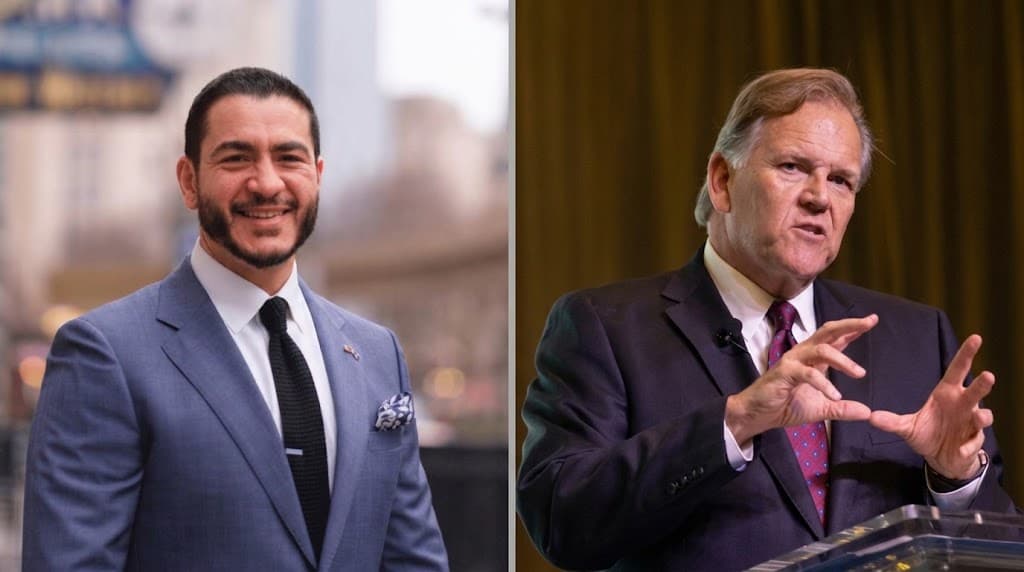
A Marist survey of Michigan voters provides a separate illustration. Among likely voters, it found El-Sayed ahead of Republican Mike Rogers by 2 points in the Senate race and Benson ahead of Republican John James by 6 points for governor. The 4-point difference between those leads resembles the gap in Silver Bulletin’s averages, but it is a result from one poll and should not be added to or substituted for that average.
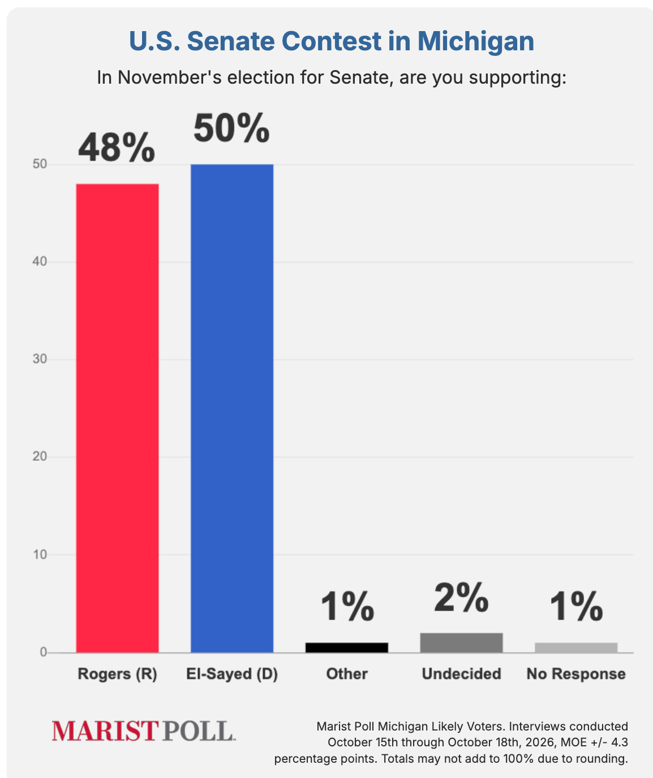
Benson’s lead exceeds El-Sayed’s in one Michigan survey, via Marist Poll.
Candidate positioning offers a possible explanation, not a proven cause. Benson and El-Sayed bring different records and campaign messages to different offices. Rogers and James also present voters with distinct Republican choices. Without evidence tracking individual ballots, the polling cannot tell us how many Benson supporters intend to vote for Rogers or remain undecided about Senate.
That distinction is crucial. A wider gubernatorial margin could reflect persuasion across party lines, different levels of undecided support, or differences in enthusiasm. Calling all of it ticket-splitting would claim more than the polls measure.
Texas Reverses the Democratic Pattern
Texas presents the opposite comparison. Silver Bulletin’s cited averages show Talarico ahead of Paxton for Senate while Abbott leads Hinojosa for governor. A Democrat polling competitively for a federal office in a state with a Republican governor ahead for reelection is a notable departure from the assumption that both races will move together.
An October Marist survey in Texas found Talarico ahead 47% to 45% among likely voters. The same survey put Abbott ahead 49% to 45%. Its Senate lead and gubernatorial deficit create a 6-point gap between Democratic margins, although both individual candidate leads were within the poll’s reported 4.9-point margin of error for likely voters.
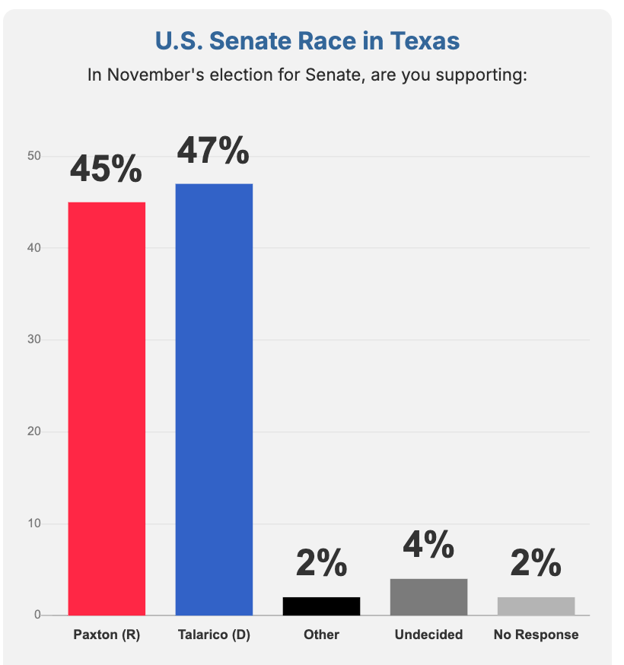
Talarico and Abbott lead different Texas contests in the same survey, via Marist Poll.
A candidate-specific interpretation is plausible. Paxton and Abbott are different Republican nominees, and voters may assess their records differently. But these toplines alone cannot prove that dissatisfaction with Paxton is causing Republican voters to cross over to Talarico. They establish a divergence in support across two races. The explanation requires more evidence than the divergence itself.
Nationalization Has Narrowed the Usual Gap
Differences between Senate and governor results used to be much larger. Decision Desk HQ’s historical comparison puts the median gap between the two statewide winning margins at about 25 points in 1990. Silver Bulletin reports approximately 13 points in 2014 and 8 points in 2022.
Silver Bulletin places the median gap at about 6 points in its 2026 projection. That last figure is an estimate of future results, not an observed election outcome. Decision Desk HQ’s separate forecast points to an even smaller projected median, below 5 points. Different models need not produce the same number to identify the same broad historical pattern.
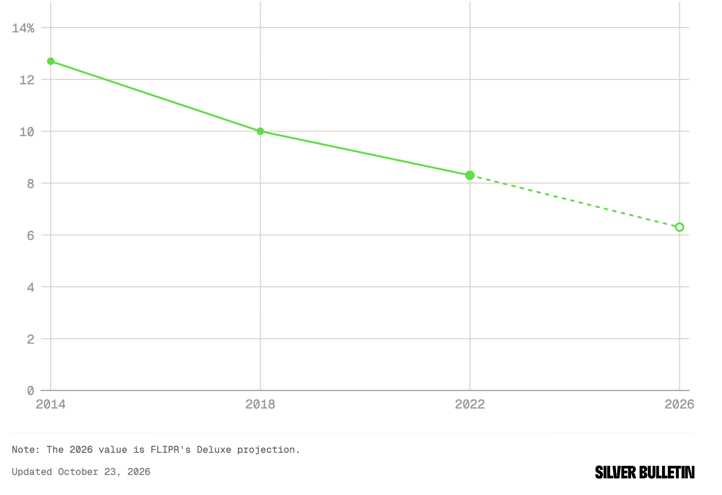
Historical margin gaps show a long decline in statewide divergence, via Silver Bulletin.
Nationalized party identities make it harder for candidates to separate themselves from the broader partisan environment. They do not erase differences between nominees or the offices they seek. Michigan and Texas can therefore show meaningful polling gaps even if the national median continues to shrink.
Wrap Up
Michigan and Texas are not evidence that ticket-splitting has returned to its earlier scale. Their current polling shows that candidate support can diverge within a state. Whether those differences produce split ballots or different party winners remains an Election Day question.
For campaigns, the distinction changes what the numbers mean. Benson’s stronger Michigan lead cannot simply be transferred to El-Sayed, and Talarico’s Texas standing does not automatically lift Hinojosa. Each candidate must persuade voters within a shared partisan environment.
Partisan gravity has narrowed the distance between statewide races. It has not made candidates interchangeable. The final margins in Michigan and Texas will show how much room remains for an individual campaign to depart from its party’s baseline.