
Summer Senate polls show meaningful Democratic strength, but recent midterms suggest those advantages may narrow substantially before November.
What to Know
- A 3.7 point average Democratic error across 3,312 polls limits confidence in narrow summer leads.
- A late July error peak of 5.9 points makes current margins especially uncertain.
- Final midterm polling was nearly directionally neutral in 2018 and 2022.
- A Senate majority requires Democrats to gain 4 seats from a difficult electoral map.
- Current ratings across 10 states show competitive potential without guaranteeing November outcomes.

Patrick Ruffini, Pollster and Political Strategist, Image via C-SPAN.
Summer Senate polling offers an unusually favorable picture for Democrats in several states that usually lean Republican. Patrick Ruffini’s public findings report that 3,312 polls across 4 election cycles overstated Democratic margins by an average 3.7 points, with approximately 73 percent missing in that direction. His trend reaches D+5.9 points during late July before narrowing to D+2.6 points near Election Day.
Meaning lies in how that pattern changes between presidential and midterm cycles. Presidential year errors remained visible through Election Day, while midterm surveys moved much closer to final results as voting approached. Because 2026 is a midterm, recent history supports caution about current Democratic leads without assuming that presidential year errors will automatically persist through November.
Summer Error Is Real, but Cycle Type Changes the Ending
Recent cycles show that the direction of polling error can remain consistent while its duration changes. Summer surveys have overstated Democratic performance during both presidential and midterm years. Late polling has produced a much stronger record of calibration during recent midterms.
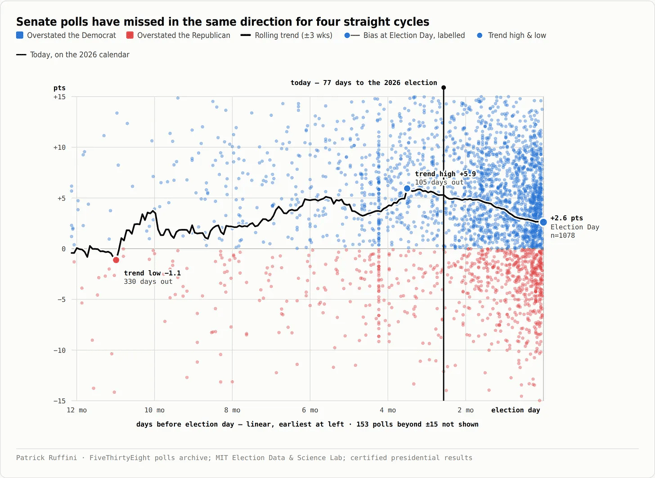
Senate polling overstatement peaked during summer. Chart via Patrick Ruffini.
Ruffini’s findings cover Senate polling from 2018, 2020, 2022 and 2024. Democratic candidates were overstated on average during every cycle, but the size and duration of the error varied substantially. Presidential cycles produced the more persistent warning, while midterm cycles produced the sharper contrast between summer polling and final accuracy.
Research from the American Association for Public Opinion Research reinforces that distinction across federal and statewide offices. Polls from the final two weeks of 2020 overstated Democratic performance by approximately 4.6 points, while the corresponding error was approximately 2.7 points in 2024. Final polling in the 2018 midterm overstated Democrats by only 0.1 points, while 2022 polling overstated Republicans by approximately 0.6 points.
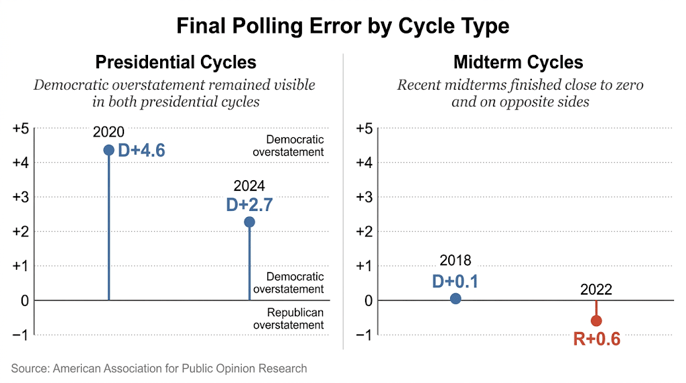
Presidential polling errors persisted while recent midterms finished near neutral, Created via Gemini
Senate polling was particularly difficult during the 2020 presidential cycle. A separate review of the 2020 election found that Senate and gubernatorial polling combined overstated Democratic margins by approximately 6 points during the final two weeks. That result helps explain why summer competitiveness in red states continued to look plausible even after campaigns entered the final stretch.
Those findings do not prove that every Democratic lead in 2026 will decline. They show that the historical risk is greatest when observers treat a summer margin as a stable forecast. Midterm history provides a more encouraging record of late calibration, but it also shows that substantial movement can occur before that calibration appears.
Recent Races Show How Summer Strength Can Dissolve
Individual races demonstrate how a plausible summer result can differ sharply from the eventual outcome. Candidate recognition, uneven advertising and incomplete voter engagement can create temporary advantages. State partisanship often becomes more influential once voters begin making final decisions.
Ohio produced a clear version of the pattern during 2024. An August survey reported by Ballotpedia placed Sherrod Brown at 52.5 percent and Bernie Moreno at 47.5 percent. Final results gave Moreno 50.09 percent and Brown 46.47 percent, producing a Republican victory of approximately 3.62 points.

Sherrod Brown, Former Ohio Senator. Image via E&E News.
Brown still outperformed the Democratic presidential ticket by a substantial margin. That candidate level strength was real, but it was not enough to overcome Ohio’s broader Republican alignment. Current polling involving Brown should therefore be read as evidence of his individual appeal rather than proof that the state’s underlying political structure has changed.
South Carolina supplied another clear warning in 2020. A Quinnipiac University survey conducted from July 30 through August 3 placed Lindsey Graham and Jaime Harrison at 44 percent each. Final results gave Graham 54.44 percent and Harrison 44.17 percent, producing a Republican margin of approximately 10.27 points.
Ohio repeated the pattern during the 2022 midterm. Tim Ryan led many surveys during the summer and remained narrowly ahead in a September Suffolk University poll by 47 percent to 46 percent. Official results later gave JD Vance approximately 53.03 percent and Ryan 46.92 percent, a Republican margin slightly above 6.1 points.
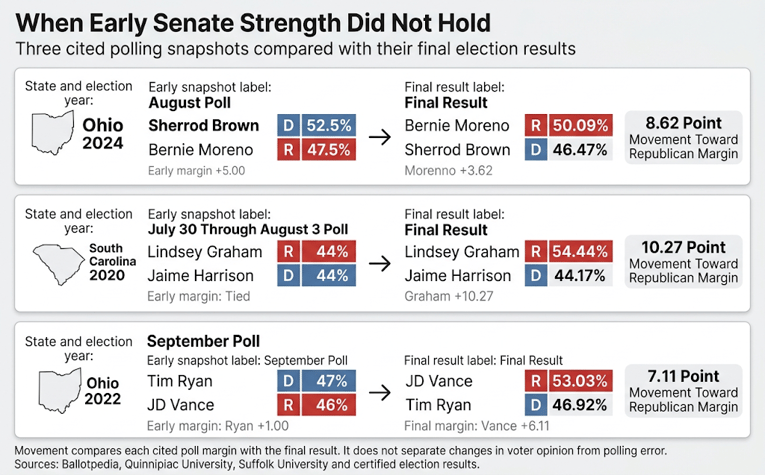
Early Democratic margins reversed across three recent Senate races, Created via Gemini
Late polling eventually detected the Republican movement. An October Suffolk University survey placed Vance ahead 47 percent to 45 percent. Ohio therefore demonstrates how Democratic summer strength and comparatively accurate final midterm polling can exist within the same election.
Survey Design Changes How Much a Summer Lead Means
Polling error does not come from a single methodological failure. Sampling frames, turnout assumptions, response rates, demographic weighting and undecided voters can all affect the reported margin. Two surveys conducted during the same week can therefore produce different results without either one being fraudulent or professionally unsound.
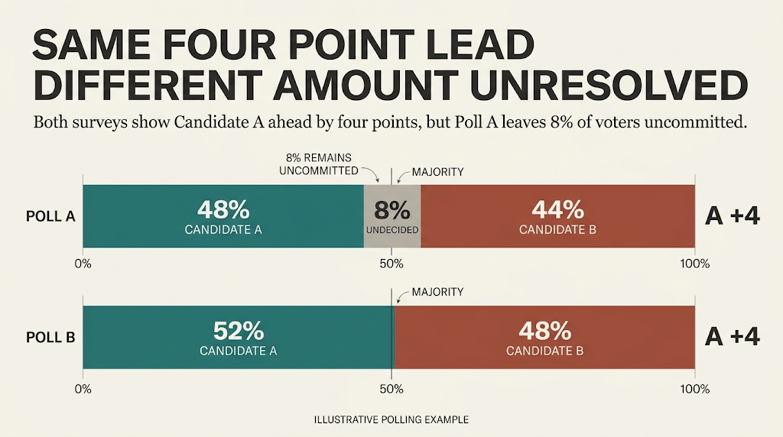
Equal four point leads can carry very different uncertainty, Created via Gemini.
Registered voter polls measure opinions among people eligible to participate, but they do not fully model who will cast a ballot. Likely voter surveys apply additional assumptions involving voting history, stated intention, political interest or other indicators. Those assumptions generally become more informative as Election Day approaches and voter engagement becomes easier to observe.
Likely voter status does not automatically make a survey more accurate. Early models can exclude newly motivated voters, underestimate unusual enthusiasm or rely too heavily on participation patterns from a different political environment. Observers should therefore examine how each pollster defines likelihood rather than treating the label as a universal quality standard.
Weighting presents a similar challenge. Pollsters commonly adjust samples for age, race, education, gender and geography, but those corrections cannot fully measure political engagement or willingness to answer surveys. The American Association for Public Opinion Research concluded that at least some of the 2020 polling error was caused by nonresponse and that matching samples to standard demographic categories did not fully correct the imbalance.
Past vote weighting can reduce some of that imbalance by aligning a sample with the previous election. Its success still depends on respondents accurately recalling their vote and on the next electorate resembling the previous one. Changes in turnout among young voters, rural voters, infrequent voters or particular demographic groups can weaken those assumptions.
Partisan sponsorship requires additional scrutiny. Campaign and party polls can provide useful information, but sponsors may release only the results that support their strategic goals. Polling averages reduce the influence of isolated results, although they cannot remove an error shared across multiple firms.
Undecided voters remain another source of uncertainty. A candidate leading 48 percent to 44 percent has not secured the same position as a candidate leading 52 percent to 48 percent. Late movement among undecided voters can materially change a close race even when neither candidate loses existing supporters.
Current Ratings Expand the Map Without Settling It
Republicans currently hold a 53 to 47 Senate majority, including independents who align with Democrats. Among the 35 seats on the 2026 ballot, 23 are held by Republicans, but Democrats need a net gain of 4 seats to control the chamber. Inside Elections published its latest Senate report on August 20, 2026, placing Michigan in the Toss Up category, Georgia and North Carolina at Tilt Democratic, and Maine at Tilt Republican.
Alaska illustrates why current polling and professional ratings should be read separately. Inside Elections rates the race Lean Republican, while a Data for Progress likely voter survey placed Mary Peltola ahead of Dan Sullivan 52 percent to 48 percent under its final ranked voting assumptions. That result identifies a competitive race without overriding the state’s Republican lean or the uncertainty created by ranked voting transfers.

Mary Peltola, Former Alaska Representative. Image via CNN.
Each polling result below is an illustrative snapshot of current summer sentiment. Ratings account for a wider set of factors, including candidate strength, state partisanship and the broader political environment. Neither a rating nor a summer survey should be interpreted as a final projection.
Variation across these states is strategically important. Georgia and North Carolina combine Democratic polling strength with Tilt Democratic ratings, while Ohio and Alaska combine Democratic polling strength with Republican leaning ratings. Texas, Michigan and Iowa offer further evidence that current polling can expand the map without determining its eventual hierarchy.
Confidence Rises Only When Independent Signals Converge
Summer polling deserves moderate confidence as a measure of current direction. It deserves less confidence as an estimate of the final margin and even less as an implied probability of victory. Repeated results from independent pollsters carry more weight than an isolated favorable number.
Current evidence supports real Democratic opportunities without supporting a mechanical correction to every Democratic lead. Subtracting a fixed 3.7 points would ignore the near neutral final midterm errors reported in 2018 and 2022. Ignoring Ruffini’s historical pattern would be equally hazardous in states where Democratic strength rests primarily on registered voter surveys or a small collection of polls.
Campaign spending can provide another useful signal. Parties and outside groups often possess private polling that is unavailable to the public, so advertising reservations and resource movements can reveal whether professional strategists believe a race is tightening. Spending decisions are not infallible, but they can confirm or challenge the public polling narrative.
Wrap Up
Summer 2026 Senate polling should influence expectations without settling them. Historical evidence shows a recurring Democratic overstatement during this stage of recent cycles. Midterm evidence also shows that polling can become considerably more accurate once turnout models mature and voter attention increases.
Current Democratic leads in Ohio, Alaska, Maine, Georgia and North Carolina are meaningful observations about the electorate today. They are not guarantees that the same margins will survive through November. Republican advantages in Michigan, Texas and Iowa are also provisional rather than conclusive.
Best judgment requires treating summer polls as early signals within a broader evidence system. Campaigns, donors, consultants and political observers should watch whether margins persist across independent likely voter surveys after Labor Day. Confidence should rise only when polling trends, ratings, candidate strength, state fundamentals and turnout evidence begin telling the same story.