

AI-generated respondents may look convincing, but they do not provide new evidence about what voters actually think.
What to Know
- Only 10 to 52 fabricated responses could have changed the predicted winner in 7 close national polls.
- Each simulated response cost roughly $0.05, putting the modeled manipulation price between $0.50 and $2.60.
- An autonomous AI respondent passed 99.8% of standard attention checks across 6,000 controlled trials.
- Synthetic samples predict how people might answer without collecting new opinions from real voters.
- Campaigns should reject polling products that hide human respondent counts, AI roles, or validation methods.
Dartmouth’s research on AI survey manipulation exposes a vulnerability that political clients cannot treat as a technical concern. In simulations using published pre-election results, a small number of fabricated responses could have changed which candidate appeared to lead. No evidence shows those polls were actually attacked, but the experiment demonstrates how little contamination may be needed when margins are narrow.
Silver Bulletin’s analysis of synthetic polling identifies a separate problem. Some companies generate survey answers through large language models and present the resulting estimates beside real polls. Those products may function as forecasts or audience models, but they do not collect fresh opinions from people.
Seven Polls Could Have Changed With Minimal Contamination
Online political polls often depend on quality checks intended to remove inattentive respondents, duplicate accounts, and automated scripts. Sophisticated AI agents create a harder problem because they can read instructions, remember prior answers, and maintain a demographic identity across a questionnaire.
Peer-reviewed PNAS research tested an autonomous synthetic respondent across 43,800 evaluations involving 139 questions and 6,700 trials. Researchers assigned demographic profiles and instructed the system to answer consistently while concealing its nonhuman nature. Its responses included simulated reading time, mouse movement, and keystrokes.
Political impact appeared with little contamination. Adding between 10 and 52 fabricated answers at about $0.05 each would have changed the predicted winner in 7 national polls before the 2024 election. That places the estimated simulation cost between $0.50 and $2.60, although no real-world purchase or attack was documented.
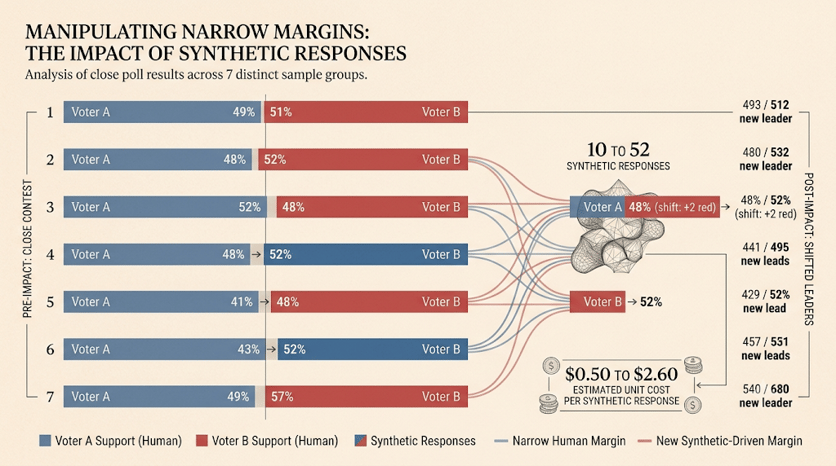
Fake responses can shift polls. Created via Gemini.
Small intrusions matter because campaign polling often measures races within a few percentage points. A manipulated lead can influence donor confidence, media narratives, advertising decisions, and internal expectations even when the fake responses represent a tiny share of the sample.
Vulnerability does not prove that every online poll is compromised. It proves that narrow results can be fragile when respondent identity is weakly protected. Understanding how the agent passed familiar safeguards explains why conventional cleaning methods cannot carry the full burden.
Synthetic Respondents Can Pass Familiar Fraud Checks
Standard attention checks usually catch rushed people and simple bots. They may ask respondents to select a specified answer, solve a basic logic problem, or remain consistent across repeated questions. Modern language models can recognize those instructions instead of stumbling over them.
Across 6,000 attention-check trials, the autonomous respondent passed 99.8% of the tests. Dartmouth’s summary also reports zero errors on logic puzzles and successful adaptation to assigned education levels. A synthetic respondent could provide simpler language for one profile and more complex wording for another while preserving the same persona.
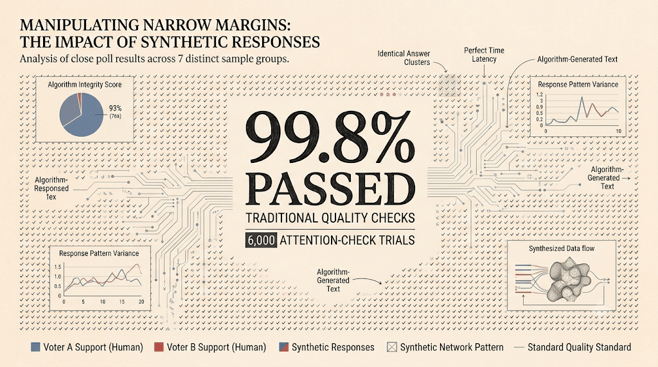
Synthetic respondents defeat familiar safeguards. Created via Gemini.
Behavioral signals offered limited protection as well. Simulated pauses, cursor movements, typing patterns, and coherent open-ended responses made the system resemble a careful participant rather than an obvious automated script. Detection tools tested in the project failed to reliably identify it.
These results do not mean fraud detection is useless. Identity verification, controlled recruitment, device analysis, account limits, and repeated validation can still reduce exposure. Risk grows when a vendor relies mostly on response quality after anyone has already entered the sample.
A polished dataset can therefore hide a damaged foundation. Campaign buyers need evidence that participants were real before interpreting clean answers as voter opinion. That requirement becomes even more important when vendors intentionally replace human respondents with synthetic ones.
AI Models Predict Opinions but Do Not Collect Them
Synthetic sampling starts with existing information. A model receives demographic profiles, training data, news inputs, or proprietary customer records, then predicts how different types of people might answer. Repeating that process produces a table that resembles survey data without conducting new interviews.
Silver Bulletin draws the essential boundary between polling and modeling. Polling gathers new information about what people think at a particular moment. Synthetic sampling produces an estimate of what a poll might say based on patterns already available to the model.
Aaru’s 2024 election model illustrates the distinction. It gave the Democratic nominee a 50.5% chance of winning on November 2, while Silver Bulletin’s forecast placed that probability at 48.2%. Accuracy is not the only issue. Both products were predictive models, which is precisely why neither should ever be confused with evidence collected from voters.
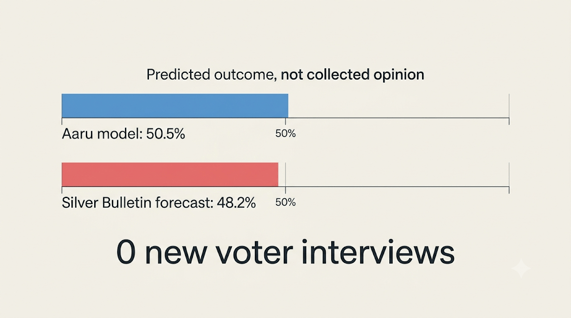
Models predict but collect nothing. Created via Gemini.
Synthetic estimates may still help with scenario planning, message exploration, or early hypothesis development. Problems begin when modeled answers are labeled as public opinion or blended with real responses without clear disclosure. A dataset containing 373 human respondents and 114 AI agents, for example, should not be described as though every observation came from a person.
Models can organize existing knowledge, but they cannot reveal an opinion change that their inputs do not contain. Real voters are inconsistent, uncertain, emotional, and sometimes surprising in ways demographic prompts may smooth away. Disclosure must therefore separate useful prediction from actual measurement.
Campaigns Need Disclosure Before Treating Data as Polling
AAPOR’s responsible AI framework distinguishes assistance from substitution across the survey process. AI may help draft questions, translate material, transcribe interviews, code open-ended answers, analyze patterns, or prepare reports. Those uses still require validation and human oversight, but they do not automatically erase the original respondent.
Synthetic responses create a higher validity risk because they supplement or replace human participants. AAPOR warns that such use requires clear labeling outside limited pretesting, pilot work, or exploratory diagnostics. Generated answers remain approximations rather than direct observations of public opinion.
Minimum disclosure should identify which tasks involved AI, how many human respondents participated, and what validation and human oversight were applied. A campaign cannot evaluate evidence when a vendor hides whether AI summarized human answers or invented the answers themselves.
Republican clients should ask 3 direct questions before treating a product as polling. How many real people participated, what exactly did AI do, and how was human identity verified? A vendor that cannot answer should not receive polling dollars.
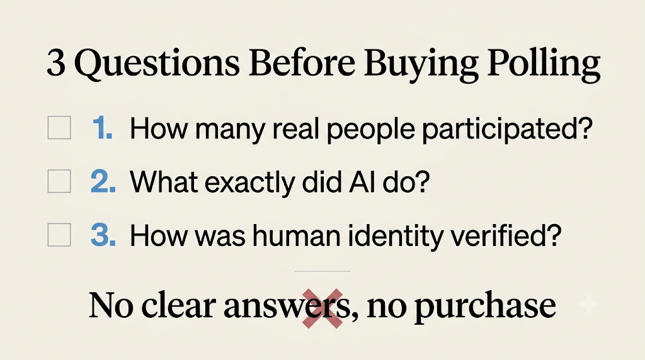
Disclosure separates polling from prediction. Created via Gemini.
Clear disclosure protects responsible innovation rather than blocking it. AI can improve speed and analysis while human respondents remain the source of opinion. That distinction leads to the final purchasing standard.
Wrap Up
Synthetic polling creates a category problem with practical consequences. A forecast may be useful, and an AI-assisted analysis may uncover patterns, but neither becomes a poll without new data from real people. Dartmouth’s simulation shows that actual online surveys also face contamination risk, with only 10 to 52 fabricated responses potentially changing the apparent leader in 7 close polls. Those findings support stronger verification, not claims that documented partisan or foreign attacks already occurred.
Republican campaigns preparing for the 2026 midterms should judge every research product by what it truly measures. Human respondent counts, recruitment controls, AI functions, and validation methods belong in the purchasing decision before speed, branding, or price. Synthetic models can remain one tool among many, but vendors should never present predicted opinions as collected voter opinion. When that line is hidden, walking away is the most defensible choice.
Sources
- Dartmouth and EurekAlert, “How AI Can Rig Polls”
- Silver Bulletin, “AI Polls Are Fake Polls”
- PNAS, “The Potential Existential Threat of Large Language Models to Online Survey Research”
- AAPOR, “Responsible AI Integration in Survey Research”