

Verification may improve political email delivery, but strict eligibility and recipient feedback will still determine lasting access outcomes.
What to Know
- September 8, 2026 marks the program’s launch for eligible United States political committees.
- Participating domains must keep reported spam below 0.3% across a 14 day average to remain compliant.
- Verification is limited to registered 527 political entities, excluding most nonprofit and advocacy organizations.
- Approval requires domain authentication, dedicated sending infrastructure and a verified Postmaster Tools account.
- Policy violations can trigger a 7 day suspension or permanent removal from protected delivery treatment.
Google is creating a route around ordinary Gmail spam filtering for eligible political senders, but verification is not an unrestricted inbox pass. Campaigns & Elections reported that the program begins on September 8, 2026, covering compliant messages to personal Gmail accounts. Continued access depends on authentication, infrastructure, registration status and recipient response.
Political committees therefore face a different deliverability calculation. Verified status may help legitimate messages reach intended recipients, while every spam complaint counts toward compliance. Advocacy organizations must distinguish political purpose from formal eligibility because Google and Campaign Verify define participation through entity registration, not email subject.
Verified Status Changes Filtering, Not Recipient Control
Verified Sender status establishes authenticity and provides qualifying messages an alternative to ordinary spam filtering. Google still allows recipients to mark messages as spam, block senders and unsubscribe. Enrollment changes Gmail’s initial treatment of compliant mail, but not the controls producing enforcement data.
Google requires participating domains to remain below a 0.3% user reported spam rate across a 14 day average. That ceiling makes list quality operational because dissatisfied recipients can jeopardize access. Old, purchased or weakly permissioned addresses become risky when recipient feedback determines continued treatment.
Gmail preserves spam, block and unsubscribe controls. Image via Google.
Violations carry consequences. Google may impose a 7 day suspension or permanent termination, returning mail to standard spam filtering. Resolved technical and spam problems can produce automatic reenrollment within 7 days, although egregious violations can end participation.
Organizational Structure Determines Eligibility
Program access begins with legal status. Google limits enrollment to candidates, parties, political action committees and other committees operating as 527 tax exempt organizations registered with federal, state, local or tribal election authorities. Campaign Verify uses that boundary and requires a valid Employer Identification Number.
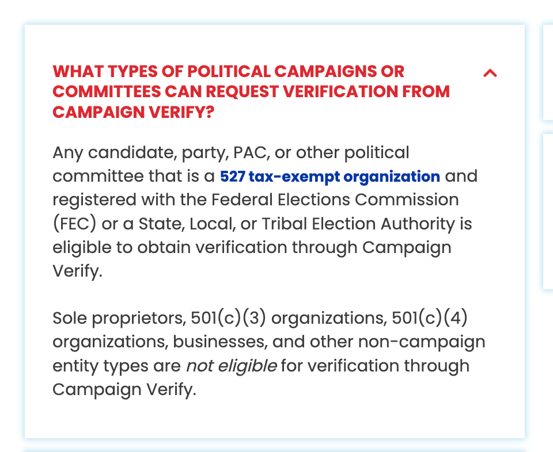
Campaign Verify identifies the political entities eligible for verification. Image via Campaign Verify.
Campaign Verify specifically lists sole proprietors, businesses, 501(c)(3) organizations, 501(c)(4) organizations and other noncampaign entities as ineligible. A nonprofit with political communications does not qualify merely because its messages discuss elections or public policy. A related political committee would need its own qualifying status, published filing record and verified sending domain.
Registration records must be available through an election authority before verification can proceed. Campaign Verify says unpublished documents supplied directly by a committee generally cannot substitute for a public filing. Campaigns & Elections also reported that identity and background checks are part of the process and that only one verified email address may be used for each campaign domain.
Infrastructure Determines Admission and Retention
Technical preparation begins with the exact domain used for bulk political email. Google requires that domain to host or redirect to a public website associated with the committee, and it must be connected to a verified Postmaster Tools account. Campaign Trend recommends updating a sending subdomain so it redirects to the committee’s main website before enrollment begins.
Authentication requirements extend beyond a recognizable sender name. Google requires Sender Policy Framework configuration and DomainKeys Identified Mail signatures tied to the sending domain. Verified participants must also avoid shared sending infrastructure because another organization’s practices can damage a shared Internet Protocol address reputation.
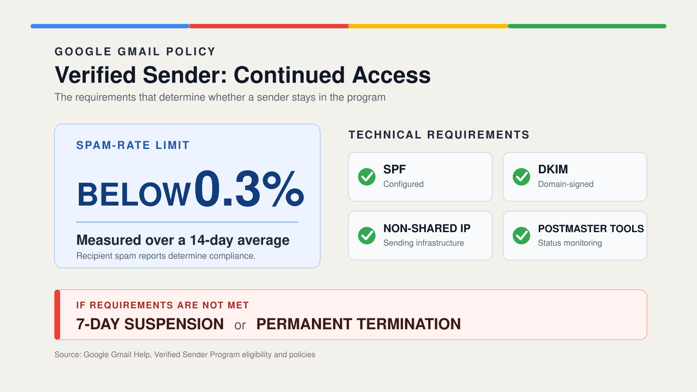
Google’s Verified Sender program Created via Gemini using Google policy data.
Existing Gmail rules remain relevant. Senders distributing more than 5,000 messages daily must support one click unsubscribe for marketing and subscribed mail, while headers, display names and content must accurately represent the sender. Postmaster Tools provides delivery errors, spam reports, feedback data and compliance status, making it the central monitoring system rather than a final setup task.
Political Disputes Shaped the New Rules
Republican complaints about Gmail filtering form the immediate political background. A Republican National Committee lawsuit filed in 2022 alleged that Google throttled messages because of political affiliation and views. Google denied discrimination, and a previous political email pilot that reduced filtering protections ended in early 2023.
Regulatory and judicial findings did not validate the central discrimination claim. In Matter Under Review 7991, the Federal Election Commission voted 6 to 0 to find no reason to believe Google made prohibited corporate contributions through its filtering practices. A Ninth Circuit memorandum issued on January 16, 2026, also affirmed dismissal of the committee’s state law claims.
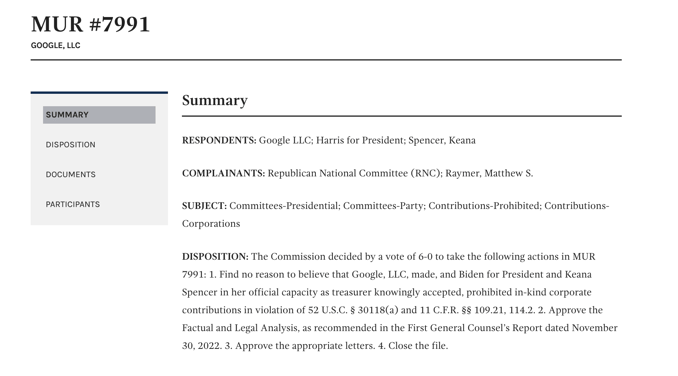
The FEC found no reason to believe, voting 6-0.
Current reactions reflect the same partisan divide. Campaigns & Elections documented Republican support for a change described as overdue, while a progressive digital executive warned that political senders could receive special treatment despite unsolicited or deceptive fundraising practices. Google answers that concern through verification, recipient controls, antiabuse rules and the 0.3% complaint limit, but actual enforcement will determine whether those safeguards restrain misuse.
Preparation Begins Before Enrollment Opens
Operational readiness requires coordination among compliance staff, digital teams, email vendors and domain administrators. Filing records should match the committee’s current legal name and contact information, while the sending domain should redirect properly and authenticate through the required records. Vendors should confirm whether the domain or Internet Protocol address is shared because Google’s policy calls for dedicated infrastructure.
Campaign Verify says it will begin verifying political committee sender domains on September 8, 2026. Its Get Started form collects basic contact and organization information so interested entities can receive identity verification resources. Google says successful Campaign Verify approval should activate Verified Sender status within 1 to 2 business days, with status visible through Postmaster Tools.
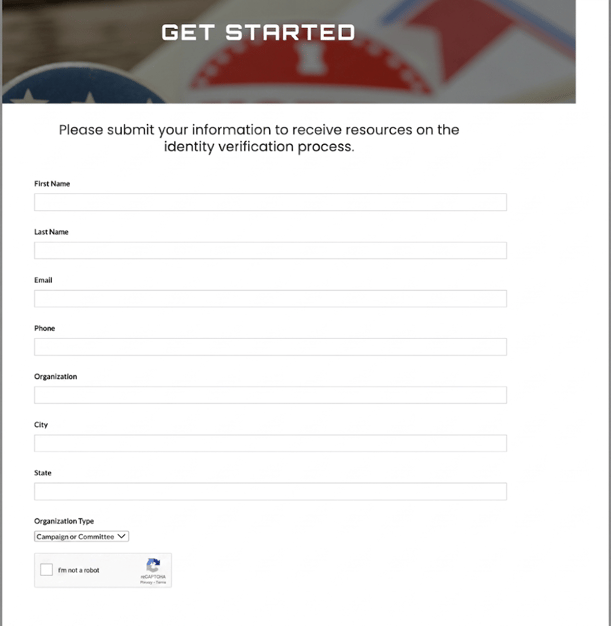
Campaign Verify provides the form used to begin identity verification.
List management deserves equal attention before launch. Teams should suppress repeated bounces, honor unsubscribe requests, review inactive addresses and avoid sudden volume increases that surprise recipients. Google recommends sending expected content at reasonable volume because verification confirms identity, while engagement and complaint behavior determine lasting deliverability.
Wrap Up
Verified Sender creates a meaningful opportunity for registered political committees, but its value depends on disciplined execution. Authentication, public registration and domain verification establish entry. Recipient trust and complaint control determine whether that entry lasts.
Nonprofits, advocacy organizations and political committees should not assume they share the same eligibility. Formal entity structure decides who may enroll, while technical practices decide who remains compliant. Organizations outside the program still benefit from stronger authentication, cleaner lists and transparent unsubscribe systems.
Political organizations can prepare by confirming eligibility, securing the correct domains, auditing vendors and improving list quality. Postmaster Tools should provide continuous measurement before the first verified message. Performance after September 8 will show whether verification improves legitimate access without weakening inbox protection.
.png)