-Aug-01-2026-11-56-55-1279-AM.jpg)

A durable Democratic edge collides with uncertain margins and a district-by-district House fight.
What to Know
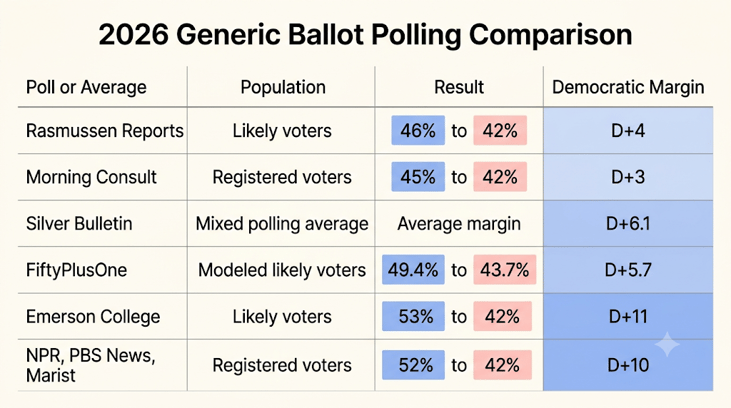
- Democrats lead all 6 national polls and averages, with reported margins ranging from 3 points to 11 points in 2026.
- Democrats currently hold a 46% to 42% advantage among 2,224 likely voters, preserving a 4-point national edge in the survey.
- Two major polling averages place Democrats near a 6-point advantage, suggesting the broader national environment remains favorable overall for now.
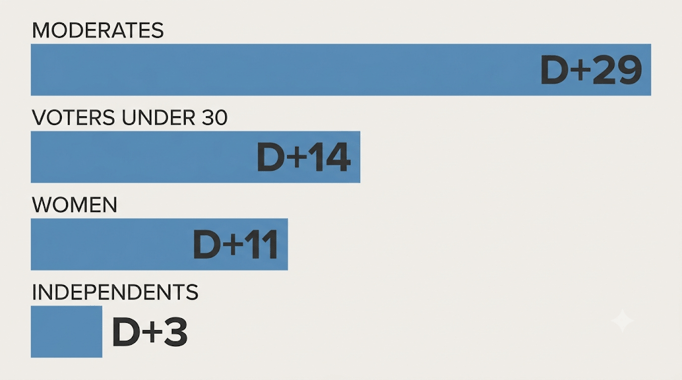
- Women favor Democrats by 11 points, younger voters by 14, and moderates by 29 in current national polling this cycle.
- Democrats need 3 additional House seats, but national polling cannot directly predict where enough district-level victories will occur in November.
Democrats lead the generic congressional ballot as the 2026 midterm campaign develops, but no single margin captures the full environment. Rasmussen Reports placed Democrats ahead 46% to 42% among likely voters, while other recent polls and averages have ranged from roughly three points to double digits. Agreement about the leader is therefore stronger than agreement about the scale or durability of the advantage.
Movement also depends on which polling series is examined. Rasmussen’s Democratic lead narrowed from D+6 in May to D+4 in its July release, while the Silver Bulletin average eased from a cycle high of D+7.1 on June 1 to about D+6.1 by July 27. Those shifts suggest some narrowing, but the broader national picture continues to favor Democrats.
Polls Agree on the Leader but Not the Margin
Rasmussen surveyed 2,224 likely voters from June 24 through July 1 with a ±2-point sampling error. Its D+4 result sits near the lower end of the current polling range. One quality-control problem remains because the release says eight percent are undecided while printing 7%, and its components total 100 only when seven is used.
Morning Consult’s tracker showed Democrats ahead 45% to 42%, or D+3, among registered voters for the week ending July 5. That verified result differs from the 46% to 42% figure included in the original brief, which came from an earlier wave. Morning Consult pools about 24,000 registered voters for its release and reports an approximate ±1-point topline margin of error.
Polling averages sit above both trackers. Silver Bulletin reported about D+6.1 on July 27 after weighting quality, recency, sample size, and house effects, while FiftyPlusOne placed Democrats at 49.4% and Republicans at 43.7% on July 23, roughly D+5.7. FiftyPlusOne adjusts registered-voter polls toward likely-voter estimates, while Silver Bulletin combines several sample types but prefers likely voters when available.
Individual national surveys show the upper end of the range. Emerson College Polling found Democrats ahead 53% to 42%, or D+11, among likely 2026 voters in July, extending its D+10 result from June. An NPR, PBS News, and Marist survey earlier found a 52% to 42% Democratic advantage among registered voters.
Comparing national generic ballot results
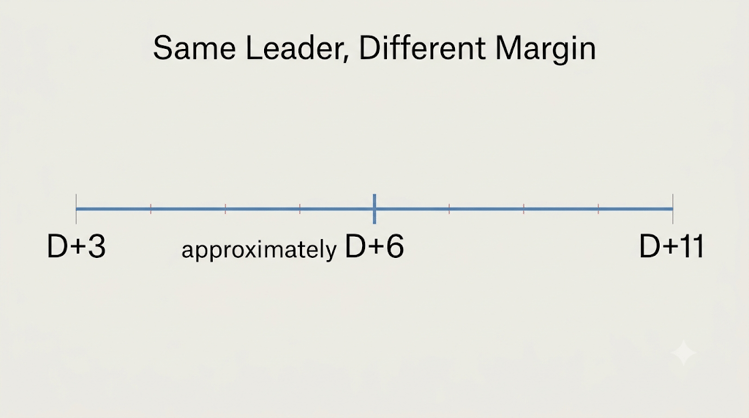
Comparison across these sources supports two conclusions. Democrats lead in every measure even though field dates, populations, and questions are not identical. Averages near six points suggest that the lowest and highest polls are better understood as bounds than as precise descriptions of the electorate.
A D+3 result can coexist with D+11 when sampling error, house effects, turnout models, and timing pull estimates apart. Neither figure cancels the other or defines the national picture alone. Democrats probably hold a mid-single-digit advantage, but uncertainty remains large enough to change expectations for marginal House districts.
Campaign Now (Gemini), Democratic lead spans eight points
Polling will show whether July’s range narrows as voter attention increases. Sustained movement across multiple pollsters would matter more than a single sharp result. Until then, the polling average offers a steadier measure than either end of the range.
Democratic Strength Comes From Several Voter Groups
Rasmussen’s cross-tabs identify several groups creating pressure for Republicans. Independents favored Democrats 37% to 34%, women backed Democrats 49% to 38%, and voters younger than 30 gave Democrats a 14-point advantage. Moderates produced the largest ideological gap, supporting Democrats 54% to 25%, while men leaned Republican only 45% to 43%.
Campaign Now (Gemini), women, moderates, and younger voters drive advantage
Partisan retention added another small Democratic benefit. Rasmussen found 86% of Democrats supporting their party’s candidate, compared with 82% of Republicans choosing the GOP candidate. A four-point difference inside the parties can matter when the national margin is narrow, although later turnout and persuasion efforts may change both figures.
Morning Consult shows the same broad coalition with different margins. Its July 5 tracker placed independents at D+13, women at D+11, men at R+5, and Generation Z at D+26. Emerson’s June poll also placed independents at D+15, reinforcing the conclusion that unaffiliated voters currently lean Democratic even though the exact size varies sharply.
Hispanic voters are the clearest contradictory finding. Rasmussen reported Republicans ahead 48% to 39% among Hispanic likely voters, while Morning Consult showed Democrats leading Hispanics 51% to 37% and Emerson’s June survey reported a 34-point Democratic margin. Subgroup samples carry larger errors, so the Rasmussen result should be treated as an unusual signal requiring confirmation rather than proof of a national realignment.
Women present a more consistent story. Rasmussen measured an 11-point Democratic advantage among women, Morning Consult also reported D+11, and Emerson’s July likely-voter survey showed women favoring Democrats by 27 points. Different magnitudes may reflect sample composition or weighting, but all three sources identify women as a central part of the Democratic lead.
Methodology Explains Much of the Polling Spread
Likely-voter and registered-voter samples answer different questions. Registered-voter polls describe everyone listed as registered, while likely-voter models estimate who will participate using stated intention, voting history, demographics, or turnout scores. As the midterms approach, more pollsters adopt likely-voter screens that can change party shares and undecided levels.
Results do not move in one predictable direction when likely-voter screens appear. Rasmussen and Emerson both poll likely voters, yet they report D+4 and D+11, while Morning Consult’s registered-voter tracker shows D+3. Pollster-specific recruitment, weighting, mode, and turnout assumptions therefore matter alongside the population label.
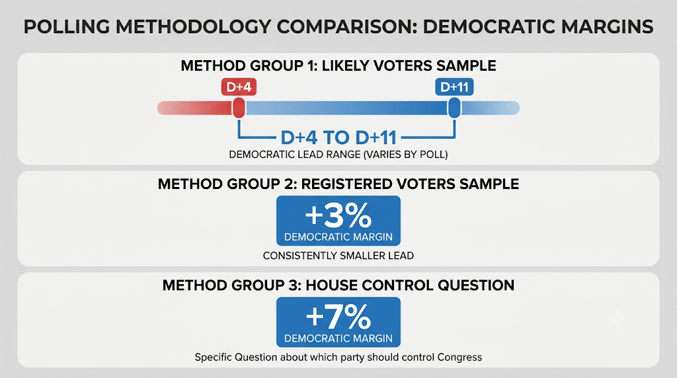
Campaign Now (Gemini), sample choices widen the polling range
Question wording changes what respondents are asked to imagine. Rasmussen and Morning Consult ask about a Democratic or Republican candidate in the respondent’s district, while Quinnipiac asks which party should control the House. Quinnipiac’s June poll produced a 49% to 42% Democratic preference, but that D+7 measures desired control rather than a district vote choice.
Timing creates another source of disagreement. A poll taken after an economic report, court decision, international event, or major campaign controversy may capture a temporary response that an average later smooths. Polling averages reduce dependence on one release, but they also react more slowly when public opinion genuinely changes.
Margins of error explain only part of the spread. Sampling uncertainty can move a result several points, especially within demographic subgroups, yet recurring differences between pollsters can reflect stable house effects. Silver Bulletin adjusts for those patterns, while FiftyPlusOne also estimates how registered-voter results might look among likely voters.
National Leads Do Not Convert Directly Into House Seats
A generic-ballot lead is a national climate indicator, not a House seat count. Democrats can win votes inefficiently by building enormous margins in urban districts, while Republicans can remain competitive through geographically distributed support and favorable district lines. Candidate quality, incumbency, fundraising, and local issues further separate individual contests from the national average.
Current House math makes even a modest shift important. Inside Elections lists a 220 to 215 Republican majority, meaning Democrats need 3 seats, and projects a Democratic gain of 2 to 10. Decision Desk HQ gave Democrats a 62% House chance on July 15 and identified the generic ballot and presidential approval as leading indicators.
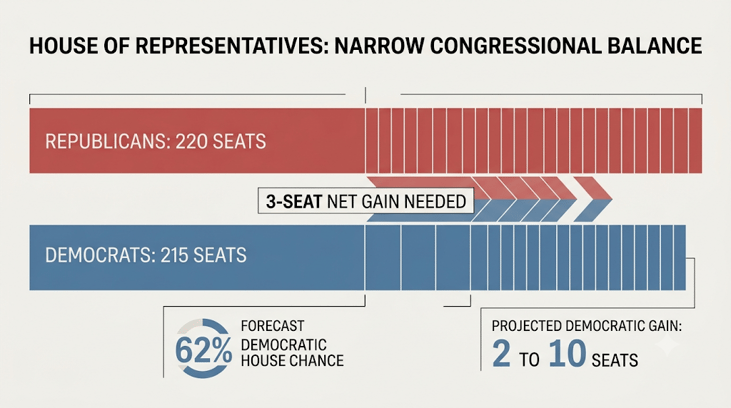
Campaign Now (Gemini), three seats could decide House control
Redistricting complicates that advantage. Mid-decade map changes reduced the number of naturally competitive seats and shifted several districts before voters cast ballots, so Democrats may need a larger national margin than a uniform swing would imply. National polling can identify pressure on Republicans without showing exactly where enough seats will change hands.
District ratings also reveal that the battlefield remains concentrated. A party can lead nationally while still depending on a limited set of suburban, exurban, and redrawn districts where small local movements decide control. Generic-ballot strength is most useful when combined with district polling, candidate assessments, fundraising, and updated maps.
Wrap Up
Democrats’ national lead is holding, but evidence of narrowing depends on the starting point. Rasmussen moved from D+6 to D+4, Morning Consult stood at D+3, and Silver Bulletin eased from D+7.1 to D+6.1, while newer Emerson polling expanded to D+11. Taken together, the results show a durable Democratic advantage with genuine uncertainty about its size.
Coalition patterns are clearer than the topline spread. Women, younger voters, moderates, and independents repeatedly lean Democratic, while Hispanic results vary enough to demand caution. Sample definitions, question wording, weighting, timing, and pollster effects explain why one national environment can produce margins from three points to double digits.
House control remains unresolved because national votes are filtered through 435 separate districts. Democrats need only 3 seats, and current forecasts give them a meaningful opportunity, but redistricting and geographic efficiency can limit what a national lead produces. Generic-ballot polling is therefore a warning sign for Republicans, not a direct forecast of the final House majority.
Campaign conditions can still change before voters decide control of Congress. Economic developments, presidential approval, candidate recruitment, fundraising, and district-level events may either reinforce the Democratic advantage or narrow it further. Durable movement across several pollsters and competitive districts will matter more than any single national release.