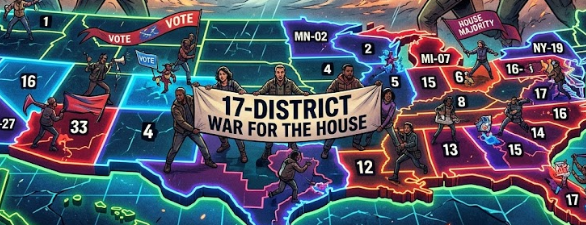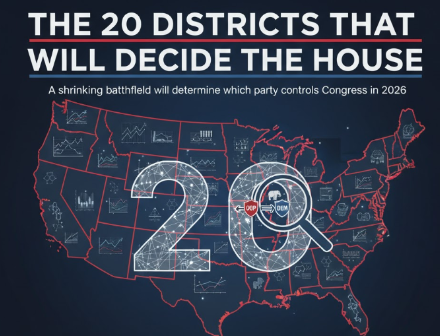


The fight for control is no longer national. It is concentrated, fragile, and already underway.
What to Know
- Republicans hold 213 seats, Democrats hold 212, with 218 needed for a majority
- Only 3 seats are required to flip control of the House
- There are 10 true toss-up districts, meaning control is decided by a narrow battlefield
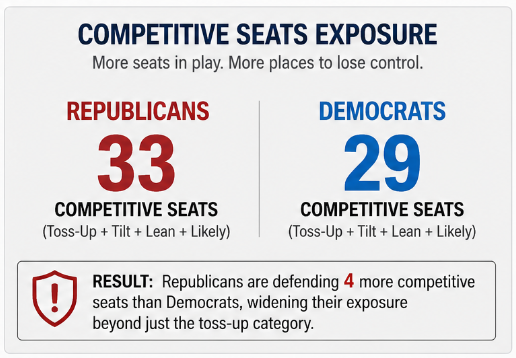
- Republicans are defending more competitive seats (33) than Democrats (29), creating structural exposure
- Early analysis suggests the election is shaping into a referendum on the party in power, not a policy comparison
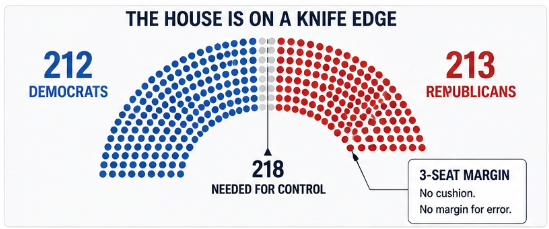
The 2026 House cycle does not begin with an advantage. It begins with a standoff. According to Inside Elections, the current balance sits at 213 Republicans to 212 Democrats, with 218 needed for control. The margin is so thin that the House is effectively undecided before a single vote is cast.
This is not a typical midterm environment where one party must climb. It is a near-even split where either side can take control with minimal movement, and where small shifts carry outsized consequences. That reality reframes the election entirely. The question is no longer who can build a majority. It is who loses it first.
Where the Majority Is Actually Decided
Control of the House now runs through a three-seat margin, shrinking a national election into a narrow and highly defined fight. Each competitive district carries national weight, where a race in Iowa, Pennsylvania, or Arizona feeds into a chain reaction that can shift the balance of power.
According to Inside Elections, there are just 10 toss-up races shaping the outcome. That is the full field of play, leaving no cushion and no margin for error as campaigns move with precision and every decision carries consequence. The House may have 435 seats, but control is concentrated in a narrow slice of the map.
Those districts are not random. They are clustered in suburban corridors, mixed rural-urban regions, and areas with tight partisan margins, where small swings in voter sentiment carry disproportionate impact. This matters because it compresses the entire election into a handful of outcomes. Campaigns are not competing everywhere. They are competing where movement is still possible, and that is where control of the House will be decided.
A Breakdown of 10 Districts That Could Decide the House
The 2026 House fight is not spread across the country. It is concentrated in a small set of districts that will decide control. According to Inside Elections, there are just 10 toss-up seats, and most are currently held by Republicans, creating immediate exposure on the map.
|
The 10 Toss Ups |
||
|
State |
District |
Current Incumbent / Status |
|
Arizona |
AZ 1 |
Open (David Schweikert, R running for Governor) +1 |
|
Arizona |
AZ 6 |
Juan Ciscomaní (R) +1 |
|
Colorado |
CO 8 |
Gabe Evans+ (R) +1 |
|
Iowa |
IA 1 |
Marianette Miller-Meeks (R) +2 |
|
Michigan |
MI 7 |
Tom Barrett (R) +1 |
|
New York |
NY 17 |
Mike Lawler (R) +1 |
|
Ohio |
OH 1 |
Greg Landsman (D) +2 |
|
Pennsylvania |
PA 7 |
Ryan Mackenzie (R) +2 |
|
Texas |
TX 34 |
Vicente Gonzalez (D) +1 |
|
Virginia |
VA 2 |
Jen Kiggans (R) +1 |
These districts span Arizona, Colorado, Iowa, Michigan, New York, Ohio, Pennsylvania, Texas, and Virginia, with a mix of open seats and incumbents running in tightly contested environments. Each one represents a standalone battleground, but together they form the entire path to a majority. Winning or losing just a handful of these races determines which party controls the House.
Why Margins This Thin Create Instability
The numbers show how little room there is to operate. The House stands at 213 Republicans and 212 Democrats, with 218 needed for control, and only 10 districts rated as toss-ups. Of those, 8 are currently held by Republicans and 2 by Democrats, meaning the GOP is defending the majority of the most vulnerable ground. Republicans are also defending 33 competitive seats compared to 29 for Democrats, widening exposure beyond just the toss-up category.
That structure creates instability because control is tied to a handful of outcomes rather than a broad national shift. A swing of just three seats flips the House, and those seats are concentrated in districts where margins are already narrow and conditions are fluid. External factors add pressure before voting even begins. Proposed redistricting changes in Virginia alone could shift up to four seats toward Democrats, altering the map mid-cycle. In a system this tight, control is not decided once. It is constantly at risk of moving.
Wrap Up
The 2026 House election is not a traditional midterm defined by broad swings or national momentum. It is a constrained fight where structure matters more than scale. With the chamber effectively split and only a handful of districts in play, control is determined by localized shifts that carry national consequences.
That is the strategic reality. A movement of a few thousand votes across a small set of districts can decide the majority, reshape committee control, and redirect the legislative agenda. In a cycle this tight, the House is not trending in either direction. It is balanced in a way that makes every competitive seat decisive and every outcome capable of changing control outright.