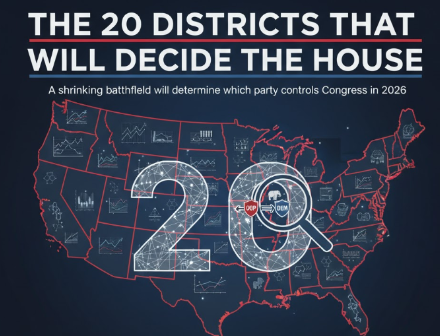

The 2026 House fight will likely be decided within a small cluster of highly competitive districts where minor shifts carry outsized consequences.
What to Know
- The House battlefield is far narrower than the national conversation suggests, with only a limited number of districts truly in play.
- Most congressional seats are structurally safe because of geography, partisan sorting, incumbency, and district design.
- That reality forces both parties to concentrate money, staff, media, and analytics into a small number of must-win races.
- Competitive districts require a different campaign model built around local issues, segmented persuasion, and turnout precision.
- In a compressed battlefield, even small vote shifts can decide control of the chamber.
The broad-wave theory of House elections is increasingly out of step with the data. The Cook Political Report shows that only a small fraction of districts are truly competitive, with just 17 Toss Up races out of 435. National coverage still frames each cycle as a sweeping referendum, but the actual battlefield is far narrower. In 2026, control of the House is far more likely to be decided by a concentrated set of competitive districts than by any uniform national tide.
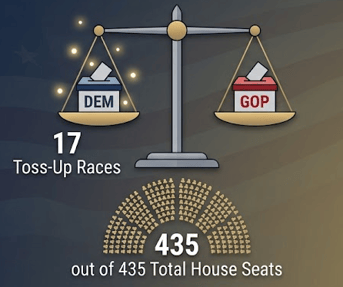
That structural compression is the reality campaigns have to operate within. Most seats are effectively locked by partisan alignment, district boundaries, incumbency, and predictable voting behavior, leaving only a thin margin where persuasion and turnout still matter. When the map shrinks to that scale, the margin for error disappears. Every dollar must be deployed with precision, every message has to convert, and every strategic misstep carries disproportionate consequences.
Most House Districts Are Not Truly in Play
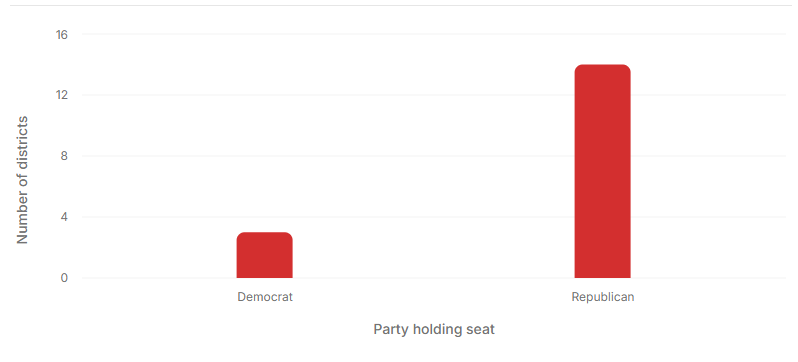
The first reality of the 2026 House map is that most districts are effectively decided well before Election Day. This is not simply a function of partisan loyalty. It is the result of structural insulation baked into the modern map. The Cook Political Report reinforces this dynamic, with only a small number of districts rated as genuinely competitive and just 17 Toss Up races defining the core battlefield.
Partisan sorting has hardened district identities over time. Urban districts consistently anchor Democratic strength, while rural districts remain reliably Republican. Suburban seats that once acted as swing territory are increasingly defined by stable partisan leanings. Seat
|
District |
Incumbent / Candidate |
Current Party Holding Seat |
|
AZ-01 |
Republican |
|
|
AZ-06 |
Republican |
|
|
CA-22 |
Republican |
|
|
CO-08 |
Republican |
|
|
IA-01 |
Republican |
|
|
IA-03 |
Republican |
|
|
MI-07 |
Republican |
|
|
NJ-07 |
Republican |
|
|
NY-17 |
Republican |
|
|
OH-09 |
Democrat |
|
|
PA-07 |
Republican |
|
|
PA-08 |
Republican |
|
|
PA-10 |
Republican |
|
|
TX-34 |
Democrat |
|
|
VA-02 |
Republican |
|
|
WA-03 |
Democrat |
|
|
WI-03 |
Republican |
When layered with incumbency advantages and district design, the number of races that can meaningfully shift shrinks to a narrow band. The House is no longer a 435-seat contest in practice. It is a concentrated fight over a limited set of politically elastic districts where persuasion still matters and outcomes remain fluid.
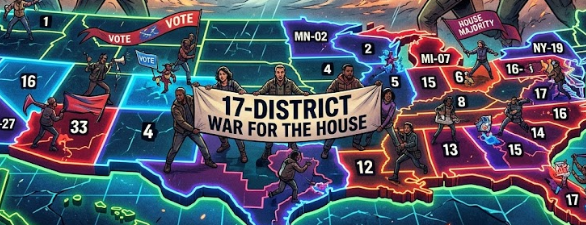
This is the operational reality behind what can be described as a 17-district war. Control of the chamber may be determined by the full map on paper, but in execution it will hinge on a tightly constrained set of races where strategy, turnout, and message discipline will ultimately decide the majority.
Why a Narrow Battlefield Raises the Stakes
When only a small number of districts are truly competitive, strategy shifts from expansion to concentration. The 2026 map makes that explicit. With just 17 Toss Up races and a limited number of additional Lean seats, a narrow slice of districts is effectively deciding control of all 435 seats. That reality forces campaigns to abandon broad, generic approaches and instead build highly targeted operations designed to win in specific, high-pressure environments.
The downstream effect is a surge of resources into a compressed battlefield. More money flows into fewer races. More candidate visits are concentrated in the same regions. Field organizing, polling, message testing, digital targeting, and rapid response all intensify within these districts because the stakes are higher and the margin for error is smaller. Candidates in these races are not just running local campaigns. They are operating inside a national proxy fight where every tactical decision can influence control of the House.
That dynamic is not theoretical. It is how party leaders themselves are defining the map. As NRCC Chair Richard Hudson put it, the fight for the House is no longer a national wave but “30 knife fights in 30 dark alleys,” where each race can be decided by razor-thin margins. In that kind of environment, scale becomes irrelevant. Execution becomes everything.

This creates a distinctly uneven campaign environment. Safe-seat campaigns can rely on consistent partisan alignment and maintain lower-intensity operations. Battleground campaigns do not have that luxury. They must operate with precision, discipline, and constant adjustment, because in a map defined by scarcity, a small number of races carry the weight of the entire chamber.
Messaging in Competitive Districts Has to Be Tighter
Messaging in competitive districts operates under different constraints than in safe seats. Base-focused communication is not sufficient. Candidates must hold core voters while persuading independents, weak partisans, and late deciders who are less responsive to national partisan framing.

That requires a more localized and practical message. Voters in these districts prioritize cost of living, public safety, schools, and economic conditions over ideological positioning. Campaigns that rely on broad national narratives risk missing the issues that actually move votes. Campaigns that align messaging with local concerns create real persuasion opportunities.
In a compressed battlefield, discipline alone is not enough. Specificity is what drives results. Precision targeting and relevant messaging outperform volume when the electorate is small and highly contested.
Small Vote Shifts Can Decide the Chamber
One of the most important implications of a condensed battlefield is that control of the House can turn on very small changes. In safe seats, a two-point shift may not matter. In a true battleground district, it can be decisive.
A modest turnout increase in one demographic pocket. A slight improvement with suburban independents. A better-performing absentee chase program. A more effective local contrast message. Any one of those can alter the district. Enough of them across a small battlefield can alter the chamber.

This is why campaigns should stop thinking only in terms of broad momentum and start thinking in terms of marginal gain. In a compressed map, victory often comes from stacking small advantages in the right places rather than waiting for a national wave to do the work. The side that understands this first gains operational edge. The side that ignores it risks misallocating time, money, and strategic focus.
Wrap Up
The 2026 House fight is likely to be decided in a far smaller arena than most national coverage suggests. The decisive contest is not spread evenly across the country. It is compressed into a small number of districts where structural competitiveness still exists and where execution will matter more than rhetoric.
That makes this cycle less about broad national waves and more about battlefield discipline. Most seats are safe. A few are not. Those few will carry the weight of the majority. Campaigns that understand the map as a condensed war zone will be better positioned to win it. The ones still campaigning like every district is equally movable will waste resources chasing the wrong fight.