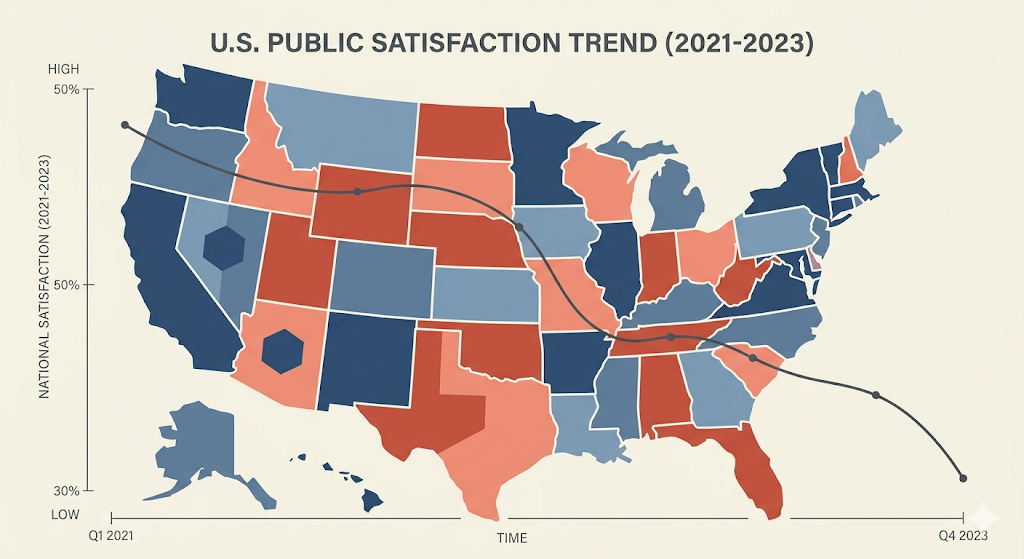

National dissatisfaction and falling executive approval are creating severe headwinds that could offset structural advantages.
What to Know
- National satisfaction now stands at 36%.
- Executive net approval has dropped to a record low of negative 21%.
- Consumer economic confidence declined to negative 45 in recent assessments.
- Public trust in major government institutions remains near historical lows.
- Voter discontent historically poses significant challenges for congressional incumbents.
Deepening public anxiety is shaping a highly volatile political landscape as voters across diverse demographic groups express intense frustration with current national conditions and economic trends. Fresh data published by Rasmussen Reports reveals that a mere 36% of Americans believe the country is headed in the right direction, highlighting a profound crisis of confidence. This severe deficit in public optimism creates immediate pressure on the governing majority, threatening to disrupt typical midterm dynamics in competitive districts where key swing voters hold the balance of power.
Legislative majorities frequently rely on structural elements such as favorable district boundaries and incumbent visibility to retain control during difficult midterm cycles. Widespread discontent, however, has historically acted as an electoral equalizer that can overcome geographic defense and tip close races in unexpected directions. Strategy professionals must carefully evaluate whether these structural bulwarks can withstand a coordinated national wave driven by deep voter anger, rising energy prices, and worsening economic indicators.
Economic Distress Eroding Governing Party Advantages
Severe financial strain is currently dominating voter decision-making as families grapple with high energy costs, persistent inflation, and rising interest rates. Severe price hikes and rising fuel costs have pushed the Gallup Economic Confidence Index to a net negative 45, marking its lowest point since 2022 and signaling widespread distress. This negative sentiment creates an exceptionally difficult environment for congressional candidates who must defend their economic records to highly skeptical constituents who feel financially insecure about their future.
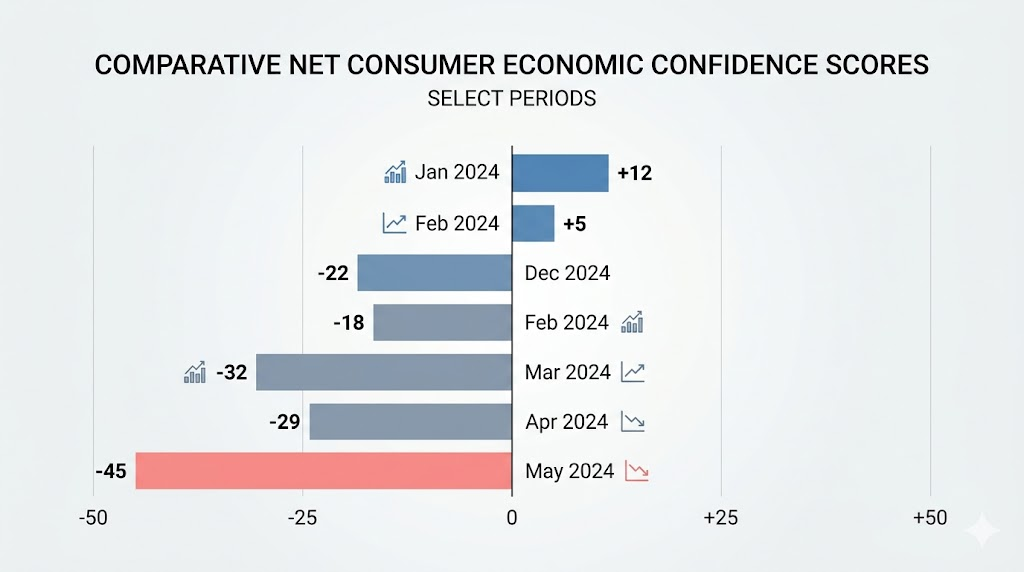
Campaign Now (Gemini), illustrating downward trends in national economic confidence

Joanne Hsu, Director of the Surveys of Consumers
Joanne Hsu, Director of the Surveys of Consumers, explained the consumer sentiment drop:
“Consumer sentiment fell by 13% this month, reaching its lowest level in nearly two years as inflation concerns reemerged.”
Consumer sentiment has plummeted to 44.8 on the University of Michigan tracker, reflecting widespread public anxiety over long-term financial stability and household purchasing power. This sharp contraction suggests that pocketbook issues will likely overshadow traditional geographic advantages in upcoming regional races and suburban contests. Political strategists must recognize that voters frequently punish the governing party when economic conditions worsen, fuel prices rise, and financial security declines during critical election cycles.
Executive Approval Declines Among Key Voting Blocs
Executive approval ratings serve as a critical bellwether for the governing party's midterm prospects. Historical trends demonstrate that a sitting chief executive's popularity heavily influences down-ballot success in competitive congressional districts.
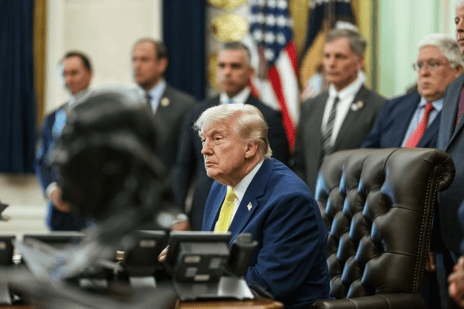
Donald Trump, President of the United States
Electoral success in midterm cycles is heavily correlated with the standing of the sitting chief executive. President Donald Trump has seen his net approval rating drop to negative 21% in recent tracking models, driven largely by independent voter flight in key suburban areas. This erosion of support among middle-of-the-road voters complicates the path for congressional incumbents who rely on these moderate cohorts to win tough reelection bids in purple districts.

G. Elliott Morris, Editorial Director of Data Analytics at The Economist
G. Elliott Morris, Editorial Director of Data Analytics, analyzed the tracker data:
“Independent voters have shifted significantly away from the administration, leading to a notable drop in overall approval.”
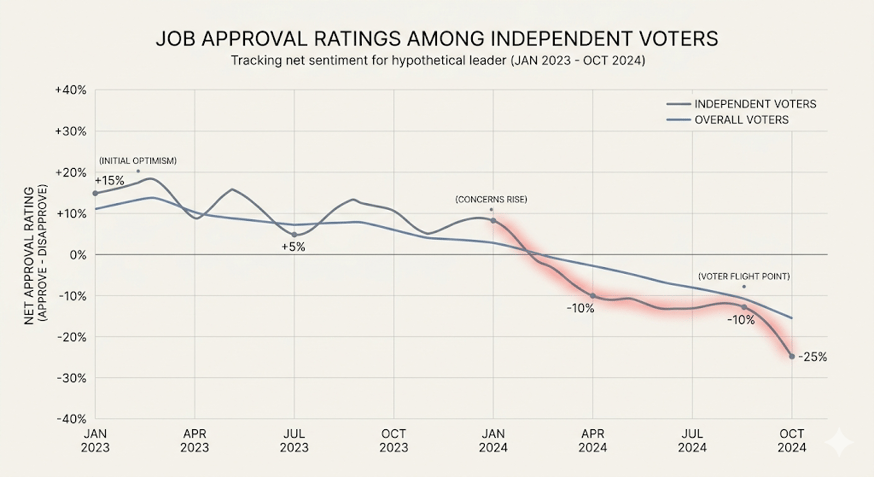
Campaign Now (Gemini), tracking executive approval trends among independent voters
Loss of independent support is historically a leading indicator of significant legislative seat losses for the governing party. Moderate voters who backed the administration in previous cycles are now expressing deep frustration over foreign policy uncertainties, trade tensions, and rising cost of living. Candidates running in competitive suburban districts must find ways to appeal to these swing voters without alienating their core activist base or depressing turnout.
Institutional Distrust Reshaping Midterm Electoral Dynamics
Widespread skepticism toward public institutions has reached critical levels, fundamentally altering how voters engage with congressional contests and political messaging. Historical tracking from the Pew Research Center indicates that public trust in government has languished near record lows for years, reflecting deep-seated disillusionment. This deep-seated suspicion makes it difficult for any governing majority to present a status-quo message to an increasingly frustrated electorate that demands systemic change from their leaders.

Carroll Doherty, Director of Political Research at Pew Research Center
Carroll Doherty, Director of Political Research, commented on the public trust trend:
“Public trust in government remains at some of its lowest levels in over six decades, reflecting a prolonged era of deep skepticism.”
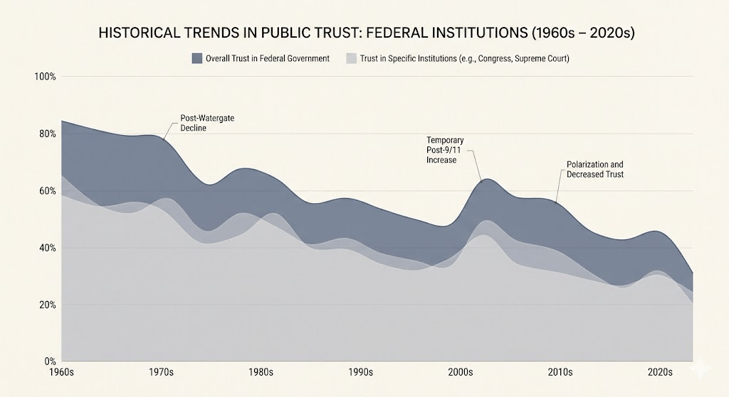
Campaign Now (Gemini), detailing historical levels of public institutional trust
Sustained institutional distrust often fuels an anti-incumbent environment where voters seek systemic change rather than incremental reform. Congressional candidates are finding that traditional legislative accomplishments fail to resonate with a deeply disillusioned public that feels ignored by Washington leaders. Governing parties must adapt by adopting outsider postures, emphasizing accountability, and focusing on reform-oriented messaging to survive this anti-establishment climate in their home districts and states.
Defensive Map Breakdown
Independent voter erosion does not register evenly across the country. It concentrates in the suburban and exurban districts where the Republican congressional majority is physically located. Republicans are defending 10 of the 12 pure Toss-Up House seats, with the most exposed clustered in metros where college-educated moderates and low-propensity suburban voters have shifted between parties across three consecutive election cycles. Districts including AZ-06 (Ciscomani), NY-17 (Lawler), PA-07 (Mackenzie), VA-02 (Kiggans), NJ-07 (Kean Jr.), and CO-08 (Evans) were decided by razor-thin margins in 2024 and sit squarely in the kind of suburb where a 2% national shift translates directly into seat losses.
Brookings Institution research identified 19 Republican-held House districts as structurally vulnerable going into 2026. Only 1 is predominantly rural, and only 1 is in the South. The remainder are concentrated in the Northeast, Mid-Atlantic, and Midwest, in communities that sit at or above national averages for college education and household income. These seats were drawn to be safe Republican territory, not competitive ones. The structural problem is that the voters most responsive to executive approval declines are disproportionately concentrated here, and a gerrymander calibrated for 2021 partisan behavior cannot automatically hold a 2026 electorate that has moved.
The same independent erosion is reshaping the Senate map simultaneously. NPR identified North Carolina, Maine, Ohio, and Alaska as Democrats' core four pickup targets, and each state carries a substantial suburban independent population where Trump's negative 21% net approval registers most sharply. Republicans must hold nearly all of their seats to protect their 53-47 Senate majority. A defensive posture that forces simultaneous resource commitments across suburban House districts and multiple Senate battlegrounds is precisely the attrition dynamic a deteriorating national approval environment is built to create.
Wrap Up
Governing coalitions facing severe economic pessimism and low executive approval must prepare for a highly challenging environment across all key battleground states and competitive swing districts. Historic precedents suggest that structural advantages like gerrymandered districts and incumbent war chests rarely provide full immunity against broad national shifts in voter sentiment. Successful strategies will require candidates to distance themselves from unpopular national trends while championing localized, reform-minded policies that address immediate constituent needs directly.
Midterm elections in 2026 and beyond will serve as a crucial test of whether polarized geography can withstand widespread economic discontent and systemic institutional distrust. If independent voters continue their flight, structural defenses in the House and Senate may prove insufficient to maintain working majorities. Ultimately, candidates who fail to address deep-seated public frustrations are likely to face significant setbacks regardless of their institutional advantages, fundraising prowess, or geographic alignment.
-4.jpg)
-May-16-2026-10-24-03-9739-PM.jpg)