
The initial battle lines for 2026 are being drawn in the states, and a new analysis suggests a significant portion of the legislative landscape is up for grabs.
What to Know
- An initial rating from Sabato's Crystal Ball finds 15 state legislative chambers are competitive heading into the 2026 midterms.
- Of the competitive chambers, a remarkable nine are classified as pure Toss-ups, setting the stage for intense partisan battles.
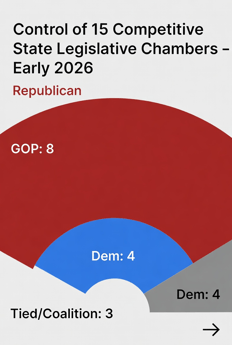
- Republicans are on the defensive, currently holding eight of the competitive chambers compared to just four held by Democrats.
- Six of the nine Toss-up chambers are currently controlled by the GOP: the Arizona House and Senate, the Michigan House, the New Hampshire House, and the Wisconsin House and Senate.
- The political environment is described as a potentially "favorable cycle" for Democrats, who may be positioned to "ride a blue wave."
Control of state legislatures is emerging as a critical battleground for the 2026 midterm elections. An initial handicapping of the races from the experts at the University of Virginia's Center for Politics' Sabato's Crystal Ball reveals that 15 chambers are already considered competitive, a slightly higher number than at similar points in the 2022 and 2024 cycles.
This expanded map creates a wealth of opportunities for both parties, but it places the Republican party in a more defensive posture. As the analysis notes, the current political dynamics put the GOP at a disadvantage.
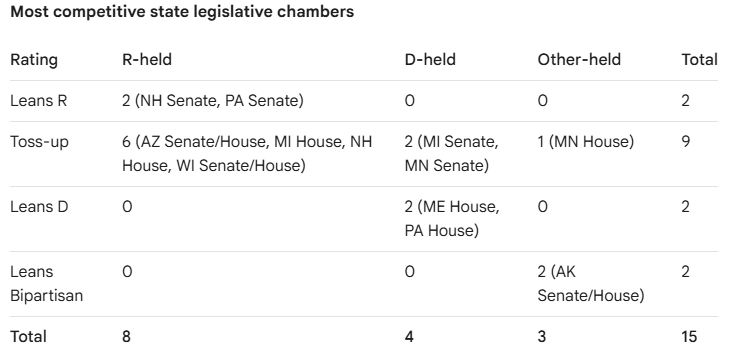
Gemini made chart from data at Center for Politics
Befitting the dynamics of the first midterm election of President Donald Trump's second term, the Republicans are currently playing defense to a disproportionate degree. The GOP currently holds 8 of the chambers we deem competitive, while the Democrats hold 4. This defensive stance for the GOP sets the stage for a cycle where Democrats are on the offensive, looking to break Republican supermajorities and flip chambers in key states.
The Toss-Up Chambers
The heart of the 2026 legislative fight will be in the nine chambers rated as pure Toss-Ups, with either party having a strong chance of winning control. For Republicans, the list of vulnerable chambers is extensive and includes both houses in Arizona and Wisconsin, as well as the Michigan House and the New Hampshire House. Democrats, meanwhile, must defend their majorities in the Michigan Senate and the Minnesota Senate. The ninth Toss-up chamber is the currently tied Minnesota House, which is expected to be fiercely contested.
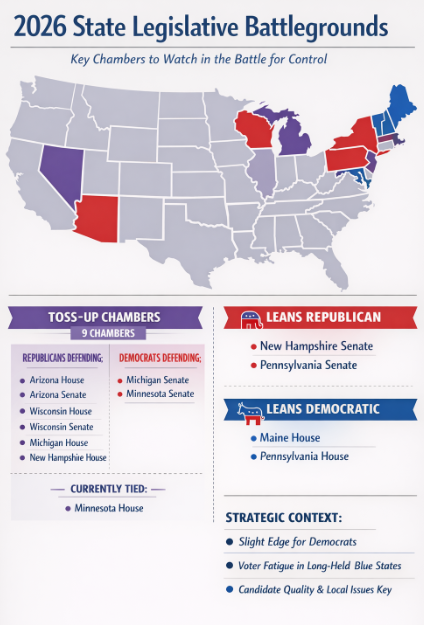
Beyond the Toss-ups, Sabato's Crystal Ball has identified two chambers as Leans Republican (the New Hampshire Senate and Pennsylvania Senate) and two as Leans Democratic (the Maine House and Pennsylvania House).
These ratings underscore the fluid nature of state-level politics, where local issues and candidate quality can create "cross-cutting pressures" that run against national trends. While the overall environment appears to favor Democrats, the report cautions that voter fatigue in states with long-term Democratic governance could temper a potential "blue wave."
Republicans Are Defending More Ground Than They Have in Years
The most consequential data point in the early 2026 map is not the number of competitive chambers but who holds them. Republicans currently control 8 of the 15 competitive chambers, while Democrats hold just 4, with the remainder tied or under coalition control. That imbalance means the GOP is structurally exposed before the cycle has fully formed.
In practical terms, this reverses the dynamic seen in recent cycles. In early 2022 and 2024 handicaps, Republicans were largely playing offense in state legislatures. In 2026, they are protecting incumbencies across multiple battleground states simultaneously, stretching donor attention and field capacity. Historically, midterm cycles in which one party defends a disproportionate share of marginal seats tend to amplify losses if national conditions deteriorate.
Toss-Up Chambers Cluster in Presidential Swing States
The nine Toss-up chambers are not randomly distributed. They are concentrated in states that have recently decided presidential elections by narrow margins, including Arizona, Wisconsin, Michigan, Minnesota, and New Hampshire. These states collectively accounted for fewer than 200,000 combined votes separating the presidential candidates in 2024.
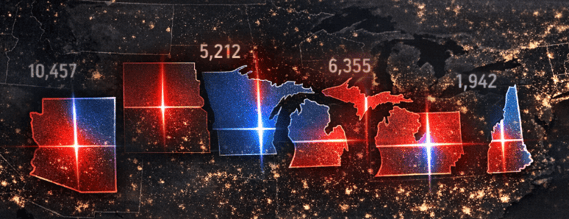
This clustering matters because turnout mechanics, messaging infrastructure, and donor networks already exist in these states. Legislative races can be pulled along by top-of-the-ticket dynamics, particularly in years with competitive gubernatorial or U.S. Senate contests. In Wisconsin and Michigan alone, both legislative chambers and at least one statewide race will be contested in parallel, creating overlapping mobilization effects that can tip narrow margins.
Supermajorities Are the Real Target in Red and Purple States
Beyond outright chamber control, Democrats are explicitly targeting Republican supermajorities in states rated “Likely Republican,” including Florida, Iowa, Missouri, North Carolina, and Ohio. In many of these chambers, Democrats would need to gain between one and six seats to strip the GOP of procedural dominance.
“The main reason for the increase in 2026? This year, there are more Republican-held chambers that aren’t in line to flip control outright, but which Democrats, aided by the blue environment, might be able to end Republican supermajorities. In many cases, Democrats would only need to net seats in the low-to-mid single digits.” — Louis Jacobson, Handicapping The 2026 State Legislative Map: A First Look
The loss of a supermajority can fundamentally alter governance. In states like Florida and North Carolina, supermajorities allow Republicans to override vetoes, fast-track legislation, and control constitutional amendment processes. Breaking those margins would not flip control, but it would immediately constrain the majority party’s ability to govern unilaterally, making these races strategically valuable even in states that remain red at the presidential level.
Long-Term Trends Still Favor the GOP, But the Margin Is Shrinking
Despite the competitive outlook for 2026, Republicans retain a long-term advantage in state legislatures. As of early 2026, the GOP controls 56 legislative chambers, compared with 39 controlled by Democrats. That gap, however, has narrowed steadily over the past decade.
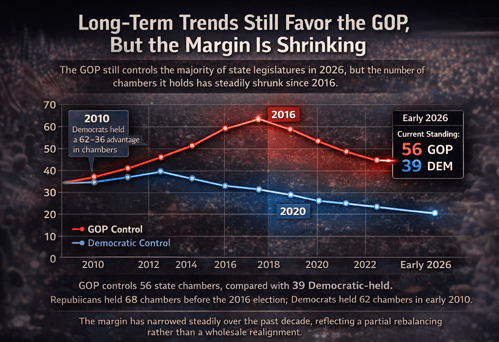
Before the 2016 election, Republicans held 68 chambers. Democrats briefly held a 62–36 advantage as recently as 2010, before losing ground due to the GOP wave that year, aggressive post-census redistricting, and the collapse of conservative Democratic strongholds in the South. The current environment reflects a partial rebalancing rather than a wholesale realignment, with control increasingly concentrated around a smaller number of competitive states.
Wrap Up
The initial 2026 legislative ratings from Sabato's Crystal Ball highlight a volatile and competitive environment where control of state-level power is very much in play. The fact that Republicans are defending twice as many competitive chambers as Democrats suggests a challenging cycle for the GOP, which will need to allocate resources carefully to protect its incumbents and maintain its majorities. For Democrats, this represents a significant opportunity to build power from the ground up, with the potential to influence policy on everything from abortion access to voting rights for years to come.
Looking ahead, these state-level contests will be more than just local affairs; they will serve as a crucial barometer of the national political mood. The outcomes in these 15 competitive chambers will have profound implications for the 2028 presidential election, shaping the political landscape and determining the balance of power in key swing states. The battle for the states has begun, and the results will reverberate across the country.