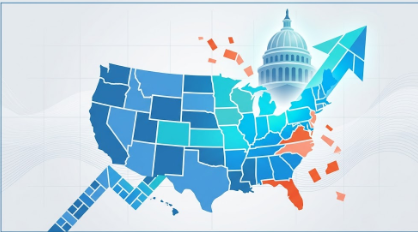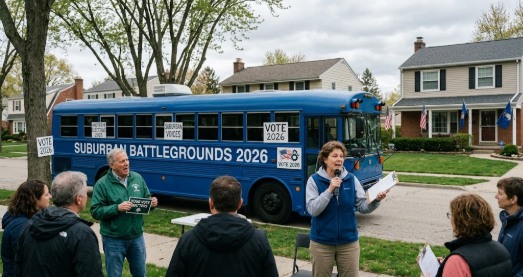
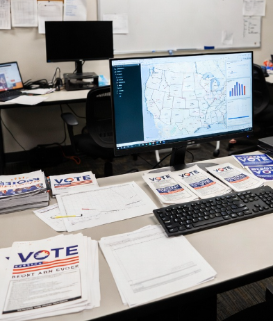

While deepfakes get attention, AI's true impact is reshaping the campaign ground game through real-time data, precision targeting, and measurable voter mobilization.
What to Know
- Democratic and Republican campaigns are expanding beyond AI-generated content and investing in AI-driven voter targeting and experimentation ahead of 2026.
- Groups like Tech for Campaigns are launching structured testing models to evaluate AI personalization, message optimization, and new digital channels.
- AI tools are being used to generate multiple tailored versions of emails, texts, and ads for specific voter segments.
- Campaigns are using AI to accelerate large-scale A/B testing and real-time message refinement.
- The competition to deploy and regulate AI in politics is intensifying, shaping both campaign strategy and the broader 2026 policy environment.
The public conversation around artificial intelligence in the 2026 cycle has focused heavily on deepfakes and digital manipulation. But recent reporting from POLITICO on Tech for Campaigns launching an AI experimentation “Lab,” alongside Bloomberg’s coverage of AI’s expanding influence in political persuasion, suggests the more significant transformation is happening beneath the surface. Campaigns are not simply experimenting with generative tools. They are restructuring how they test messages, segment voters, and allocate resources.
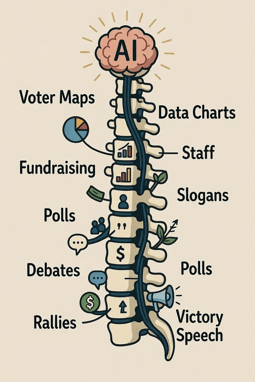
Behind the headlines, AI is being integrated into the operational backbone of modern campaigns. From structured experimentation models to accelerated message optimization, campaigns are using data-driven systems to refine targeting and mobilization strategies in real time. The emerging ground game is less about spectacle and more about efficiency, where rapid iteration, personalization, and measurable outcomes are redefining how elections are contested.
The Algorithm in the War Room
Modern campaigns are not short on data. They are short on time. Voter files, digital engagement metrics, donor histories, and platform performance data create more information than traditional analytics teams can process between cycles. That is where AI is being integrated.

As reported by POLITICO, Democratic-aligned groups such as Tech for Campaigns are launching structured AI experimentation efforts to test personalization, message optimization, and how campaigns appear inside AI search platforms. The objective is measurable gains in persuasion and turnout ahead of 2026.
This marks a shift from broad demographic targeting to controlled experimentation. Instead of relying on assumptions about voter blocs, campaigns are using AI to generate multiple message variants, deploy them across segmented audiences, and refine strategy based on performance data. Bloomberg has noted that AI’s political influence is growing through iterative optimization rather than spectacle.
AI Debate Moves From Campaign Strategy to Capitol Hill
The modern war room is becoming a testing environment where speed of learning, not intuition alone, increasingly shapes electoral advantage.As lawmakers debate how aggressively Washington should move on AI policy, members of Congress are offering sharply different outlooks on workforce disruption. Sen. Elizabeth Warren, D-Mass., offered a more cautionary view, warning:
“I am deeply concerned about AI and what it's going to mean when people go out one day for lunch and come back and their jobs aren't there anymore,” adding that without preparation, large-scale displacement could trigger “a full-blown crisis right here in this country.”

Senator Elizabeth Warren, image via official website
As concerns grow over artificial intelligence reshaping white-collar work, some lawmakers are urging caution without panic. Rep. Jay Obernolte, R-Calif., acknowledged that displacement is inevitable but pushed back on alarmism, stating,
“There will be job displacement. We need to re-skill the workers that are in industries with that job displacement and equip them with the skills that they need to succeed in other industries.”
Rep. Obernolte, who has long worked on AI policy and co-chaired the House Artificial Intelligence Task Force, has acknowledged that disruption is part of the technological cycle but argues it should be managed rather than feared. He also argued that history shows technological revolutions ultimately expand opportunity, not eliminate it.

Representative Jay Obernolte, image via official website
Supporters of accelerated AI adoption argue that disruption does not automatically translate into decline. Proponents contend that while certain roles may disappear, new industries, higher-skilled positions, and productivity gains could drive long-term economic growth. From this perspective, the policy focus should center on workforce retraining, regulatory clarity, and responsible deployment rather than slowing innovation itself.
A competing view in the policy debate argues that fear-driven regulation risks undermining the very gains AI promises to deliver. Writing for FEE.org, Carnegie Mellon professor Param Vir Singh contends that AI should be viewed as a continuation of humanity’s long tradition of transformative technologies, not as an existential economic threat.

Carnegie Mellon Professor, Param Vir Singh, image via official wesbite
He argues that algorithmic AI already powers pricing systems, energy grid management, logistics optimization, fraud detection, and federal administrative processes, often improving efficiency and reducing human error.
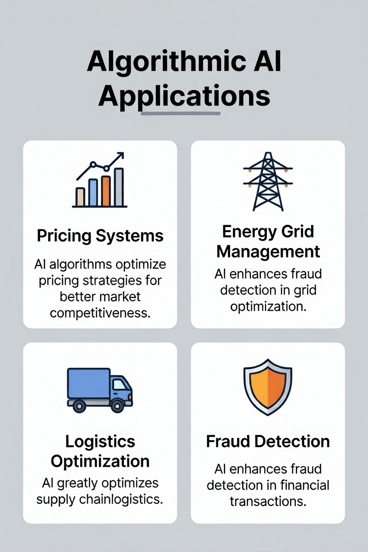
From this perspective, overly aggressive regulation could slow innovation, weaken U.S. competitiveness against rivals like China, and inadvertently harm consumers by limiting market efficiencies. Proponents of this approach maintain that the focus should be on responsible deployment and targeted safeguards rather than broad restrictions that treat AI as inherently suspect.
Personalization at Scale
The personalization revolution in campaigns is no longer limited to smarter email subject lines. Structured AI experimentation models, such as the new “Lab” initiative launched by Tech for Campaigns, are explicitly built to test message variation, refine segmentation, and measure persuasion outcomes in real time.
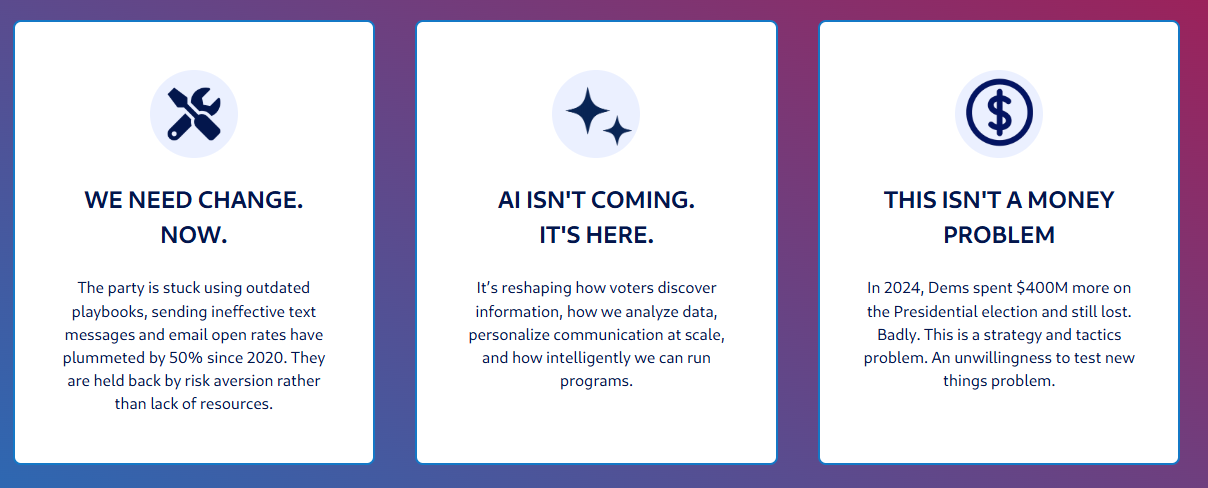
Screenshot of website factoids taken from Tech for Campaigns
Instead of deploying a single message to millions of voters, campaigns can now generate multiple controlled versions of the same message, distribute them to carefully defined voter segments, and quickly scale the versions that perform best. The advantage is not simply customization. It is accelerated learning.
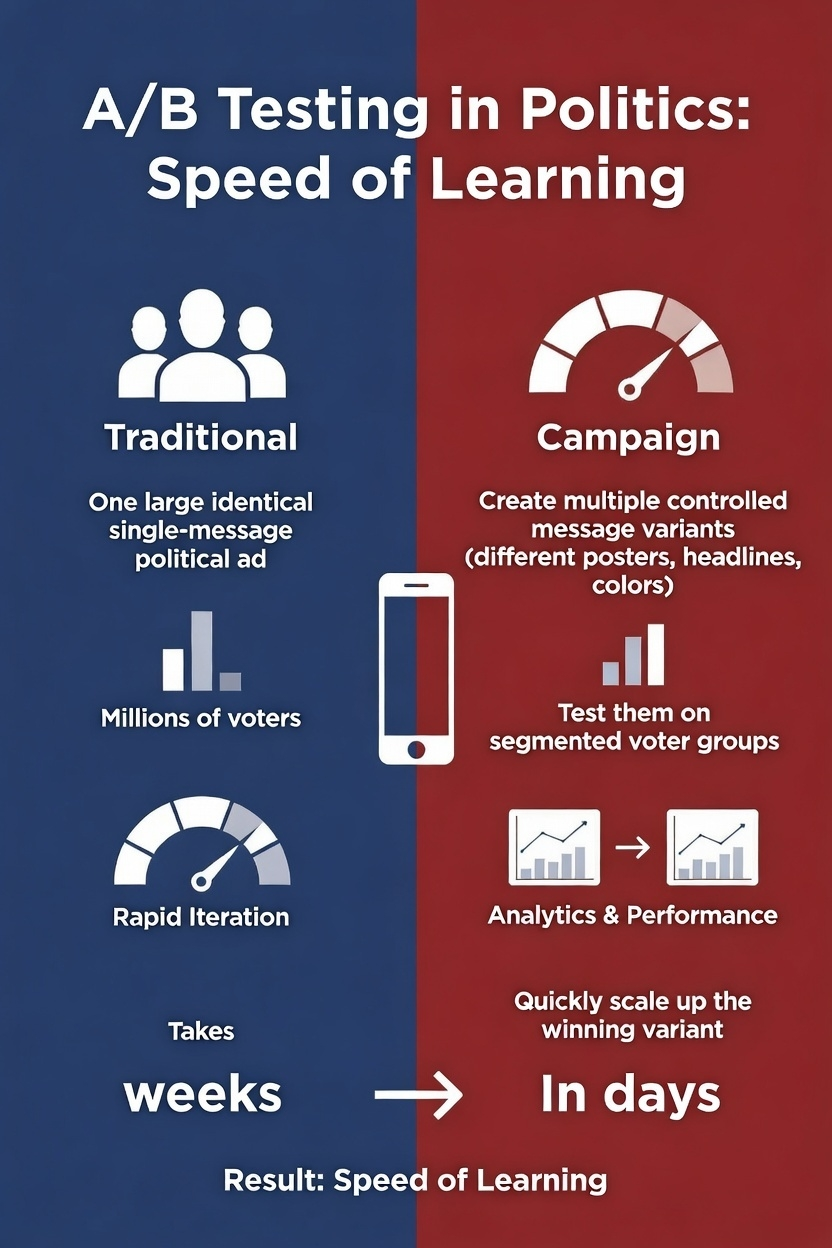
This process relies on A/B testing, a method borrowed from digital marketing, where two or more variations of a message are sent to comparable groups to measure which one drives higher engagement, donations, sign-ups, or turnout intent. The results are analyzed in real time, allowing campaigns to refine tone, framing, and issue emphasis based on measurable voter response rather than instinct alone.

This shift is occurring against the backdrop of massive AI infrastructure expansion. Global investment in AI-related systems is projected to exceed $3 trillion over the next five years, with leading technology firms spending hundreds of billions annually on computing capacity and model development. That computational power enables campaigns to run large-scale testing environments that continuously analyze engagement signals, donation patterns, and voter responses. Each open, click, reply, or conversion feeds back into the system, sharpening the next round of outreach.
Wrap Up
The rapid adoption of AI tools has sparked an escalating competition between parties and political tech firms ahead of 2026. Well-funded campaigns are investing in advanced modeling and experimentation systems, knowing that speed and precision can translate into turnout gains. This dynamic risks widening the gap between national campaigns and smaller races that lack the resources to deploy similar technology.
Artificial intelligence is now embedded in the operational core of modern campaigns, enabling continuous message testing and data-driven mobilization. While this promises efficiency and sharper targeting, it also raises questions about voter data use and ethical persuasion. As campaigns look toward 2028, the central challenge will be harnessing innovation without compromising democratic integrity.