
Local fights over electricity, water and permitting are turning artificial intelligence infrastructure into a bipartisan midterm campaign issue.
What to Know
- Local data center construction faces opposition from 73% of registered voters.
- Opposition reaches 85% among Democrats, 76% among independents and 55% among Republicans.
- Data centers in 7 leading states depend on about 3.4 trillion gallons of freshwater annually for electricity generation.
- At least 75 projects worth about $130 billion faced local opposition during the first quarter of 2026.
- Stricter artificial intelligence guardrails make 71% of registered voters more likely to support a candidate.
Local data center fights have moved from planning meetings into national politics. A Quinnipiac University survey released on September 30, 2026, found that 72% of American adults would oppose an artificial intelligence data center in their community, compared with 21% who would support one. Opposition had increased from 65% in the university’s March survey.
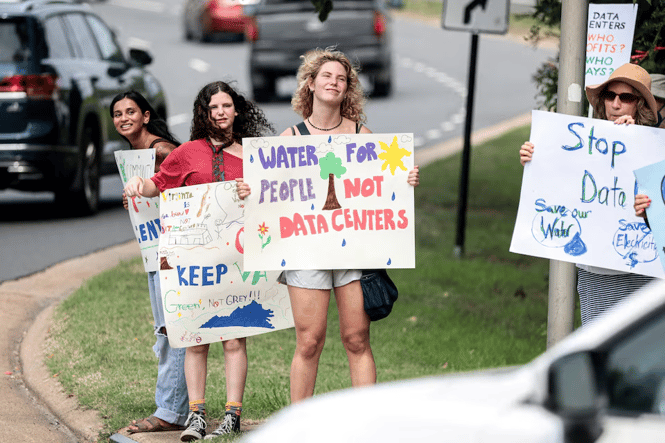
Virginia demonstrators show how data center resistance has entered politics. via REUTERS/Evelyn Hockstein/File Photo
Registered voters expressed slightly greater resistance. Quinnipiac’s separate registered voter findings placed opposition at 73%, with majorities extending across Democrats, independents and Republicans. Artificial intelligence may operate online, but its electricity demand, water requirements, transmission infrastructure and industrial footprint have created a deeply local political problem.
Local Opposition Crosses Party Lines
Quinnipiac’s registered voter sample found opposition reaching 85% among Democrats, 76% among independents and 55% among Republicans. Support remained below 40% within every partisan group. That alignment does not create a unified national ideology, but it gives candidates in very different communities a shared political opening.
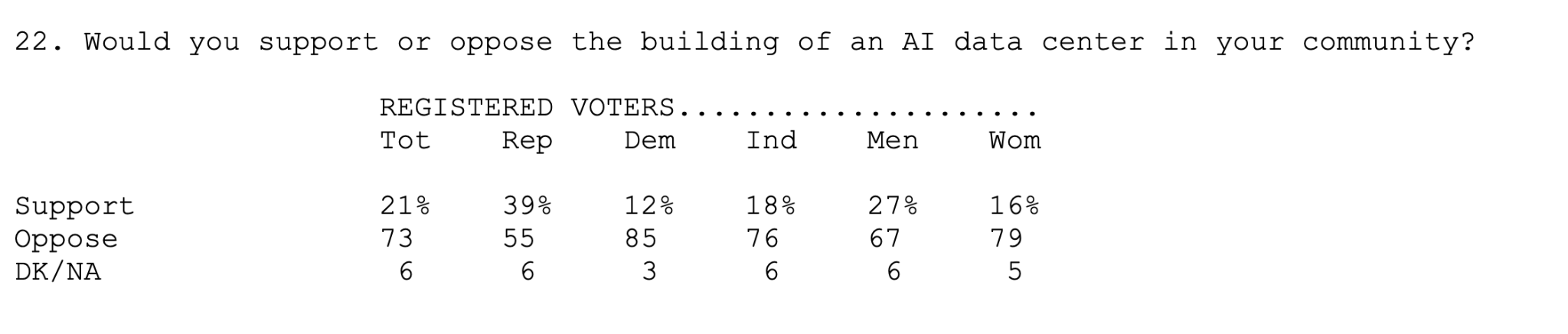
Data center opposition crosses party lines but varies in intensity. via Quinnipiac University poll
Democratic opposition can draw from environmental concerns, corporate distrust and support for stronger technology regulation. Republican resistance can grow from private property disputes, utility costs, government incentives and objections to local officials approving industrial development without sufficient consultation. Independents can respond to either frame because the consequences arrive through household bills, land use and public infrastructure.
Broad opposition still requires careful interpretation. Quinnipiac surveyed 1,032 registered voters from September 24 through September 27, with a margin of error of 3.8 percentage points. National sentiment does not determine the outcome of an individual zoning decision, but it shows that developers cannot assume local acceptance even in communities that support economic growth or artificial intelligence investment.
Campaign messaging will therefore depend on the dispute in front of voters. A suburban county facing a large campus may focus on electricity rates, noise and property values. A rural community may care more about wells, farmland, transmission corridors and whether a project produces enough permanent employment to justify its public costs.
Water Risk Extends Beyond Facility Boundaries
Public discussion often concentrates on water used inside data centers for cooling. That is only part of the infrastructure burden. Electricity generation can create a much larger freshwater dependency far beyond the facility itself.
A Ceres analysis examined Arizona, California, Georgia, Illinois, Ohio, Texas and Virginia, which together host about half of the nation’s data centers. Facilities in those 7 states depend on about 3.4 trillion gallons of freshwater annually for electricity generation. Ceres compared that amount with roughly 12 times the combined annual water use of Los Angeles, Phoenix and Washington, D.C.
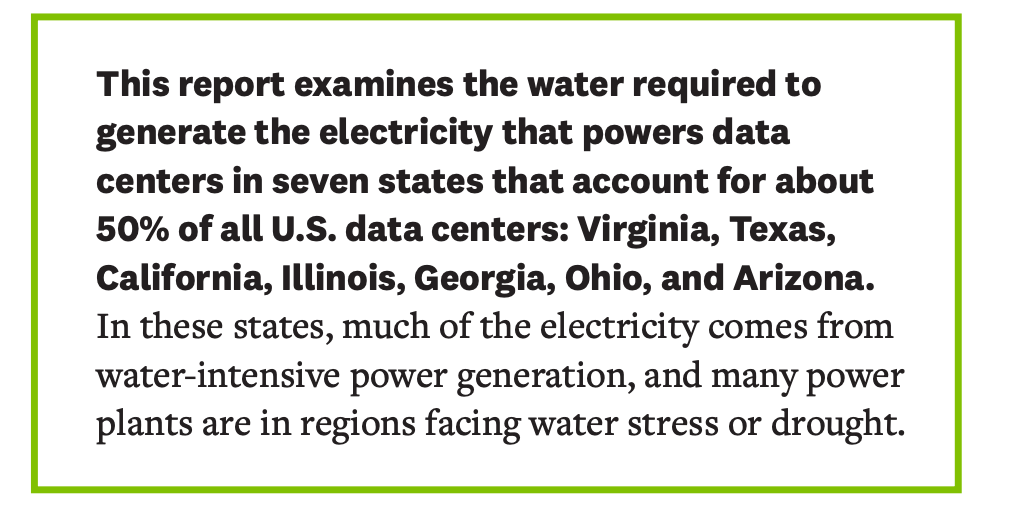
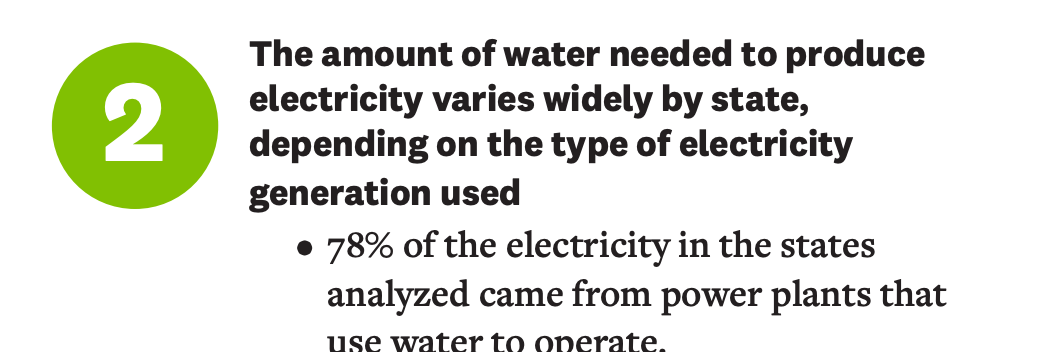
Power generation creates data centers’ largest hidden freshwater dependency risk. via Ceres report
Ceres also found that 78% of electricity in the analyzed states came from power plants that use water to operate. About 66% of the water dependent electricity was generated in areas facing medium high to extremely high water stress. Those figures measure exposure to freshwater dependency, not simply water consumed inside a server facility.
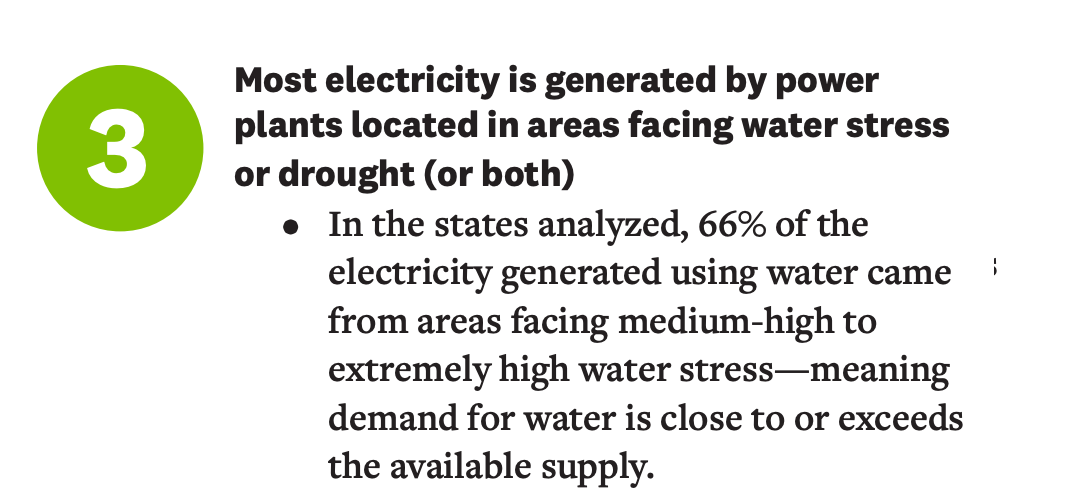
via Ceres report
That distinction changes the policy question. A project can reduce on site cooling demand while remaining connected to a water intensive power supply. Local officials therefore need information about both facility operations and the electricity resources supporting them before judging the full effect on community water security.
Utility commissions and state regulators control another part of the outcome. They can determine whether developers or existing customers pay for new generation, substations and transmission upgrades through utility rate cases and connection agreements. Local governments control zoning and permits, but they cannot resolve every cost created elsewhere on a regional power grid.
Permitting Resistance Now Carries Financial Consequences
Grassroots opposition has moved beyond public complaints. Data Center Watch counted at least 75 projects worth approximately $130 billion that were blocked or delayed during the first quarter of 2026. That total roughly matched the organization’s estimate for all of 2025 within only 3 months.
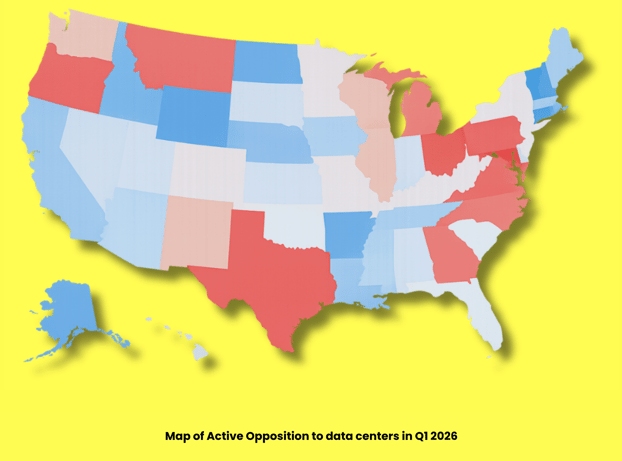
Local opposition now changes project timelines, financing risks and permits.
Project disruption does not mean every development was permanently canceled. Some proposals lost permits, some encountered moratoria and others faced delays while developers revised their plans. Political resistance still changed the financial calculation because time, regulatory uncertainty and additional infrastructure requirements can increase borrowing and construction costs.
Data Center Watch also reported more than 300 state data center bills filed during the first 6 weeks of 2026. Statewide moratorium proposals appeared in 14 states, while active opposition groups extended across 49 states. Local disputes had become a national pattern without relying on a single party or advocacy organization.
Financiers have noticed. Reuters reported that banks increasingly examine community support, permitting readiness and the risk of project delays before committing capital. Local approval has become more than a public relations concern. It is now part of credit and execution risk.
Candidates can no longer treat data center policy as a simple choice between development and obstruction. Voters may support investment while opposing arrangements that transfer infrastructure costs to households or conceal water demand. Credible campaigns must explain the conditions under which a project should proceed, who pays for required upgrades and which information communities receive before approval.
Voluntary Promises Face a Public Trust Deficit
Corporate assurances enter this debate from a weak position. Quinnipiac found that 74% of adults had little or no trust in artificial intelligence company leaders, including 45% who had no trust at all. Only 24% reported at least some trust.
Public demand for independent oversight was even broader. Quinnipiac found 86% support for requiring artificial intelligence companies to meet independent safety standards, even if those standards slowed development. Among registered voters, 71% said they were more likely to support a candidate favoring stricter artificial intelligence guardrails.

Voluntary safeguards leave voters questioning enforcement behind corporate safety promises. via WhiteHouse
A voluntary White House agreement announced in late September 2026 called for internal controls and outside audits among 6 major technology companies. Reuters found that the agreement contained no stated consequences when a company failed to comply. President Donald Trump described the agreement as morally binding, but moral pressure cannot replace enforceable local terms.
Safety commitments also do not answer the central questions confronting host communities. Residents still need to know how much power and water a facility requires, who finances grid improvements, what permanent jobs will remain and how local agencies will verify company disclosures. National promises cannot settle a county permitting dispute without those answers.
Local and state authority therefore matters as much as federal artificial intelligence policy. Planning commissions can attach conditions to land use approval, utility regulators can determine cost allocation and state legislatures can establish reporting requirements. Fragmented authority may slow development, but it also gives voters several points of leverage when corporate assurances fail to persuade them.
Wrap Up
Data center opposition has become politically durable because it combines abstract distrust with visible local consequences. Electricity bills, water availability, land use and infrastructure costs turn artificial intelligence expansion into a household issue. Bipartisan resistance follows when voters believe benefits will travel elsewhere while costs remain local.
Industry investment will not stop, and public opposition does not mean every community will reject every project. Developers can improve their prospects through transparent resource estimates, enforceable cost protections and early consultation. Communities are demanding terms, not merely expressing fear of technology.
Midterm candidates now face a clear test. Supporting artificial intelligence growth without addressing its physical footprint leaves them exposed to local anger. Opposing every project ignores jobs, tax revenue and national infrastructure needs. Political advantage will belong to candidates who define credible conditions for development and show voters exactly who carries the risk.